The Compliance Question
One of the most important decisions on an excavation job is also one of the easiest to oversimplify: what protective system is actually right for this trench before workers enter it? Employers and supervisors often know that a trench deeper than five feet generally requires protection unless it is entirely in stable rock. They may also know the common terms, including sloping, benching, shoring, and shielding. The harder question is how those options should be selected, checked, and communicated on a real jobsite where soil, water, utilities, traffic, equipment, access, and production pressure all compete for attention.
That decision cannot be reduced to whatever equipment happens to be nearby. A trench box that worked well on one utility repair may be wrong for a wider cut, a tie-in around existing services, or a changing soil condition after rain. Sloping may look simple on paper but require more horizontal space than the jobsite allows. Benching may not be allowed in every soil type and can be misunderstood by crews that have not been trained on the difference between a true protective design and a convenient ledge. Shoring can support soil movement, but it must be installed, used, and removed according to the system and conditions it was designed for.
OSHA Subpart P expects employers to protect employees from cave-ins and related excavation hazards. That expectation includes more than naming a protective method. The employer must ensure that the excavation is evaluated, that a protective system is used when required, and that a Competent Person is able to identify existing and predictable hazards and take prompt corrective action. In practical terms, the question is not, "Do we have a box?" The better question is, "What has changed on this excavation, what protection is required before entry, and who has the authority and training to stop the work if the setup is not right?"
Protective system selection is also a training issue. Crew members need to recognize when they are about to enter a trench that is not protected, when a shield is being used improperly, when spoil or equipment loads are too close to the edge, and when a change in soil or water should be escalated. Supervisors need a stronger understanding of how production decisions affect compliance. Competent Persons need enough role-specific training to classify soil, inspect the excavation, understand protective system limits, and document conditions before workers enter.
For employers, the compliance question is whether the company has a repeatable way to move from job conditions to the right protective system. A good excavation safety program does not rely on assumptions, habit, or field improvisation. It gives trained people a clear process for evaluating the excavation, selecting or verifying the protective method, communicating the limits of that method, and keeping workers out until the trench is ready.
Why This Matters on Excavation Jobsites
Cave-ins are fast, violent, and often unforgiving. A trench wall can fail without giving workers enough time to climb out, and even a relatively shallow trench can trap or crush a worker under thousands of pounds of soil. Protective systems exist because visual judgment alone is not reliable. Soil that appears firm at the start of the shift may lose strength after vibration, surcharge loads, drying, wetting, or nearby equipment movement. A trench that looked controlled yesterday may require a different decision today.
The protective system decision affects more than the person standing in the trench. It affects the operator placing pipe, the laborer guiding grade, the foreman scheduling crews, the municipal inspector waiting on a repair, and the safety manager who must show that the employer took reasonable steps to control known hazards. When the wrong protective method is chosen, the job can face stop-work decisions, rework, damaged utilities, equipment delays, and serious liability exposure.
Consider a utility contractor excavating in a narrow street. Sloping may be technically acceptable for a soil type and depth, but the available right of way may not allow the required slope without undermining pavement, interfering with traffic control, or exposing nearby utilities. A trench shield may appear more practical, but it must be the right size, be placed to protect the workers, and be used in a way that does not create a hazard at the ends or around access points. If workers must exit the shielded area to make a connection, the employer has not solved the cave-in hazard for that part of the task.
Now consider a site where crews begin in dry, cohesive soil and then encounter seepage near the bottom of the excavation. Water changes the conversation. The Competent Person may need to reclassify conditions, remove workers, reassess the protective system, control the water, or change the excavation plan. A trench box sitting in the cut does not remove the need for inspection or corrective action. If the box is surrounded by unstable material, has inadequate clearance, or is used beyond its tabulated data, the presence of steel does not automatically mean workers are protected.
Benching and sloping can also create jobsite misunderstandings. A stepped excavation may look like benching, but the dimensions, soil type, and depth still matter. Workers may see a wide cut and assume it is safe because the walls are not vertical. Supervisors may underestimate how much room a properly sloped excavation requires. Equipment operators may place spoil near the top edge because the excavation looks open and stable. Each of these gaps can turn a planned protective method into an uncontrolled hazard.
Shoring introduces a different set of responsibilities. Hydraulic shoring, timber shoring, aluminum systems, and engineered designs can be effective, but they must match the excavation conditions and be installed correctly. Crews must understand that shoring components are not casual braces. Missing members, damaged components, improper spacing, unsupported ends, or removal in the wrong sequence can expose workers to the very movement the system is meant to control.
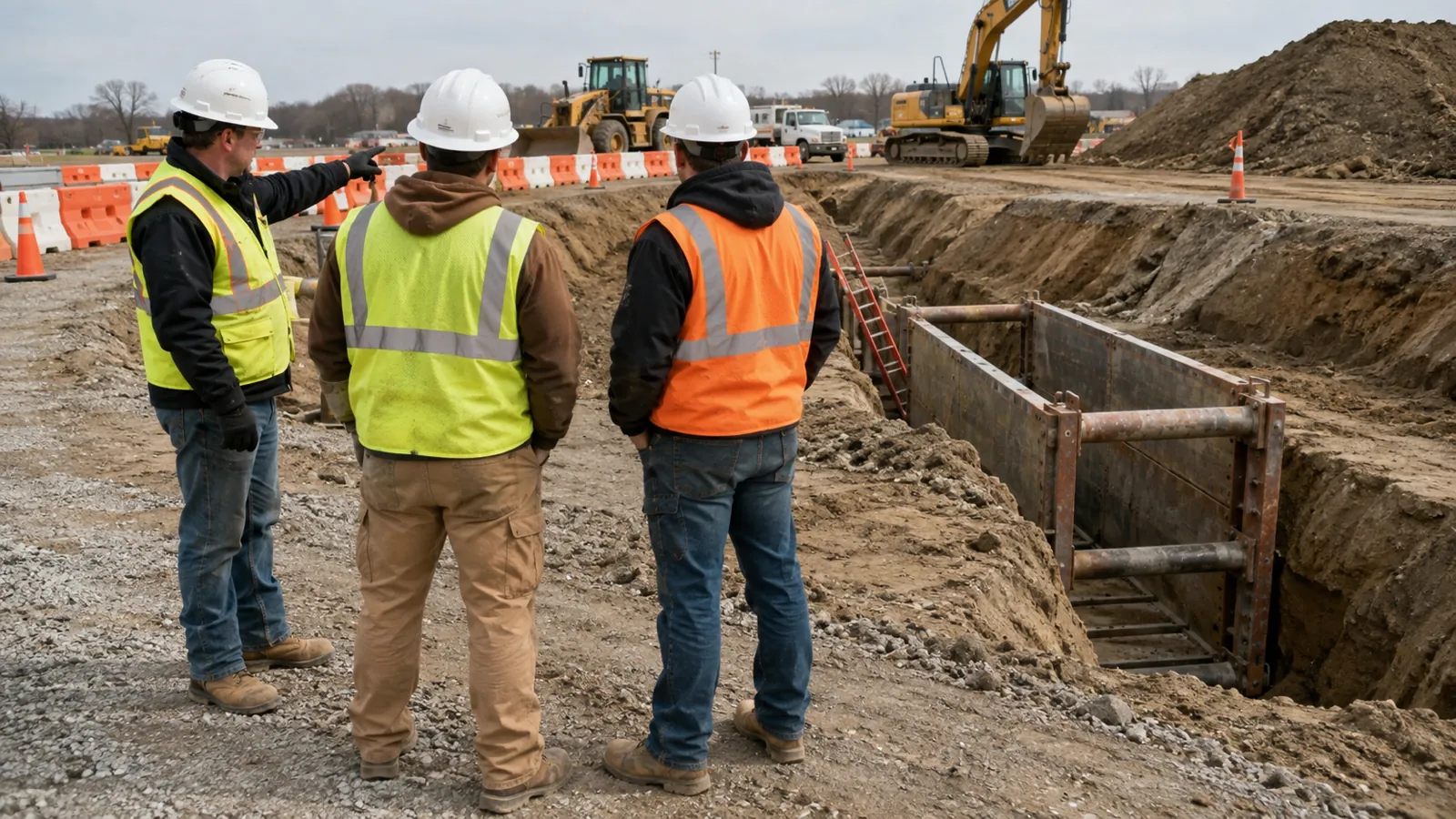
Shielding, including trench boxes, is often familiar to underground contractors, but familiarity can create complacency. Shields are designed to protect workers inside the shield, not to prevent soil from moving outside it. Workers must stay within the protected zone. Access and egress must be planned so workers are not climbing over or around hazards. The shield must be rated and configured for the depth and conditions involved. The bottom of the shield, the top of the shield, and the area between the shield and trench wall all need attention from a trained Competent Person.
These details matter because OSHA citations and incident investigations often look at the decision process, not just the final appearance of the trench. Was there a Competent Person? Was the soil evaluated? Was the protective system appropriate for depth, soil, water, and nearby loads? Were inspections performed before work started and as conditions changed? Were workers trained to recognize when they should not enter? Employers that cannot answer those questions consistently are carrying avoidable risk.
What Employers and Supervisors Should Know
Employers and supervisors should treat protective system selection as a controlled job planning step. It belongs in pre-task planning, daily excavation inspection, crew briefings, and supervisor decision-making. The goal is not to make every worker a design engineer. The goal is to ensure the right people understand the limits of each option and that no one enters a trench based on guesswork.
A practical selection process should start with the excavation itself. How deep will it be? How wide is the cut? Will workers enter? What work will they perform inside? Are there utilities, pavement edges, foundations, poles, structures, or traffic loads nearby? Is there water present or likely? Will the excavation stay open across shifts? Will weather, vibration, or equipment movement affect the soil? These questions shape whether sloping, benching, shoring, shielding, or a registered professional engineer design may be needed.
Employers should also separate availability from suitability. Having a trench box on the truck is helpful only if the box is appropriate for the work and used correctly. Having shoring components in storage is not enough if crews do not know how to inspect and install them. Choosing sloping is not enough if the site cannot support the required angle. Protective system decisions should be based on conditions, not convenience.
Important points supervisors should reinforce include:
- A protective system must be selected before workers enter a trench where protection is required.
- Soil conditions must be evaluated by a trained Competent Person, and assumptions should be revisited when conditions change.
- Sloping and benching require enough space and must follow the limits that apply to the soil and excavation.
- Shoring systems must be installed, inspected, and removed according to the applicable design, manufacturer information, tabulated data, or engineered plan.
- Shields protect workers inside the shielded area, so crews must not work outside the protected zone.
- Access and egress must be integrated with the protective system so workers can enter and exit without exposure to uncontrolled cave-in hazards.
- Spoil piles, equipment, traffic, vibration, water, and nearby structures can all affect the protective system decision.
- If conditions change, the excavation should be reinspected before work continues.
Training should match job roles. Crew-level excavation safety training should help workers recognize trench hazards, understand why protective systems are required, follow access and egress rules, stay inside protected areas, and speak up when conditions do not match the briefing. This matters because workers are often the first to notice water entering the trench, cracking near the edge, a shifted shield, a ladder that has been moved, or equipment operating too close to the excavation.
Supervisor training should focus on planning and enforcement. Supervisors need to know how excavation choices affect schedule, budget, and compliance. They should understand that a production push cannot override the Competent Person’s hazard decision. They also need to know when to pause work for a new evaluation, when to bring in engineering support, and how to coordinate excavation safety with traffic control, utility locating, confined space concerns, and subcontractor activity.
Competent Person training must go deeper. A Competent Person for excavation and trenching should understand soil classification, visual and manual tests, protective system options, inspection triggers, atmospheric concerns when relevant, water accumulation, hazardous atmospheres, access and egress, falling load exposure, surface encumbrances, and the authority to remove workers from danger. This role is not ceremonial. It is a jobsite responsibility that requires knowledge, judgment, and employer support.
Documentation should support the decision without becoming a paper exercise. Daily excavation inspection records, soil evaluation notes, protective system checks, crew briefings, and corrective actions can help show that the employer had a process. The best documentation is specific. It identifies the excavation, conditions observed, protective method used, changes found, and actions taken. Vague checkmarks are weaker than notes that reflect what the Competent Person actually evaluated.
Employers should also make sure crews understand the difference between OSHA-aligned training and unsupported claims. Training can help workers and supervisors understand OSHA requirements and safer practices, but training alone does not guarantee compliance and does not create any automatic government credential. Compliance depends on applying the training correctly, giving the Competent Person authority, using proper protective systems, and correcting hazards in the field.
How Training Supports a Safer Excavation Program
OSHA-aligned excavation, trenching, and shoring training gives employers a common language for decisions that otherwise get handled inconsistently from crew to crew. When everyone understands the basic purpose of sloping, benching, shoring, and shielding, field conversations become more precise. Instead of saying, "It looks fine," a trained crew can talk about depth, soil, water, spoil placement, access, the protected work zone, and whether the current setup matches the task.
Training also helps employers define who is responsible for what. Crew members need to know when not to enter and who to notify. Foremen need to know how to coordinate production around inspections and corrective actions. Competent Persons need to understand their inspection duties and their authority to remove workers from hazardous conditions. Managers need to understand why giving that authority real support is part of the employer’s safety obligation.
Protective system training is especially useful because the terms are easy to confuse. Sloping removes soil to create an angle that reduces cave-in risk. Benching creates a stepped excavation where allowed and properly configured. Shoring supports the sides of the excavation to prevent movement. Shielding protects workers within the shield if a cave-in occurs. These options are not interchangeable labels. Each comes with limits, site requirements, and inspection needs.
A strong training program should include practical jobsite examples. Crews should discuss what happens when a trench shield is too short for the work area, when a worker steps outside the box to connect pipe, when spoil is placed near the edge, when a rainstorm changes soil conditions, when vibration from traffic affects the cut, or when a utility crossing prevents a standard setup. These examples help workers connect rules to the decisions they face during real excavation work.
Training also supports better pre-job planning. Before the first cut, supervisors and Competent Persons can discuss likely soil types, expected depths, available protective systems, equipment access, spoil storage, emergency access, ladders, traffic exposure, and utility conflicts. That planning can reduce delays because the crew is less likely to discover halfway through the work that the intended protective method does not fit the site.
For municipal public works teams, utility contractors, pipeline crews, general contractors, and subcontractors, role-based training can reduce inconsistent field practices. One crew may frequently use trench boxes. Another may work around shallow utility repairs. Another may manage deeper excavations with engineered shoring. The hazards overlap, but the decisions are not identical. Training helps each role understand the hazards most likely to affect its work while keeping the employer’s overall excavation safety expectations consistent.
Training can also improve corrective action. When workers understand what a protective system is supposed to do, they are more likely to notice when something no longer matches the plan. A ladder may be in the wrong location. A shield may have shifted. Water may be collecting. Soil may be cracking near the top edge. Equipment may be parked too close. A bench may be cut incorrectly. These observations only help if workers know they matter and supervisors respond before entry continues.
Finally, training supports defensible documentation. A trained Competent Person is better prepared to record the conditions that drove the protective system decision. A trained supervisor is more likely to preserve inspection records and crew briefings. A trained crew is more likely to follow the documented plan because the plan makes sense to them. Documentation should reflect real hazard control, not a form completed after the fact.
Employers should view excavation safety training and Competent Person training as connected parts of the same program. Crew-level training helps workers recognize and respect the limits of protective systems. Competent Person training supports the deeper evaluation and decision-making required before and during trench work. Together, they help employers move from reactive fixes to planned, repeatable hazard control.
Key Takeaway
Choosing a protective system for trenching is not a box-checking step. It is a jobsite decision that must account for soil, depth, water, space, utilities, access, equipment, changing conditions, and the specific work employees will perform. Sloping, benching, shoring, and shielding can all be effective when they are selected and used correctly, but none of them should be treated as a shortcut around inspection, training, or Competent Person authority.
Employers that want safer excavation work should make protective system selection part of their daily process. Train crews to recognize when a trench is not ready for entry. Train supervisors to support the decision before production pressure takes over. Train Competent Persons to evaluate conditions, inspect protective systems, document findings, and take prompt corrective action. When the right people understand the limits of the protective system, the job is better positioned to protect workers, reduce avoidable delays, and support OSHA-aligned excavation safety practices.