
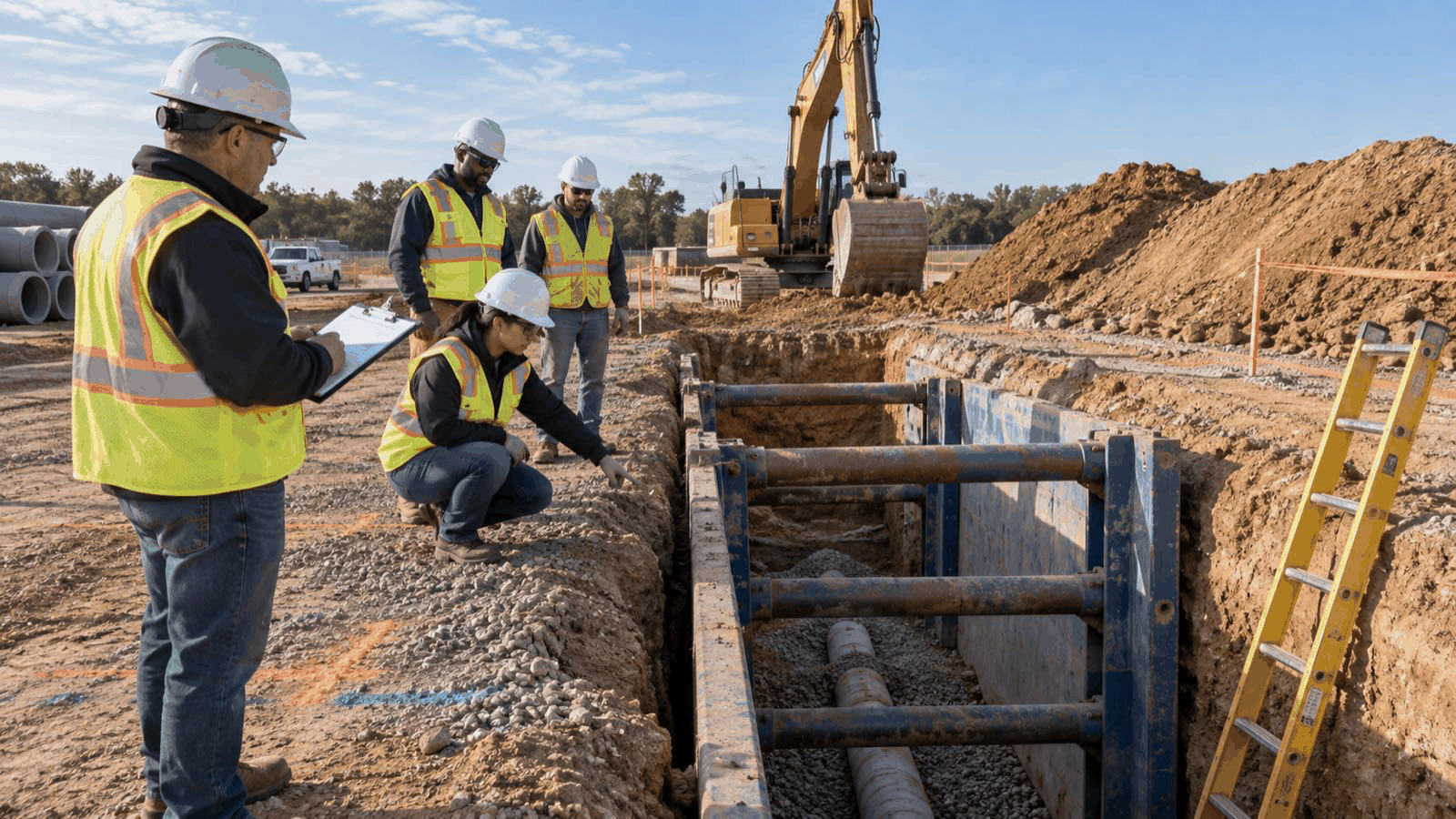
Clear trench inspection records help employers show that changing excavation conditions were reviewed before workers entered and that the designated Competent Person acted on what the jobsite revealed.
An inspection log is not a substitute for judgment, protective systems, or a stop-work decision. It is a practical record of the decisions that connect an excavation safety program to the conditions crews actually face. A short utility repair may look routine when the crew arrives, yet soil type, water, vibration, surcharge loads, access, and nearby traffic can change during the shift. The record should help a supervisor explain what was checked, what changed, and what the crew was told to do next.
Employers often ask how much documentation is enough. OSHA 29 CFR 1926 Subpart P requires competent-person inspections of excavations, adjacent areas, and protective systems before work starts and as needed throughout the shift, including after hazard-increasing events. The exact form may vary by company and project, but the process should be specific enough to support a safe entry decision and a useful review later.
Why This Matters on Excavation Jobsites
An inspection record creates a deliberate pause before entry. The Competent Person has to look at the excavation, not simply initial yesterday's form or rely on the crew's memory. That pause can identify loose material, tension cracks, sloughing, water accumulation, damaged trench-shield components, blocked ladders, or a spoil pile that has moved closer to the edge. It can also show that conditions were acceptable at one point and required a new decision after rain, a utility exposure, equipment movement, or nearby vibration.
The record matters because excavation hazards are often interconnected. A change in soil condition may affect the selected protective system. A new haul route may add surcharge loading at the edge. A leaking water line may weaken the sidewall while also creating an atmospheric concern. A ladder may be present but no longer provide a safe route because the work face moved. Treating each item as a separate checkbox can hide the interaction. A strong inspection process describes the condition and the control together.
Documentation also improves communication among the people who share responsibility for the job. The Competent Person may identify a concern, the foreman may rearrange the work, the equipment operator may need a new exclusion area, and workers may need to understand why the entry sequence changed. A dated record gives the next supervisor a starting point instead of asking the crew to reconstruct the decision from memory.
There is a productivity benefit as well. Planned checks reduce avoidable pauses caused by confusion. When a record identifies the protective system, access point, spoil setback, utility status, and inspection triggers, a crew can make a controlled adjustment quickly. That is different from rushing into an excavation and stopping later because no one knows who can authorize re-entry or what condition must be corrected first.
Finally, records support a fair review after an incident, near miss, complaint, or project audit. They do not prove that an excavation was safe simply because every box is marked yes. They do show whether the employer had a repeatable process, whether the assigned person understood the role, and whether the company responded when conditions changed.
What Employers and Supervisors Should Know
The first question is who is performing the inspection. A Competent Person under the excavation standard must be capable of identifying existing and predictable hazards and authorized to take prompt corrective measures. Listing a name on a form is not the same as assigning the authority to keep workers out, change the protective approach, call for equipment, or stop the task. Employers should make that authority clear before the crew arrives.
A useful inspection record identifies the project, location, date, time, weather or recent weather event, excavation dimensions, work activity, and people involved. It should then capture the conditions that affect entry. Consider including the following prompts:
- Soil classification or the basis for the protective-system decision, including visible changes in layers, fissures, sloughing, or previously disturbed soil.
- Protective system type, condition, installation limits, manufacturer information when applicable, and the portion of the excavation covered by the system.
- Access and egress location, condition, spacing, and whether the route remains usable as the work progresses.
- Spoil piles, materials, equipment, traffic, structures, utilities, and other surcharge loads near the edge.
- Water accumulation, surface drainage, pumping, weather changes, and any sign that water is affecting stability.
- Atmospheric concerns when the excavation could contain a hazardous atmosphere, especially near landfills, sewers, fuel lines, or contaminated ground.
- Falling-object, mobile-equipment, struck-by, and falling-worker controls around the opening.
- Required corrections, responsible person, completion time, and the Competent Person's re-entry decision.
The form should leave room for observations, not just yes-or-no answers. A note such as “water present” is incomplete without describing where it is, whether workers are exposed, what control is in place, and whether entry is delayed. A note such as “ladder okay” is stronger when it records the access point and confirms that the ladder extends to the required landing level for the work configuration.
The inspection should be repeated when conditions change. Triggers can include rain, freezing and thawing, a change in excavation depth, movement of a trench shield, a utility strike or newly exposed line, vibration from compaction or traffic, a failure of pumping, a worker report, or a change in the crew's task. Employers should define these triggers in the site plan and teach workers to report them immediately rather than waiting for the next scheduled round.
Photographs can supplement a record when the company can store them securely and connect them to the correct time and location. A photo should not replace a written decision. It may not show depth, soil texture, a concealed defect, or what happened after the picture was taken. If photographs are used, the process should explain who takes them, where they are saved, and how the Competent Person documents conditions that cannot be captured clearly.
Supervisors should review the record with the crew in plain language. Workers need to know where they may enter, where they may not stand, how to use the access route, what to do if water appears, and who can stop the task. The review should be two-way. The worker closest to the excavation may notice a change before the supervisor does, and a strong program treats that report as useful information rather than an interruption.
How Training Supports a Safer Excavation Program
OSHA-aligned excavation training gives employers a common vocabulary for the decisions that appear in an inspection record. Crew-level training can explain why spoil placement, access, protective systems, utilities, and changing conditions matter. Competent Person training can go further into soil evaluation, protective-system limits, inspection responsibilities, and the authority to correct hazards before entry.
The value of training is strongest when the lesson is connected to the employer's actual workflow. A company can use a sample inspection form during a class, then ask supervisors to complete it for a staged excavation or a recent project scenario. The exercise should include a weather change, a moving excavator, a damaged ladder, or a newly exposed utility so the learner must decide when to pause and what to document. That practice makes the form a decision tool instead of paperwork completed after the fact.
Training should also clarify role boundaries. A worker who notices a crack needs to report it. A foreman may coordinate the response. The Competent Person evaluates the hazard and directs corrective action. An employer may need an engineer, utility owner, shoring supplier, or emergency service depending on the condition. These roles should not be blurred by assuming that one online course or one certificate replaces site-specific planning and field judgment.
Employers can reinforce the lesson through short toolbox talks, supervisor observations, periodic form reviews, and a simple process for tracking repeat findings. If the same inspection repeatedly notes blocked egress or spoil encroachment, the solution may be equipment staging, a revised layout, or a management decision, not another reminder to be careful. Reviewing records can reveal where the safety program needs a design change.
For new supervisors and designated Competent Persons, a structured course can establish a foundation before project-specific mentoring. For broader crews, awareness training can make the inspection process understandable and encourage early reporting. The employer remains responsible for selecting training that matches each person's duties, verifying competence, and applying the instruction to the actual excavation.
Key Takeaway
An excavation inspection record should tell a clear story: who inspected, what conditions were found, what controls were in place, what changed, and why entry was allowed, delayed, or stopped. That story protects workers only when it reflects an honest field decision and leads to action.
Employers should compare their current form with the hazards their crews face in utility work, road construction, municipal repairs, and larger excavations. Train workers to report changes, train supervisors to coordinate responses, and train designated Competent Persons to evaluate conditions and use their authority. An OSHA-aligned course and a certificate of completion can support the program, but the employer still needs site-specific planning, inspections, protective systems, and follow-through.