
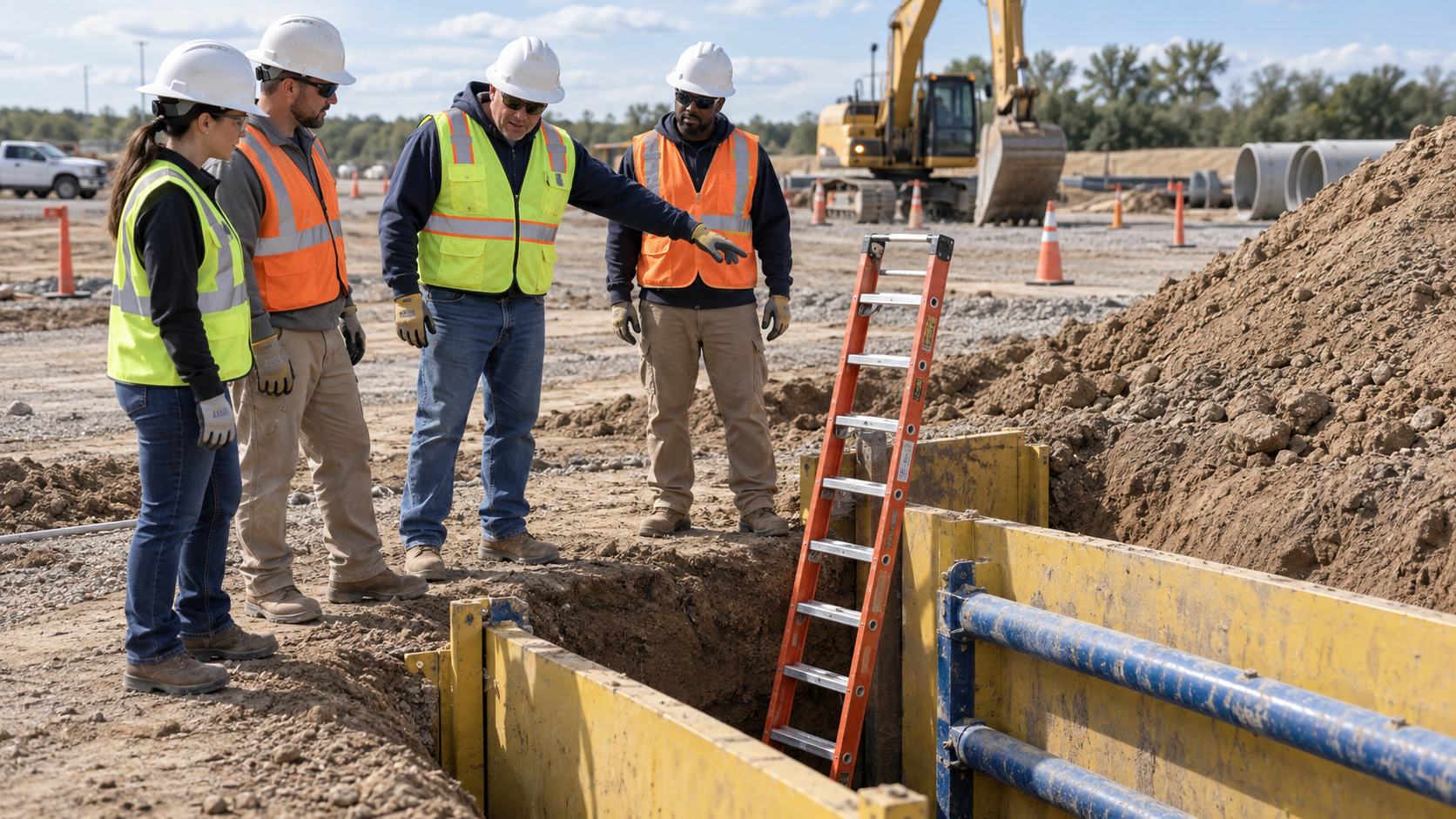
The Compliance Question
A trench can look controlled in the morning and become a different job by the afternoon once crews
expose a utility line, uncover an old service, change the trench length, or open a pocket of
disturbed soil. The compliance question for employers is not only whether a protective system was
selected before work started. It is whether supervisors and the Competent Person know when utility
exposure changes the excavation enough to require a fresh inspection, a pause in entry, and a clear
decision before workers continue.
This matters because utility work often creates the exact conditions that make excavation safety
complicated. A crew may begin with a planned alignment, known depth, and chosen protective system.
Then the bucket finds a gas service that was shallower than expected, an abandoned clay tile, an
unmarked irrigation line, a void near a previous repair, or a water service that begins leaking into
the cut. The original plan may still be useful, but it cannot replace the Competent Person's
judgment after conditions change.
OSHA-aligned excavation training should prepare supervisors to treat exposed utilities as a trigger
for renewed attention. The hazard is not limited to the utility strike itself. The exposure can
change soil support, create undermined areas, introduce water, force workers into awkward entry
points, add traffic from repair equipment, and make spoil placement harder to control. A practical
excavation safety program teaches crews to recognize these changes early and gives supervisors
authority to stop entry while the trench is rechecked.
Why This Matters on Excavation Jobsites
Utility exposure sits at the intersection of cave-in prevention, struck-by control, hazardous
energy, access and egress, and emergency planning. A crew that focuses only on protecting the pipe
or cable can miss the way the surrounding trench has changed. Soil around older utilities may have
been backfilled years earlier, and backfill can behave differently from native soil. The sidewall
may show seams, voids, water paths, loose material, or vibration effects from nearby pavement and
traffic.
For construction companies, municipal public works teams, utility contractors, and general
contractors, the practical risk is that work becomes routine at the same moment it becomes less
predictable. Workers may be used to exposing services by hand, stepping around small lines, or
waiting while a utility owner verifies a location. Those familiar tasks can create a false sense of
stability. Training helps crews understand that familiar work still requires trench inspection
discipline.
The Competent Person must be able to identify existing and predictable hazards and take prompt
corrective measures. After utility exposure, that means checking whether the protective system still
fits the actual depth, width, soil behavior, surcharge loads, spoil location, water condition, and
worker movement inside the excavation. If the exposed utility limits where a trench shield can sit
or changes how workers enter the cut, the inspection is no longer a paperwork step. It becomes the
decision point for whether entry should continue.
There are also productivity consequences. When crews do not pause and recheck, small problems become
larger delays. A minor leak can soften the trench bottom. Spoil pushed too close during hand digging
can add load. A ladder may be moved to work around the utility and no longer meet access
expectations. A crew trained to identify these issues can often correct them before the project
turns into an emergency repair or stop-work event.
What Employers and Supervisors Should Know
Employers should treat utility exposure as a planned inspection checkpoint, not an unusual
disruption. A pre-task plan can identify where crews expect crossings, how they will verify utility
locations, what equipment will be staged, who has authority to pause work, and how communication
will flow if the exposed utility is different from the drawings. That planning should include trench
safety, not only damage prevention.
- Recheck soil conditions around exposed utilities, especially where prior backfill, water, or voids
are visible.
- Confirm the protective system still matches the trench depth, width, soil classification, and
actual worker position.
- Verify spoil piles, excavators, repair trucks, plates, bedding stone, and pipe sections are not
adding unsafe loads near the edge.
- Make sure ladders, ramps, or other access points remain correctly placed after the utility changes
the work area.
- Control water, seepage, or leaking services before workers continue in the trench.
- Document the changed condition, inspection decision, and corrective actions in a way supervisors
can understand later.
Supervisors also need to understand that utility exposure can affect emergency planning. If a worker
is positioned between a trench shield and an exposed line, rescue access may be different from the
original plan. If a gas, electric, communications, or water utility is involved, the emergency
response may require coordination with utility owners, emergency services, or traffic control.
Excavation safety training should help supervisors think through these practical complications
before the crew is under pressure.
Crew-level training matters because the Competent Person cannot see every small change first.
Laborers, operators, pipelayers, spotters, and foremen should know what conditions to report. A
worker who sees soil sloughing beneath an exposed conduit, water collecting near a service, or a
ladder being moved away from the work face should understand that these are not minor housekeeping
details. They are signals that the trench needs attention.
How Training Supports a Safer Excavation Program
OSHA-aligned Excavation, Trenching and Shoring Safety Training gives crews shared language for
recognizing hazards before entry and during changing work. It helps workers understand protective
systems, access and egress, soil behavior, spoil placement, water accumulation, utilities, and the
role of the Competent Person. That shared language is especially useful when a utility exposure
creates a fast-moving decision.
Competent Person for Excavation, Trenching and Shoring Training goes deeper into the judgment
supervisors need on site. The person assigned to that role must know when conditions require
corrective action, when entry should pause, and how to communicate decisions to crews and
management. Training does not guarantee compliance by itself, but it supports the employer's ability
to build a program where inspections are meaningful and documented.
A strong excavation program also connects training to daily practice. Employers can require pre-
entry briefings for utility exposures, add inspection prompts to daily forms, include examples in
toolbox talks, and review near misses after a utility changes the trench. The goal is not to create
more paperwork. The goal is to make sure the right person asks the right questions while there is
still time to correct the condition.
For municipal crews and utility contractors, role clarity is especially important. The operator may
find the unexpected condition. The foreman may be coordinating traffic and residents. The Competent
Person may need to evaluate soil and protective systems. The project manager may be dealing with
schedule pressure. Training helps each role understand when safety judgment must take priority over
continuing the dig.
Key Takeaway
When a trench exposes utilities, the excavation has changed. Employers should train crews and
designated Competent Persons to treat that moment as an inspection trigger, not as a quick obstacle
to work around. Rechecking support, access, spoil placement, water, traffic, and emergency planning
protects workers and helps supervisors make defensible decisions before entry continues.
The right training helps crews recognize changed conditions and helps supervisors act on them. For
excavation employers, that is the practical value of OSHA-aligned crew training and Competent Person
training: safer decisions at the exact moment the job stops matching the morning plan.
Employers can strengthen this approach by building a short utility exposure protocol into pre-task
planning. The protocol can identify who contacts the utility owner, who evaluates the trench, who
keeps workers out during the recheck, and what conditions must be corrected before re-entry. When
that protocol is taught before the job, supervisors do not have to improvise while equipment,
traffic, and schedule pressure are all competing for attention.
Documentation should be practical and brief, but it should capture the decision. A useful note might
identify the exposed utility, the changed condition, the inspection time, the protective system
review, water control steps, access adjustments, and the person authorizing entry. Those notes can
help an employer show that inspections were active decisions, not automatic signatures on a daily
form.
Training also helps crews avoid a common communication gap between damage prevention and trench
safety. A crew may call for utility verification and still miss the need to reassess cave-in
protection. By connecting utility exposure to Subpart P concepts, employers can make sure the
conversation covers both the utility and the workers standing in the excavation.
A useful field habit is to ask what changed since the last inspection. Did the trench get deeper or
wider? Did the shield move? Did water enter? Did a truck, plate, spoil pile, or bedding box get
closer to the edge? Did workers need to stand outside the protected area to expose the line? These
questions turn training into a repeatable decision process that fits real excavation work.
Sources
OSHA 29 CFR 1926 Subpart P Excavations
https://www.osha.gov/laws-regs/regulations/standardnumber/1926/1926SubpartP
OSHA Trenching and Excavation Safety
https://www.osha.gov/trenching-excavation
NIOSH Trenching and Excavation Safety