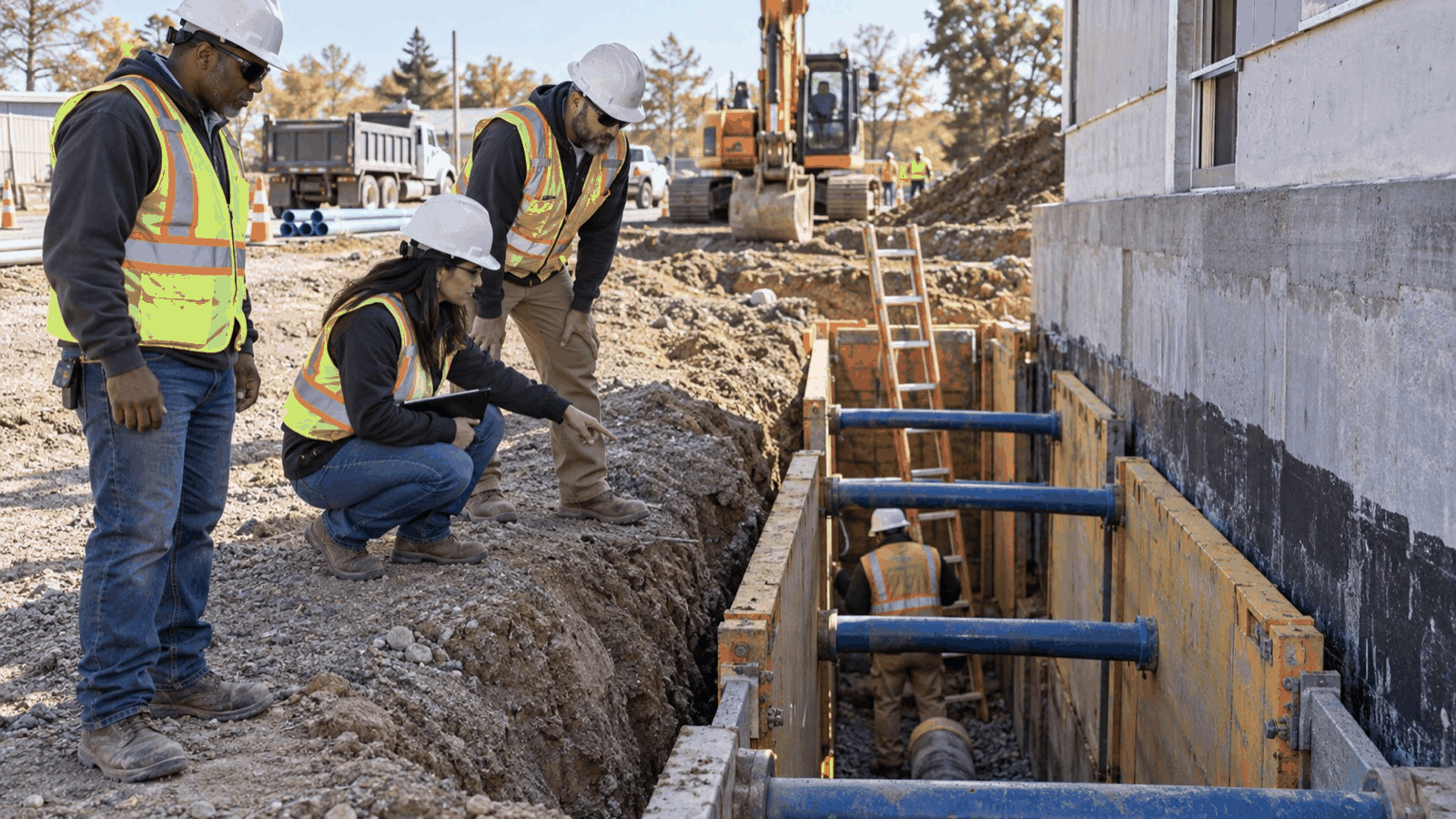
Excavation work beside an existing foundation requires a documented review of soil, structural support, protective systems, utilities, and changing conditions before anyone enters.
When a trench or pit is opened next to a building, retaining wall, pavement edge, or other fixed structure, the work changes from a simple cut into a coordinated ground-support decision. Removing soil can take away lateral support, expose buried utilities, redirect water, or create loads near the excavation edge. The visible wall may look stable while the soil beneath a footing is weakening. That is why a short excavation near a familiar structure still deserves a deliberate plan.
The employer remains responsible for organizing competent-person inspections, protective systems, access, egress, and worker training that fit the actual job. An online certificate can support the program, but it does not replace a site evaluation, engineering judgment when needed, or the authority to stop work. Supervisors need a repeatable way to recognize when an existing structure changes the excavation hazard profile.
The condition of the adjacent structure should be part of the briefing, not a detail known only to the project manager. Show the crew the limits of the excavation, the expected support sequence, the locations of monitoring points or barriers, and the signs that require immediate withdrawal. Explain who can authorize a change and how the work will be secured while the decision is made. When a building occupant, road user, or utility owner could be affected, include that communication in the plan as well.
Why This Matters on Excavation Jobsites
An excavation can affect an adjacent structure in several ways. Soil removed from one side of a footing may allow movement toward the cut. Vibration from compactors, breakers, traffic, or drilling can loosen soil or alter a crack pattern. A leaking water line can soften the base of a foundation. Rain can fill a cut, saturate the soil, and increase pressure against a wall. Spoil piles, materials, and mobile equipment can add surcharge loads close to the edge.
The risk is not limited to a dramatic collapse. Small movement can damage a foundation, crack a slab, shift a utility, pinch a pipe, or change the clearance available for a protective system. A crew may then face a new problem while trying to solve the first one. If workers are already in the excavation, the time available to make a careful decision is reduced.
OSHA 29 CFR 1926 Subpart P applies to open excavations, including trenches. Its requirements address inspections, employee exposure to falling loads, water accumulation, hazardous atmospheres, access and egress, and protective systems. The competent person must identify hazards and take prompt corrective action. When the excavation could undermine a structure or when the configuration is outside standard conditions, the employer may need support from a registered professional engineer or another qualified design resource.
There are also productivity and liability consequences. An unplanned shutdown can affect utility restoration, concrete placement, traffic control, and subcontractor schedules. A damaged structure can create a claim involving several employers. Clear records showing what was inspected, what conditions were present, which protective system was selected, and who had stop-work authority help the employer explain its process after an incident or near miss.
The people closest to the work need a shared picture of the hazard. Equipment operators need to know where they can travel and stage. Laborers need to know where the edge, safe access, and exclusion zones are. Foremen need a trigger for reinspection. The competent person needs enough authority and practical support to keep the crew out while conditions are evaluated.
What Employers and Supervisors Should Know
Start with a preconstruction review that treats the adjacent structure as part of the excavation plan. Identify the building, wall, pavement, pole, pipeline, or other feature that could be affected. Gather available drawings, utility information, prior repair records, and information about basements, footings, slabs, or buried foundations. Walk the area with the people who will excavate, support, inspect, and restore it.
The review should ask whether the planned excavation will extend below the bottom of a nearby footing or remove soil that appears to support it. It should also ask whether the structure is already cracked, leaning, water-damaged, or subject to vibration. The answer may require a different sequence, a wider setback, shoring designed for the condition, underpinning, temporary support, or an engineer's review. A competent person should not treat a generic trench box or a standard slope as an automatic answer to an undermining concern.
Before entry, verify the following items in the field:
- The excavation limits, depth, soil conditions, and nearby structures match the plan.
- Known utilities have been located, marked, and protected, with a method for exposing them safely.
- The protective system is suitable for the soil, depth, width, loads, and adjacent conditions.
- Spoil, pipe, tools, and equipment are placed to control edge loading and falling material.
- Access and egress are positioned so workers do not have to climb toward the structure or cross an unstable edge.
- Surface water is diverted, accumulated water is controlled, and pumps do not create a new hazard.
- Traffic, vibration, and nearby work are controlled or included in the inspection decision.
- The competent person has inspected before the shift, after events that increase hazards, and when conditions change.
Look at the ground, not only at the building. Tension cracks, settlement, bulging, sloughing, seepage, open joints, changes in soil texture, and newly exposed layers can signal movement. Compare the current condition with the prior inspection instead of relying on memory. A photograph can help document a baseline, but it does not replace a close inspection and a decision about whether the crew may enter.
Sequence matters. Excavating a short section, installing support, and backfilling before opening the next section can reduce exposure. A long continuous cut beside a structure may create a different risk than a series of supported sections. The supervisor should coordinate the excavation sequence with utility work, concrete work, shoring installation, and any required monitoring. If a support system must be installed from outside the excavation, plan how the crew will do that without stepping into an unprotected area.
The crew also needs an understandable stop-work process. A worker should be able to report a crack, leak, movement, vibration, or unexpected void without waiting for permission to leave the hazard area. The foreman can then contact the competent person, secure the perimeter, and preserve the condition for evaluation. Training should make this response routine rather than a personal judgment about whether a condition looks serious enough.
How Training Supports a Safer Excavation Program
Role-based training helps an employer turn Subpart P concepts into actions at the edge of the excavation. Awareness training can help general workers recognize cave-in indicators, falling-object exposure, unsafe access, water accumulation, and the importance of staying outside a restricted area. It can also explain why a familiar job or shallow cut can become hazardous when a footing, utility, roadway, or structure is nearby.
Competent Person training should go deeper. The designated person needs a working understanding of soil classification, protective-system options, inspections, access, water, atmospheric concerns, and changing conditions. The role also includes communication. The competent person must be able to explain a stop-work decision, document the basis for it, and coordinate with engineering or project leadership when the condition exceeds routine field judgment.
Supervisors benefit from training that connects planning to daily control. They need to recognize that delivery trucks, concrete pumps, excavators, cranes, and stored materials can create surcharge loads. They need to schedule inspections around rain, freezing, thawing, utility exposure, vibration, and changes in the excavation sequence. They need to know which questions to ask before authorizing re-entry after a delay.
An OSHA-aligned course can provide a common vocabulary for the crew and support an employer's training records. The employer should pair it with site-specific orientation, equipment procedures, emergency contacts, competent-person assignments, and hands-on demonstrations of the protective system used on the project. Training alone does not guarantee compliance, but it can make the employer's expectations easier to apply consistently.
A useful program also checks whether training is working. Review inspection forms for recurring findings. Compare near misses with the controls selected in the plan. Ask workers whether they know who can stop the job and whether access and egress remain usable after the excavation changes. If teams repeatedly find water, unstable edges, poor material placement, or missing utility information, improve the planning process instead of treating each finding as an isolated reminder.
Key Takeaway
An excavation beside an existing foundation deserves a structure-specific review before the first bucket removes soil. Employers and supervisors should identify the possible support relationship, select controls that fit the actual conditions, assign a competent person, and give the crew a clear reinspection and stop-work process. The right people should receive excavation awareness or Competent Person for Excavation, Trenching & Shoring Training based on their duties, followed by site-specific instruction and field verification. That combination supports safer decisions without suggesting that a certificate by itself replaces the employer's excavation safety program.