The Compliance Question
Excavation safety conversations often begin with cave-in prevention, soil classification, trench shields, sloping, benching, and Competent Person inspections. Those issues deserve attention because a trench collapse can become fatal in seconds. But employers can miss another serious exposure sitting at the surface: workers, inspectors, subcontractors, and visitors can fall into or around an excavation before anyone ever enters the trench.
That risk grows quickly on busy jobsites. A trench may be opened beside a sidewalk, driveway, utility corridor, plant yard, roadway shoulder, or building foundation. Crews may need to cross from one side to another. Inspectors may walk the edge to review grade, utilities, bedding, or protective systems. Equipment operators may climb down from machines nearby. Delivery drivers, surveyors, traffic control crews, and other trades may pass through the area without understanding how quickly the ground line changes.
The compliance question for employers is not only whether the trench has a protective system. It is also whether the jobsite controls prevent people from falling into the excavation, stepping onto unstable edges, using improvised crossings, or walking through poorly marked work zones. OSHA Subpart P addresses excavation hazards broadly, including protection from falls, falling loads, hazardous atmospheres, water, access and egress, inspections, and exposure to mobile equipment. A practical excavation safety program has to connect those requirements into the way crews set up the work area each day.
Fall protection around excavations is often treated as common sense until the job becomes crowded. A narrow trench may seem obvious to the digging crew, but it may be less obvious to a truck driver backing in, a new laborer carrying material, a municipal inspector arriving during rain, or a subcontractor moving around stacked pipe. Edges can blend into disturbed soil. Spoil piles can hide openings. Temporary plates, boards, ladders, and ramps can be mistaken for safe access points even when they were never designed or secured for walking.
That is why employers need more than a verbal warning. They need a planned method for guarding edges, controlling crossings, marking routes, inspecting walkways, and training workers to recognize when a surface-level excavation hazard requires correction before work continues.
Why This Matters on Excavation Jobsites
Fall exposure around excavations can be easy to underestimate because the opening is horizontal rather than overhead. Many crews are trained to watch trench walls, soil movement, water accumulation, and protective systems. Those are essential concerns, but workers also need to think about the approach to the trench, the edge, the crossing, and the walking path that brings people near the excavation.
On a real jobsite, the same excavation can create several different fall-related hazards. A worker may trip over uneven soil near the edge. A person may step backward while guiding pipe or watching equipment. A supervisor may walk too close to a cut that has softened after rain. A visitor may follow the shortest route through the work zone instead of a controlled walkway. A temporary bridge may shift under load. A ramp may become slick with mud. A guardrail may be moved for access and not replaced.
These hazards matter because they can create more than a simple fall injury. A person who falls into an excavation may strike shielding, pipe, utilities, ladders, tools, rebar, or uneven trench bottom conditions. A fall can also trigger a rescue problem. If the person is injured, crews may feel pressure to enter an unsafe excavation quickly, which can compound the original incident with cave-in exposure, atmosphere concerns, or equipment movement.
Edge stability is another reason fall protection matters. Workers standing at the lip of an excavation can add surcharge load near the trench. If the soil is cracked, saturated, undercut, or affected by vibration, edge activity can contribute to sloughing or loss of ground. Keeping people back from the edge is not only a fall-prevention measure. It can also help protect the excavation itself.
Crossings deserve special attention. Crews often need to move from one side of a trench to the other, especially during utility installation, pipe alignment, form work, backfill preparation, or inspection. If a safe crossing is not provided where workers naturally need it, people may create their own path. That might mean stepping over a narrow trench, walking across a bucket, using a loose plank, climbing over pipe, or crossing at an unprotected pinch point. Those workarounds usually appear when schedule pressure is high and supervision is focused on production.
Walkways and ramps also change throughout the day. Mud, spoil, equipment ruts, hoses, cords, bedding material, traffic control devices, and pipe sections can alter a route that was clear at the start of the shift. A Competent Person inspection should not be limited to looking into the trench. It should include how workers reach the work area, how they move around it, where they cross, and whether surface controls still match the actual work.
The employer's duty is practical: identify reasonably foreseeable hazards, correct unsafe conditions, and make sure workers know what controls are expected. In excavation work, that means surface-level fall hazards should be included in the same daily planning conversation as soil conditions and protective systems.
What Employers and Supervisors Should Know
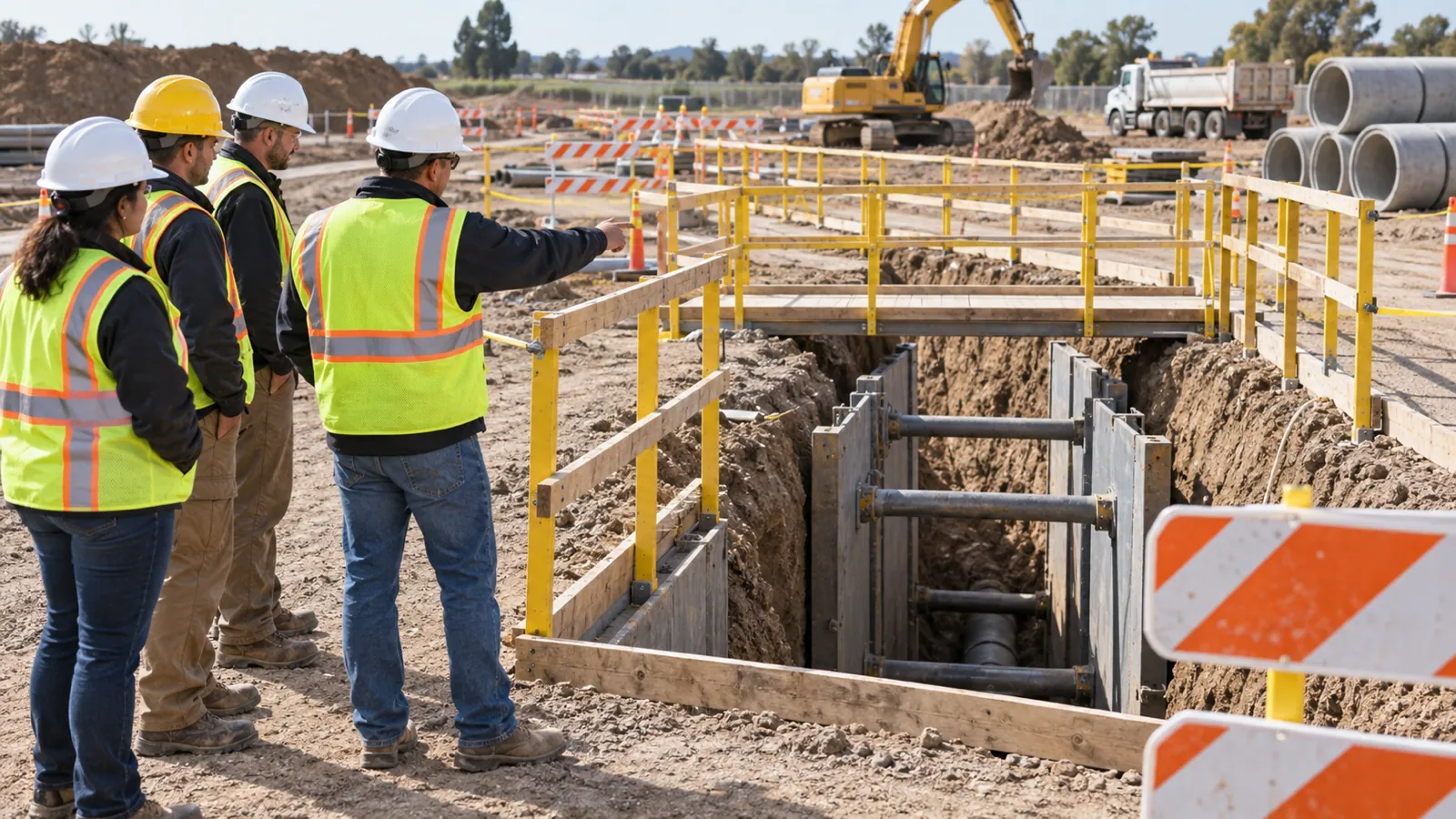
Employers and supervisors should treat excavation edge control as a planned jobsite setup item, not an afterthought. Before work begins, the crew should know where the excavation will be open, where people are allowed to walk, where they are not allowed to walk, how the edge will be marked or guarded, and how crossings will be provided when workers need to pass over an excavation.
The specific controls depend on the jobsite. Some excavations require guardrails, barricades, fences, covers, warning lines, traffic control, lighting, or controlled access zones. Some need engineered walkways, secured bridges, or properly built ramps. Some need a combination of barriers and spotters because mobile equipment, public access, or utility congestion creates overlapping hazards. The key is that the control must match the exposure, the depth, the location, and the people who can reasonably enter the area.
Supervisors should pay close attention to who is near the trench. The digging crew may understand the hazard, but other people may not. General contractors, municipal employees, inspectors, delivery drivers, adjacent trades, property owners, and the public may approach the area with different assumptions. A barrier that works for trained employees in a closed construction zone may not be enough near pedestrian traffic, a public works emergency repair, or an occupied facility.
Employers should also separate edge protection from excavation entry protection. A trench shield, shoring system, or sloped wall may help protect workers inside the excavation from cave-in hazards, but it does not automatically protect workers walking near the surface. Likewise, a barricade may reduce fall exposure at the surface, but it does not replace soil classification, protective system selection, access and egress, or Competent Person inspections for entry.
Practical planning questions include:
- Where will workers naturally want to cross the trench?
- Are those crossing points designed, secured, inspected, and kept clear?
- Are edges guarded or clearly controlled where employees, visitors, or equipment operators may approach?
- Have spoil piles, pipe, tools, and materials been placed so they do not push workers toward the edge?
- Are walkways wide enough and stable enough for the work being performed?
- Does mud, rain, ice, vibration, or equipment traffic change the stability of the route?
- Are barricades or guardrails being moved during the shift, and who is responsible for restoring them?
- Are night work, traffic exposure, or public access changing the level of control needed?
Competent Persons should include these items in daily and changing-condition inspections. A trench may be safe for entry in one sense but still poorly controlled at the surface. For example, a shielded trench with a clean ladder may still have an unguarded edge beside a high-traffic walkway. A sloped excavation may still create a fall hazard if people can walk onto the slope unintentionally. A short-duration utility repair may still need barricades and controlled crossings if the work is in a parking lot, street, or plant yard.
Documentation helps employers prove that these issues were considered. That does not mean every job needs a long form for each guardrail. It means the excavation inspection process should capture whether walkways, crossings, barricades, edge controls, access points, spoil placement, and changing conditions were reviewed. Photos can be useful when they show the actual setup before workers begin. Toolbox talks can reinforce where crews may cross and where they may not.
Training should clarify authority. Workers should know they can pause and report an unsafe crossing, missing barricade, unstable edge, or blocked walkway. Supervisors should know when they can correct the issue directly and when they need the Competent Person to re-evaluate the excavation. The Competent Person should have the authority to stop work or restrict entry when edge conditions, access routes, or crossings create hazards that have not been controlled.
Employers should be careful with improvised solutions. A board across a trench may look convenient, but if it is not designed, supported, secured, and inspected for the expected load, it can become a hazard. A metal plate may seem solid but can shift, rock, become slick, or create a trip hazard. Cones alone may be useful for visibility in some settings, but they may not prevent access where a physical barrier is needed. The control should be chosen because it works for the exposure, not because it was the nearest available item.
Communication between crews matters. Excavation work often changes quickly as digging progresses, bedding is placed, pipe is set, inspections occur, and backfilling begins. The safest route at 8:00 a.m. may be blocked by material at 10:00 a.m. A crossing that was acceptable before equipment moved may become too close to swing radius, spoil, or traffic. Supervisors should build short updates into the day so people know when routes change.
How Training Supports a Safer Excavation Program
OSHA-aligned Excavation, Trenching and Shoring Safety Training helps workers understand that excavation hazards are not limited to cave-ins. A good training program connects soil conditions, protective systems, access and egress, inspections, falling loads, mobile equipment, utilities, hazardous atmospheres, water, and surface controls into one jobsite picture. That broader view helps crews recognize why edge protection, crossings, and walkways deserve attention before work starts.
Crew-level training should give workers simple decision points. They should know not to cross an excavation unless a safe crossing has been provided. They should know not to move barricades or guardrails without authorization. They should know not to work from the edge when a safer location is available. They should know to report cracked edges, soft ground, missing controls, blocked routes, or unstable temporary surfaces. These are practical behaviors, and they only become reliable when supervisors reinforce them in the field.
Competent Person for Excavation, Trenching and Shoring Training should go further. The Competent Person needs to understand how surface conditions and worker movement affect excavation safety decisions. That includes recognizing when a walkway or crossing creates a fall hazard, when a barrier is insufficient, when public or third-party access changes the control strategy, and when weather or vibration has changed edge stability. The Competent Person should also understand how fall exposure fits into the overall excavation inspection, not as a separate checklist item that gets ignored.
Training can support a safer program in several ways:
- It gives workers shared language for describing edge hazards and route problems.
- It helps supervisors plan crossings and walkways before crews improvise.
- It reinforces the difference between protective systems for cave-ins and controls for surface fall exposure.
- It helps Competent Persons include edge conditions in daily and changing-condition inspections.
- It supports documentation that shows employers addressed foreseeable excavation hazards.
- It gives crews confidence to pause work when barriers, walkways, or crossings are missing or unsafe.
Training alone does not guarantee compliance. Employers still have to provide the right controls, assign qualified supervision, inspect the excavation, maintain the work area, and correct hazards as conditions change. But training makes those controls more effective because workers understand what they are looking at and what they are expected to do.
For owners, EHS managers, safety coordinators, and operations leaders, the goal is consistency. One crew should not guard excavation edges carefully while another relies on caution tape and verbal reminders. One foreman should not require safe crossings while another accepts planks and shortcuts. A role-based excavation training plan can set common expectations across crews, projects, and supervisors.
That consistency is especially important for contractors and public works teams that perform short-duration excavation work. Small utility repairs, service connections, drainage repairs, and emergency digs can feel too quick for formal setup. But short duration does not remove the fall hazard. In fact, fast-moving jobs often create the greatest temptation to skip edge controls, route planning, or crossing design. Training helps crews recognize that temporary work still needs disciplined setup.
Employers should also include subcontractors and visitors in the communication plan. A trained excavation crew cannot assume everyone else on the site understands the controlled routes. Pre-task briefings, site orientation, signage where appropriate, and supervisor communication can help keep non-excavation personnel away from unprotected edges and unauthorized crossings.
When training is paired with field leadership, fall protection around excavations becomes part of the normal workflow. Crews begin the day by identifying where people will walk, where they will cross, where barriers are needed, and who has authority to change the setup. Supervisors verify that the plan still matches the work. Competent Persons inspect not only the trench but the conditions around it. That is how surface-level hazards become visible before an injury forces the issue.
Key Takeaway
Excavation safety is not only about what happens inside the trench. Employers also need to control the surface around the excavation: edges, walkways, crossings, access routes, barricades, guardrails, and changing ground conditions. These controls protect workers from falls, reduce pressure on unstable edges, limit unauthorized access, and support safer movement around busy jobsites.
The right training helps crews see those hazards early. Workers learn not to improvise crossings. Supervisors learn to plan the route before production starts. Competent Persons learn to include edge protection and walking surfaces in their inspection decisions. When employers combine OSHA-aligned excavation safety training with clear field expectations, they build a stronger excavation program and give the right people the tools to stop preventable surface hazards before anyone gets hurt.