The Compliance Question
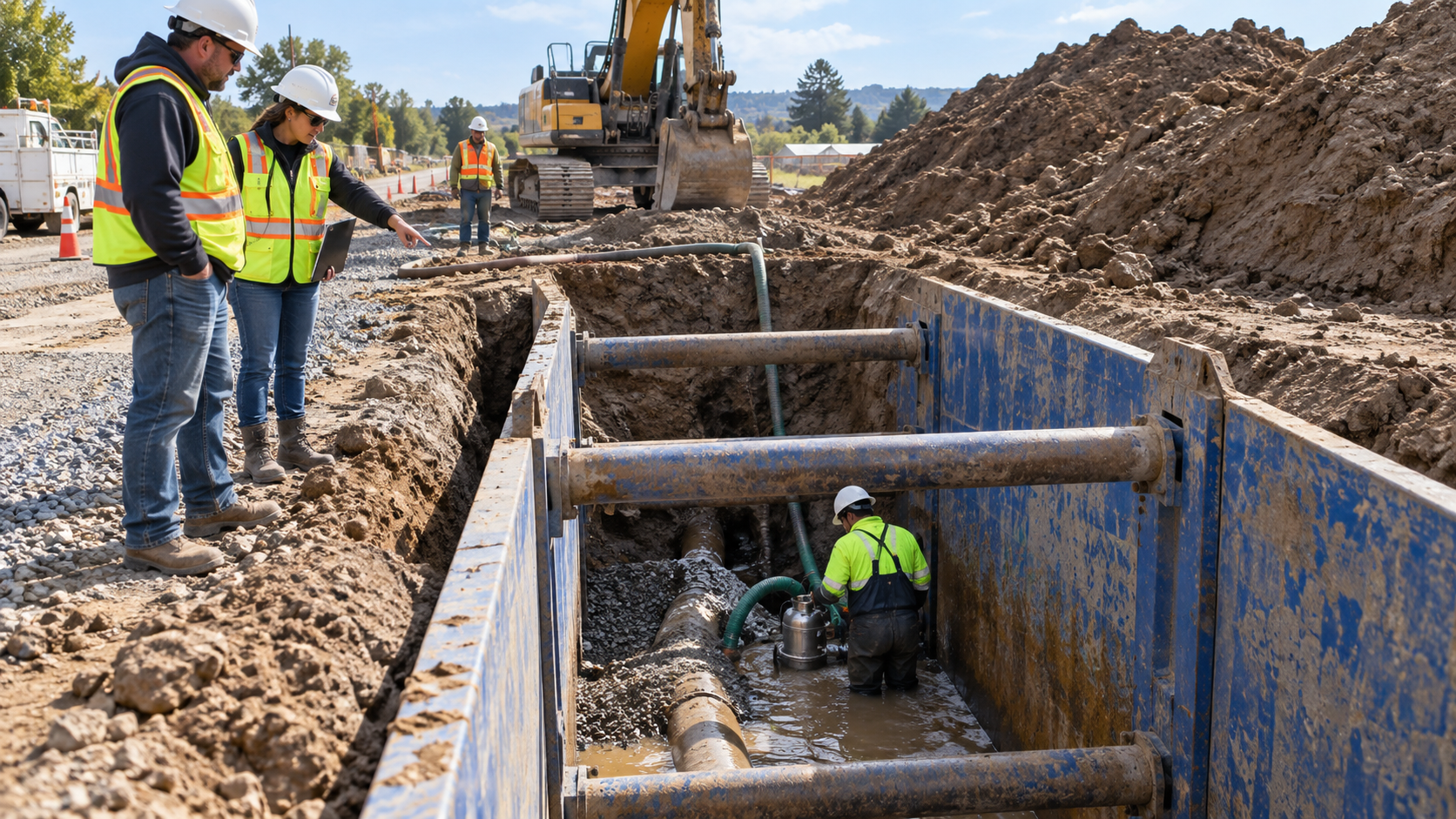
Water in or around an excavation changes the job quickly. A trench that looked orderly at the start of the shift can become a different hazard after seepage, a broken utility, nearby pumping, overnight rain, or vibration from equipment. For employers, the practical question is not whether crews can work around a little water. The question is whether the excavation has been inspected, reclassified if needed, and protected before anyone is exposed to a cave-in, unstable footing, or a damaged utility.
OSHA-aligned excavation training should prepare supervisors, foremen, and designated Competent Persons to recognize that water is not just a housekeeping problem. It affects soil strength, access and egress, protective system decisions, spoil placement, equipment movement, and emergency planning. Water may soften trench walls, hide cracks or sloughing, undermine trench boxes, change the behavior of granular soils, or create a slipping hazard that delays evacuation.
Many jobs treat dewatering as a production task handled by the most available crew member. That can leave the safety decision in the wrong place. Pumps and hoses may remove visible water, but they do not automatically make the excavation safe. The employer still needs a competent evaluation of the soil, protective system, water source, and changing conditions. Crew-level training helps workers understand when to stop, report, and wait for direction instead of assuming that pumping solves the problem.
The issue is especially common on utility repairs, municipal water and sewer work, foundation excavations, pipeline tie-ins, and projects where work continues through changing weather. A trench may be open for a short period, yet conditions can change several times during that short period. Supervisors need a repeatable process for recognizing water exposure, pausing entry, and deciding whether additional protective measures or a new plan are needed.
Why This Matters on Excavation Jobsites
Water increases excavation risk because it changes what the crew can see and what the soil can support. A wall that was standing earlier may begin to ravel, soften, or crack. Clay may hold a vertical face for a period and then fail without much warning after saturation. Sandy or gravelly soils may run or cave as water moves through them. Existing fissures can widen. Previously stable spoil may slide toward the edge. The jobsite can shift from routine production to a rescue exposure faster than many crews expect.
The Competent Person has a central role because OSHA expects excavation conditions to be inspected before employees enter, as needed throughout the shift, and after events that could increase hazards. Water intrusion is one of those events. A proper inspection is not a quick glance from the cab of a machine. It includes looking at the trench walls, the bottom, the protective system, adjacent loads, access points, spoil piles, surface water paths, and any evidence that the excavation is receiving water from a utility, groundwater, storm runoff, or nearby operations.
Water also affects protective systems. A trench shield can protect workers from cave-in exposure when used correctly, but it does not remove the need to inspect the trench and manage water. If water undermines the bottom or causes soil to move around the shield, the crew may have a new hazard. Sloping and benching decisions depend on soil classification and site conditions. Shoring systems must be installed and maintained according to the design and manufacturer instructions. Training helps supervisors understand that the selected system must match the actual conditions, not the conditions assumed when the work plan was drafted.
Access and egress can become unreliable when water is present. Ladders may shift, become slippery, or be placed where water collects. Workers may have to step over hoses, pump cords, debris, or soft soil. In an emergency, those small obstacles matter. A safe excavation plan should consider how workers will exit if water rises, a pump fails, the wall starts to move, or a utility line is struck.
Utilities add another layer of risk. Water may signal a damaged water line, sewer line, or storm drain connection. It may also conceal energized equipment, sharp debris, unstable bedding, or a void beneath pavement. Crews need training to treat unexplained water as information, not an inconvenience. The source must be identified, controlled where possible, and included in the decision about whether work should continue.
Traffic and vibration can make wet excavation conditions worse. Nearby dump trucks, compactors, cranes, or roadway traffic can transmit vibration into already weakened soil. Spoil piles and equipment parked too close to the edge add surcharge loads. When water is involved, those loads deserve renewed attention. Supervisors should be trained to reassess the entire setup, including whether barriers, traffic controls, or equipment staging need to change.
What Employers and Supervisors Should Know
Employers should build water-related excavation decisions into the pre-task plan rather than waiting for a problem. A practical plan identifies who has authority to stop entry, who will inspect after changing conditions, how water will be removed or controlled, and what conditions require escalation. This does not need to be complicated, but it does need to be clear enough for a crew under pressure.
- Identify likely water sources before digging, including rain paths, groundwater, nearby water lines, sewer infrastructure, storm drains, irrigation, and process piping.
- Confirm that the designated Competent Person understands soil classification, protective systems, water accumulation hazards, and reinspection triggers.
- Keep spoil piles, equipment, materials, and traffic loads away from the edge and reassess those distances when soil becomes wet.
- Plan pump placement, discharge routing, hoses, cords, and trip hazards before water accumulates.
- Review access and egress after pumps, hoses, or changing trench conditions alter the route.
- Treat unexplained water as a reason to pause and investigate, especially near utilities or paved areas.
- Document inspections after rain, seepage, water accumulation, vibration, or any other change that may affect stability.
Supervisors should avoid vague instructions such as keep an eye on it. Workers need to know what to report and when to stay out. Training can give crews a shared language for cracks, sloughing, bulging, water seepage, soft bottoms, undermined edges, and displaced protective systems. When that language is shared, a laborer, operator, foreman, and safety manager can make faster decisions with less confusion.
Competent Person training should go deeper than general awareness. The Competent Person must be able to inspect conditions, identify predictable hazards, and take prompt corrective measures. With water present, that may mean stopping entry, changing the protective system, improving drainage, relocating spoil or equipment, calling for engineering support, or waiting until conditions can be made safe. The exact action depends on the site, but the responsibility to act cannot be delegated to hope or habit.
Documentation matters because excavation decisions are often reviewed after an incident, near miss, complaint, or project delay. Inspection notes should show what changed, who inspected, what hazards were found, what corrective measures were taken, and when crews were allowed to re-enter. Documentation should be truthful and practical, not a paperwork exercise. A short record that captures the real decision is far more useful than a checklist completed without observation.
Crew-level training supports the supervisor by giving workers permission to raise concerns. A worker who sees water entering through the wall should know that reporting it is part of the job. An operator who notices the edge softening under equipment should know that the excavation plan may need to change. A municipal repair crew responding at night should know that speed does not remove the need for inspection and protective systems.
How Training Supports a Safer Excavation Program
OSHA-aligned excavation, trenching, and shoring safety training gives employers a structured way to explain the hazards before workers are standing at the edge of a wet trench. General crew training can cover cave-in hazards, access and egress, spoil pile placement, utility awareness, water accumulation, and the importance of following the Competent Person's direction. That foundation helps workers recognize when conditions no longer match the plan.
Competent Person for Excavation, Trenching, and Shoring Training should prepare selected supervisors or safety personnel for more detailed decisions. They need to understand soil behavior, protective system options, daily inspections, reinspection after changing conditions, and the authority required to remove workers from danger. Water control is a useful training scenario because it forces the Competent Person to connect soil, weather, utilities, access, protective systems, and production pressure.
Training also helps employers avoid the common mistake of treating excavation safety as one person's memory. A stronger program gives each role a defined responsibility. Project managers plan resources and schedule work with realistic safety time. Supervisors coordinate inspections and communicate changes. Competent Persons evaluate hazards and take corrective action. Workers report conditions and follow controls. Safety staff audit the process and help improve it.
Online training can support consistent baseline knowledge across multiple crews, locations, and shifts. Employers should still add site-specific instruction, equipment-specific guidance, and hands-on review where needed. A course can teach the decision framework, but the employer must apply that framework to the actual trench, soil, weather, utilities, and work methods. That is why training should be connected to pre-job planning, daily briefings, and field supervision.
The payoff is not only regulatory. Better water-related excavation decisions can reduce stop-work surprises, rework, damaged utilities, emergency pumping, crew confusion, and schedule pressure. When supervisors know what to check before re-entry, the job can move with fewer unsafe shortcuts. When workers understand why water matters, they are more likely to pause before stepping into a condition that has changed.
Key Takeaway
Groundwater, seepage, rain, and utility leaks can turn a normal excavation into a different hazard profile. Employers should not rely on pumping alone or assume yesterday's inspection still applies. The safer approach is to train crews to recognize water-related changes, train Competent Persons to inspect and act, and give supervisors clear authority to pause entry until the excavation is safe for the next task.
Excavation, Trenching, and Shoring Safety Training helps crews understand the hazards they may encounter, while Competent Person training supports the people responsible for inspection and corrective measures. When water appears in or near a trench, the right training helps everyone understand the same message: conditions changed, so the plan must be checked before crews re-enter.
Sources
OSHA 29 CFR 1926 Subpart P Excavations
https://www.osha.gov/laws-regs/regulations/standardnumber/1926/1926SubpartP
OSHA Trenching and Excavation Safety
https://www.osha.gov/trenching-excavation
OSHA Technical Manual Excavations
https://www.osha.gov/otm/section-5-construction-operations/chapter-2