
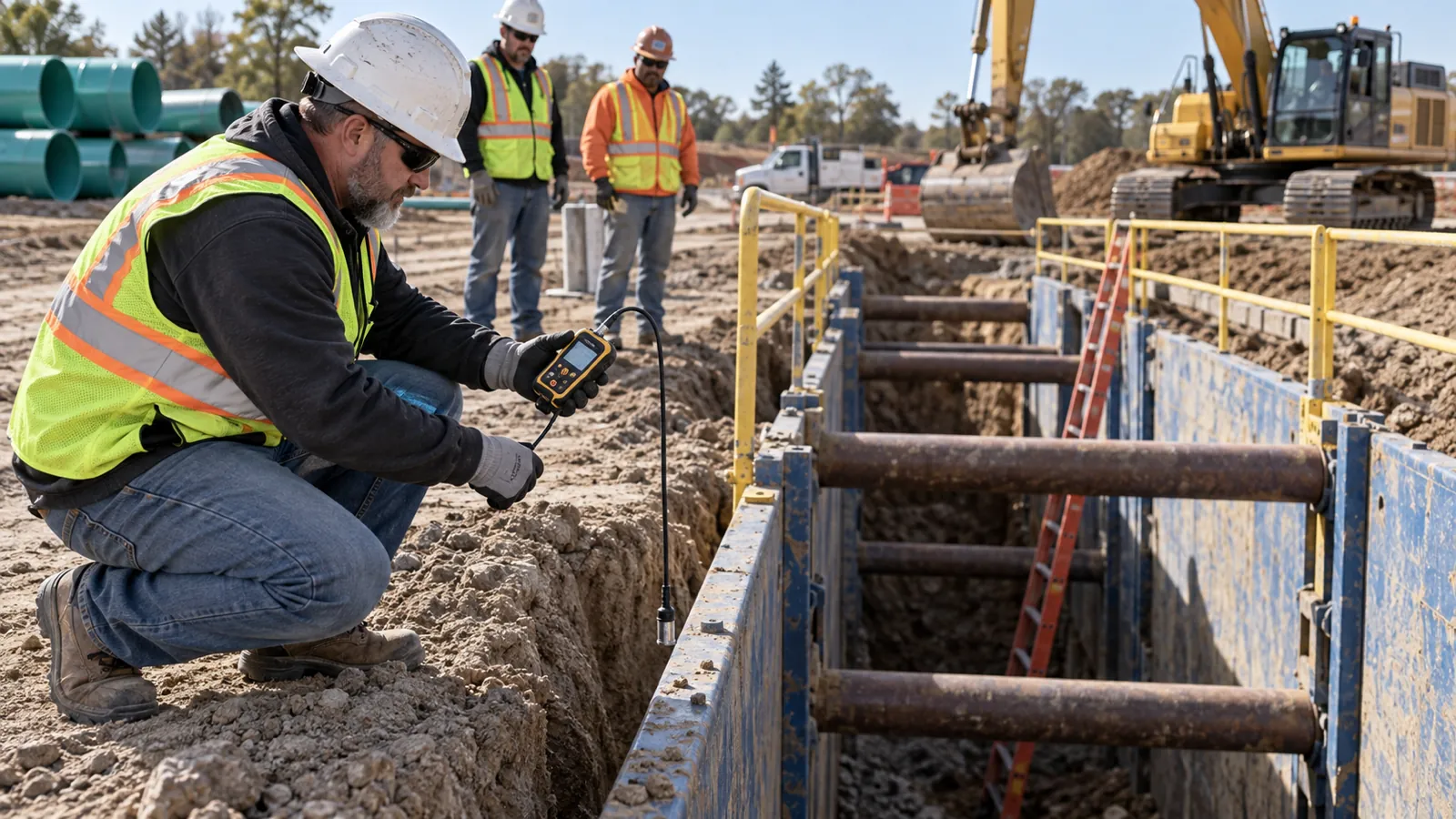
The Compliance Question
Many excavation crews think first about soil, trench depth, spoil placement, and the protective system. Those items matter every day. But an excavation can also expose workers to an atmospheric hazard, especially when the work intersects utilities, sewer systems, landfills, contaminated soil, fuel lines, industrial sites, or poorly ventilated low areas. A trench does not need to look like a confined space for the air inside it to become unsafe.
The practical compliance question is simple: before workers enter an excavation, has the employer evaluated whether the atmosphere could be hazardous, and has the Competent Person been prepared to recognize when testing, ventilation, isolation, or additional controls are needed?
OSHA Subpart P requires employers to protect workers from hazards associated with excavations. That includes cave-ins, falling loads, access and egress issues, water accumulation, adjacent structures, mobile equipment, and hazardous atmospheres. When oxygen deficiency, toxic substances, flammable gases, or other dangerous air conditions may reasonably exist, the job cannot rely on assumptions. The employer needs a plan that turns the possibility of bad air into specific field decisions.
This is where excavation safety training and Competent Person training matter. A trained crew understands that trench safety is not only about keeping soil out of the excavation. A trained supervisor understands that the conditions around the trench can change what must be inspected before entry. A trained Competent Person understands that atmospheric hazards need to be considered when the excavation environment gives warning signs or when the work scope creates exposure.
For example, a utility crew opening a trench near a sanitary sewer line may face hydrogen sulfide or oxygen deficiency. A crew excavating near a gas service may face flammable vapor concerns. A municipal public works team responding to a leak in a street may face traffic, water, unstable soil, and atmospheric concerns at the same time. A contractor working near contaminated fill or industrial property may need to consider vapors that are not visible from the surface. In each case, the trench may look ordinary until the work begins.
The mistake employers should avoid is treating atmospheric testing as a separate specialty topic that only belongs to permit-required confined spaces. Excavation crews may not be entering a tank or vault, but they can still encounter air that is oxygen-deficient, toxic, flammable, or otherwise unsafe. The better approach is to make atmospheric awareness part of the excavation planning process and to make sure supervisors know when to pause entry until the air has been evaluated.
Why This Matters on Excavation Jobsites
Hazardous atmospheres are easy to underestimate because they are often invisible. Soil movement, utility breaks, decomposing organic matter, nearby industrial processes, fuel leaks, stagnant water, and sewer connections can all change the air workers breathe. A trench can also limit natural ventilation, especially when it is deep, narrow, boxed in by a shield, or located near structures that block air movement.
That matters because excavation work already leaves little room for delay once conditions start deteriorating. If a worker feels dizzy, smells gas, or collapses in a trench, the job has already moved from prevention to emergency response. Rescue attempts can expose additional workers, especially when the crew is not trained to recognize that the atmosphere may be the cause. Employers need planning and training before that moment, not after it.
Atmospheric hazards can also interact with other trench hazards. Water accumulation can indicate a broken utility or sewer influence. Vibration and adjacent loads can change soil stability while crews are trying to solve another problem. Mobile equipment can create exhaust or fuel vapor issues near the trench. Spoil piles, plates, and equipment can limit access and make emergency retrieval harder. A protective system may reduce cave-in risk, but it does not automatically make the air safe.
Competent Persons need enough training to connect those signals. The question is not only, "Is the trench protected?" It is also, "What else could this excavation expose workers to today?" A strong inspection looks at the soil, depth, protective system, ladder placement, water, spoil piles, utilities, weather, nearby loads, and possible atmospheric hazards as parts of one jobsite picture.
OSHA excavation rules include hazardous atmosphere precautions because the hazard can be severe even when it is not common on every job. Oxygen deficiency can impair judgment quickly. Hydrogen sulfide can be dangerous at high concentrations and can dull the sense of smell. Flammable gases can create ignition hazards around tools, equipment, vehicles, or nearby work. Toxic vapors can expose workers before anyone sees a visible problem.
On busy jobsites, supervisors may feel pressure to keep entry moving. That pressure can lead to informal shortcuts: assuming the trench is safe because it is outdoors, assuming there is enough ventilation because the top is open, assuming a lack of odor means there is no concern, or assuming the utility locator process addressed every hazard. None of those assumptions replaces a hazard assessment. Training helps supervisors slow the decision down long enough to ask the right questions before entry.
This is especially important for short-duration work. Municipal repairs, service line tie-ins, small utility cuts, and emergency response excavations may feel routine because crews do them often. But routine work can create the exact pattern that leads to missed hazards. When the same crew handles similar digs every week, they may stop treating each excavation as a new set of conditions. A role-based training plan reinforces that every entry decision needs a fresh inspection.
Employers also need to think beyond the Competent Person alone. The designated Competent Person may have authority to identify hazards and take corrective action, but nearby workers should still know warning signs and stop-work expectations. Operators, laborers, foremen, spotters, and utility crew members should know that a suspected atmospheric hazard is not a personal judgment call. It is a reason to keep workers out until the situation is evaluated by someone qualified to make that decision.
What Employers and Supervisors Should Know
Employers should start by deciding when atmospheric hazards are reasonably foreseeable on their excavation work. That decision should be based on the type of work, the site history, nearby utilities, depth and configuration, surrounding structures, soil or groundwater concerns, and any known contamination or industrial use. The goal is not to test every shallow dig by habit. The goal is to make sure the crew has a consistent trigger for testing or additional review when conditions call for it.
Common situations that should raise the question include:
- Excavation near sewer lines, manholes, lift stations, vaults, tanks, or process piping.
- Excavation near natural gas, petroleum, chemical, or industrial utility corridors.
- Work in or near landfills, contaminated sites, brownfield properties, or unknown fill.
- Deep, narrow, shielded, or poorly ventilated excavations where air movement may be limited.
- Excavations where water, odor, staining, dead vegetation, unusual soil, or vapor is observed.
- Emergency utility repairs where the source of the problem is not fully known.
- Work near running engines, generators, pumps, or equipment that could introduce exhaust.
Supervisors should understand that atmospheric testing is not just a tool reading. It is a decision process. The crew needs to know who performs the test, what equipment is used, whether the monitor is calibrated or bump-tested according to the employer's program and manufacturer instructions, where readings are taken, when testing must be repeated, and what action is required if readings are outside acceptable limits.
Testing locations matter. A single reading at the surface may not tell the whole story in a deeper excavation. Some gases can collect in low areas, while others may behave differently based on their properties and site conditions. If the employer's plan calls for atmospheric monitoring, the Competent Person or assigned tester needs training on the monitor, sampling method, order of testing, alarm response, and documentation expectations.
Ventilation is another area where training matters. A fan placed near an excavation is not automatically an effective control. Supervisors need to consider whether ventilation is appropriate, where fresh air is coming from, whether equipment exhaust is being pulled toward the trench, and whether the hazard source has been isolated or controlled. Ventilation should support a planned control strategy, not serve as a quick visual substitute for understanding the hazard.
Employers also need clear stop-work rules. If a monitor alarms, if workers report symptoms, if gas odor is suspected, if utilities are struck, if unknown liquids or vapors appear, or if site conditions change, entry should pause. Workers should know that stopping entry is the expected response, not an overreaction. Competent Persons should have explicit authority to remove workers from the excavation and require corrective action before work resumes.
For Competent Person training, the atmospheric hazard topic should be tied to the broader inspection duties. It should not be taught as an isolated checklist item. The Competent Person needs to connect atmospheric questions to:
- Utility location and exposure work.
- Soil and groundwater observations.
- Protective system selection and trench configuration.
- Access and egress planning.
- Rescue and emergency planning.
- Equipment placement and exhaust control.
- Communication with contractors, utility owners, and public works staff.
Crew-level training should be simpler but still specific. Workers do not need to become industrial hygienists to understand that bad air can exist in excavation work. They do need to know what conditions are concerning, what symptoms or warning signs to report, when not to enter, and who has authority to clear the excavation for entry. They should also understand that they should not attempt a rescue into a suspected hazardous atmosphere unless they are trained, equipped, and assigned under an appropriate emergency plan.
Documentation should be practical. Employers may document pre-entry inspections, atmospheric testing results when testing is required, monitor identification, test times, corrective actions, ventilation steps, and the person responsible. The level of documentation should match the risk and the employer's program, but it should be clear enough to show that the hazard was recognized and controlled rather than guessed away.
The biggest management lesson is that atmospheric hazards need a home in the excavation safety program. If the topic only lives in a confined space binder or a separate emergency response plan, excavation supervisors may not apply it in the field. A better program tells field leaders exactly when atmospheric concerns belong in the excavation pre-entry decision.
How Training Supports a Safer Excavation Program
OSHA-aligned excavation safety training helps employers build a shared language for hazard recognition. When crews understand cave-in hazards, protective systems, access and egress, spoil placement, water, utilities, and atmospheric concerns together, they are better prepared to identify the combination of conditions that makes a trench unsafe for entry.
Competent Person for Excavation, Trenching, and Shoring Training should go deeper. It should prepare designated personnel to inspect the excavation, identify existing and predictable hazards, understand when workers must be removed, and recognize when the job requires additional controls or qualified support. Atmospheric hazard awareness fits naturally into that responsibility because it is one of the conditions that can make entry unsafe even when the trench walls appear controlled.
Good training also helps employers avoid the "one person knows everything" problem. The Competent Person may lead the inspection, but the crew sees changing conditions throughout the shift. A laborer may notice odor. An operator may expose an unknown line. A foreman may see water enter the trench. A spotter may notice equipment exhaust drifting toward the excavation. Training gives those observations a path to action.
Training should also make clear that excavation safety decisions are role-based. Owners and managers set the program. Supervisors enforce entry rules. Competent Persons inspect and take corrective action. Workers follow entry restrictions and report hazards. Equipment operators control movement, exhaust, and loads near the trench. When each role understands its part, the program becomes more reliable under schedule pressure.
For employers choosing training, the best fit is usually a combination of crew-level excavation safety awareness and deeper Competent Person instruction for designated leaders. Crew-level training helps workers recognize when something is wrong. Competent Person training helps the responsible person evaluate the condition and decide what must happen before workers enter or re-enter.
Training alone does not guarantee compliance. Employers still need site-specific hazard assessments, appropriate equipment, working monitors where required, qualified support when the hazard is outside the crew's expertise, and a clear emergency plan. But training makes those pieces more likely to be used correctly because people understand why they matter.
This is particularly valuable for contractors and municipal crews that work across changing locations. One day may involve a shallow water service repair. Another may involve a deeper trench near sewer infrastructure. Another may involve an industrial customer, a utility corridor, or unexpected groundwater. The crew's training gives them a baseline for asking, "What changed today, and does that change entry?"
Employers should review their excavation training program against the real work crews perform. If workers dig near sewer systems, gas utilities, contaminated soil, vaults, lift stations, or industrial properties, atmospheric hazard recognition should be part of the training conversation. If supervisors are expected to decide when testing is needed, they need more than a passing mention. They need enough practical instruction to apply the rule on a noisy, muddy, time-sensitive jobsite.
The strongest programs also connect training to field tools. Pre-entry forms, inspection checklists, job hazard analyses, utility coordination notes, gas monitor procedures, emergency contacts, and stop-work policies should all reinforce the same expectations. When the paperwork, training, and jobsite conversation match, workers are less likely to treat atmospheric concerns as an unusual exception.
Key Takeaway
Hazardous atmospheres are not the most visible excavation hazard, but they can be one of the most unforgiving. A trench can be protected from cave-in hazards and still be unsafe to enter if the air is oxygen-deficient, toxic, flammable, or otherwise dangerous. Employers should make sure their excavation safety program teaches supervisors, crews, and Competent Persons when atmospheric hazards must be considered, when testing or ventilation may be needed, and when entry must pause until the condition is controlled.
The right training helps turn that responsibility into field behavior. It gives workers permission to speak up, gives supervisors a consistent decision path, and gives Competent Persons the practical framework they need before workers enter the trench. For contractors, public works departments, utility crews, and employers responsible for excavation work, that preparation is a core part of keeping people safe and keeping trench work under control.
Sources
OSHA 29 CFR 1926 Subpart P, Excavations
https://www.osha.gov/laws-regs/regulations/standardnumber/1926/1926SubpartP
OSHA 29 CFR 1926.651, Specific Excavation Requirements
https://www.osha.gov/laws-regs/regulations/standardnumber/1926/1926.651
OSHA Trenching and Excavation Safety