The Compliance Question
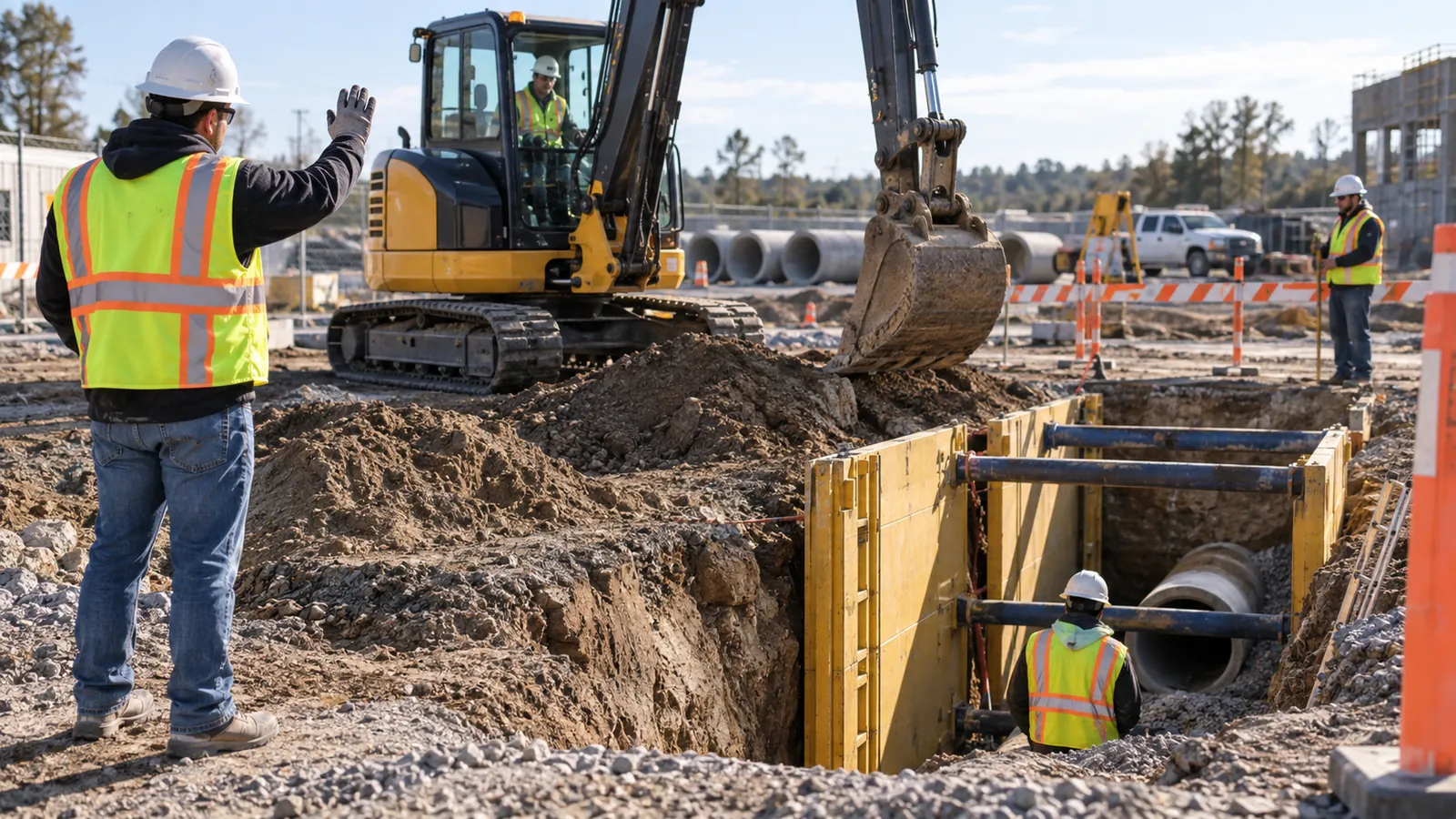
Mobile equipment can make excavation work faster, but it can also turn a trench into a much higher-risk work area in a matter of seconds. Backhoes, loaders, compactors, dump trucks, skid steers, pipe handling equipment, and service vehicles all change the way crews move around an excavation. They add weight near trench edges, limit visibility, introduce backing hazards, and create vibration that can affect soil stability. When workers are also entering, exiting, measuring, setting pipe, checking utilities, or installing protective systems, the question becomes practical and urgent: how should employers train crews to control mobile equipment risks around trenches before anyone is placed in the line of fire?
For excavation employers, the issue is not only whether the operator is trained to run the machine. The larger safety question is whether the entire crew understands how equipment movement, edge loading, access routes, spoil placement, spotter communication, barricading, and the Competent Person's inspection decisions all connect. A trench can meet basic protective system expectations and still be poorly controlled if mobile equipment is allowed to crowd the edge, swing loads over workers, block ladders, or move through a congested work zone without clear communication.
OSHA Subpart P requires employers to protect employees in excavations from cave-ins and other excavation hazards. It also addresses exposure to mobile equipment, requiring warning systems when mobile equipment approaches an excavation edge and the operator does not have a clear and direct view of the edge. That requirement matters because many excavation incidents are not caused by one dramatic failure. They come from ordinary jobsite motion: a truck easing closer for loading, a compact excavator tracking along the trench, a loader dumping too near the cut, or a worker stepping into the path of equipment because the crew did not have a shared movement plan.
The Compliance Question for employers is simple to ask and harder to execute: before work starts, has the crew been trained to recognize how mobile equipment changes trench risk, and has the site been organized so operators, spotters, laborers, foremen, and the Competent Person are working from the same plan?
That question belongs in the pre-job briefing, the daily inspection, the crew training program, and the supervisor's decision-making. It is not enough to say that everyone should "watch out." A reliable excavation safety program teaches workers what to watch for, who controls equipment movement, how warning systems are used, when equipment must stop, where workers may stand, and when the Competent Person must reassess the excavation before entry continues.
Why This Matters on Excavation Jobsites
Trenching and excavation work already involves changing ground conditions, limited work space, and serious consequences if something goes wrong. Mobile equipment adds another layer of exposure because it affects both struck-by hazards and trench stability. A worker can be struck by a moving machine, a swinging bucket, a suspended pipe, or a backing vehicle. At the same time, the weight and vibration from equipment can contribute to unstable soil conditions, especially near the edge of a trench, in previously disturbed soil, or after rain, seepage, freezing, thawing, or nearby traffic.
The danger is often made worse by the layout of the work zone. Utility repair and pipe installation jobs frequently happen in streets, parking lots, easements, plant yards, municipal rights-of-way, and active construction sites. There may be traffic control devices, spoil piles, bedding material, road plates, pumps, trench boxes, ladders, tools, survey equipment, and delivery vehicles competing for the same space. When access is tight, operators may be tempted to work close to the trench edge because it looks efficient. Crews may accept that layout because they have seen similar jobs done that way before.
That familiarity is one reason training matters. Workers need to understand that a trench edge is not just a boundary line. It is part of the support system for the excavation. Adding equipment weight too close to that edge can change the loading on the soil. Running equipment repeatedly along the same side of the trench can add vibration and disturbance. Parking a loaded truck near the trench can create a surcharge load. Swinging a bucket across the trench can expose workers below to overhead hazards. Even if the protective system is appropriate, uncontrolled equipment movement can create risks the crew did not account for when the day started.
The Competent Person plays a central role because excavation conditions must be inspected before work begins and as needed throughout the shift. Mobile equipment should be part of that inspection. The Competent Person should be looking at how machines will approach, where they will travel, whether the operator can see the excavation edge, how workers will be warned, whether spoil and materials are set back, whether ladders remain clear, and whether equipment activity has changed the condition of the trench. If the work plan changes, the inspection mindset should change with it.
Mobile equipment risk is also a communication problem. Operators may be trained and experienced, but they cannot manage what they cannot see. Workers in or near a trench may assume the operator sees them. Spotters may use hand signals that are not understood by everyone. A foreman may give a verbal instruction that is not repeated to the operator. A delivery driver may enter the work zone without knowing the crew's movement plan. Training gives the team a common language for these moments.
The most serious excavation incidents often involve a chain of missed signals. A machine gets closer than planned. A worker steps into a blind spot. A trench edge deteriorates. A ladder becomes blocked. A truck backs toward the excavation. A spotter turns away to answer a question. No single decision may look reckless in isolation, but the combined effect can put a worker in a place where there is very little time to react. A well-trained crew is better prepared to interrupt that chain before the exposure becomes immediate.
Employers should also remember that mobile equipment around trenches can create hazards for workers who are not inside the excavation. Laborers cutting pipe, inspectors checking grade, survey crews, utility locators, municipal employees, traffic control personnel, and subcontractors can all be exposed. If the excavation safety plan only focuses on the person in the trench, it misses the broader work zone. A practical plan controls the area around the trench as deliberately as the trench itself.
What Employers and Supervisors Should Know
Employers and supervisors should treat mobile equipment planning as part of excavation safety, not as a separate equipment issue. The equipment route, loading zone, spoil location, worker access path, and protective system all affect one another. A good plan answers several basic questions before the first bucket of soil is moved.
- Which machines and vehicles will operate near the excavation?
- Where will each machine travel, stage, load, dump, park, and turn?
- How far will equipment and spoil be kept from the trench edge?
- Who has authority to stop equipment movement?
- When is a spotter required?
- What warning system is used when the operator cannot clearly see the excavation edge?
- Where are workers allowed to stand during digging, loading, pipe placement, and backfill?
- How will access and egress remain open when equipment is moving?
- What changes require the Competent Person to reinspect the excavation?
These questions should not live only in a binder. They should be discussed in the field where crews can see the actual space constraints. A plan that looks reasonable on paper may not work once trucks begin arriving, material is staged, traffic control is set, or the trench box is moved. Supervisors should be ready to adjust the plan and communicate the change clearly.
One of the most important concepts is the line of fire. Workers need to recognize areas where they could be struck, pinned, caught between equipment and materials, or exposed to a collapsing edge. Around trenches, the line of fire can include the swing radius of an excavator, the backing path of a truck, the travel path of a loader, the area below a suspended pipe, the edge zone near the trench, and the route workers use to reach ladders. Training should help crews identify those areas before the task starts, not only after a close call.
Supervisors should also be careful with the phrase "spotter." A spotter is not a decorative role. If a spotter is used, that person needs a clear position, a clear signal method, authority to stop movement, and freedom from other duties that pull attention away from the equipment. The operator and spotter should agree on signals before movement begins. If visual contact is lost, equipment should stop until communication is restored. That expectation should be trained and enforced consistently.
Warning systems near excavation edges deserve the same clarity. OSHA recognizes that operators may not have a clear and direct view of the excavation edge. In those situations, warning systems such as barricades, hand or mechanical signals, or stop logs may be needed. The point is to keep equipment from unintentionally approaching an edge in a way that endangers workers or the excavation. Employers should decide which warning method fits the job and make sure the crew understands how it works.
Equipment placement also affects soil conditions. A loaded dump truck, excavator, or material delivery vehicle can impose a significant load near the edge. Supervisors should coordinate with the Competent Person when equipment needs to work close to the excavation. Soil type, trench depth, protective system design, surcharge loads, vibration, water, and adjacent structures all matter. If the plan requires unusual equipment positioning, the answer should not be guesswork. It may require manufacturer instructions, tabulated data, engineered guidance, or a different work sequence.
For crew-level training, the goal is practical recognition. Workers do not need to become engineers to understand that equipment weight and vibration can change excavation risk. They do need to know when to speak up, when to move out of the area, when to keep clear of the swing radius, when to stay out from under loads, and when conditions have changed enough to call for the Competent Person.
For Competent Person training, the expectations go deeper. The Competent Person should understand how mobile equipment interacts with soil classification, protective systems, spoil placement, access and egress, water accumulation, atmospheric concerns, and changing conditions. They should know how to evaluate the excavation as the work progresses, not just at the start of the day. They should also be able to communicate decisions to operators and supervisors in a way that can be followed in the field.
Documentation can support the program, but it should be meaningful. Employers may document pre-job briefings, daily inspections, equipment routes, traffic control coordination, spotter assignments, and corrective actions. Records are most useful when they show that the employer recognized the hazard, trained the right people, and adjusted the work as conditions changed. A checkbox that says "equipment discussed" is weaker than a field note showing that the crew moved spoil back, added a spotter, changed the truck loading location, or stopped work until the trench was reinspected.
Supervisors should pay special attention during transitions. Many exposures happen when the job moves from digging to setting pipe, from pipe setting to backfill, from backfill to compaction, or from one trench box location to the next. During transitions, workers may leave familiar positions, equipment may change direction, and the Competent Person may need to reassess the excavation. A short pause to reset the movement plan can prevent confusion.
How Training Supports a Safer Excavation Program
OSHA-aligned Excavation, Trenching and Shoring Safety Training helps workers connect the rules to the real work happening around them. It gives crew members a framework for recognizing trench hazards, understanding protective systems, maintaining safe access, watching for changing conditions, and respecting the role of the Competent Person. When mobile equipment is part of the job, that training helps workers see why an excavation is not safe simply because a trench shield is present. The surrounding work zone also has to be controlled.
Training supports consistency. Without it, each foreman, operator, or crew may handle equipment movement based on habit. One crew may use a spotter every time trucks back near the trench. Another may only use a spotter when the area feels crowded. One operator may keep a cautious distance from the edge. Another may work closer because the soil looked firm yesterday. Training creates a shared baseline so crews are less dependent on memory, personality, or luck.
Competent Person for Excavation, Trenching and Shoring Training is especially important because the Competent Person must be able to identify existing and predictable hazards and take prompt corrective measures. Around mobile equipment, that responsibility can include recognizing surcharge loads, vibration, blocked access, poor visibility, unsafe worker positions, changing soil conditions, water accumulation, and warning-system gaps. The Competent Person may need to stop entry, move equipment, adjust the work sequence, or require additional controls before work resumes.
Good training also helps employers build role-based expectations. Operators need to understand the excavation plan and the limits of their visibility. Laborers need to understand where they may stand and when to stay out of the line of fire. Spotters need to understand signals and stop authority. Supervisors need to coordinate schedule pressure with safety controls. The Competent Person needs to evaluate the excavation and act when conditions change. When each role understands its part, the crew is less likely to rely on vague warnings.
Employers should consider including mobile equipment scenarios in toolbox talks and refresher discussions. These do not need to be complicated. A supervisor can walk the crew through the day's trench, point out the equipment route, identify blind spots, mark the edge control method, assign a spotter, and ask what will happen if the truck staging area changes. That conversation turns training into jobsite behavior.
Training can also improve how crews respond to near misses. If a truck backs too close to a trench or a worker steps into an excavator swing area, the response should be more than frustration. The crew should ask what control failed. Was the route unclear? Was the spotter distracted? Was the worker access path poorly placed? Did the operator lack visibility? Was the edge warning system missing? A trained crew can turn a near miss into a program improvement instead of treating it as a one-time scare.
It is important to say what training does not do. Training by itself does not guarantee compliance, and it does not replace the need for site-specific planning, competent inspections, protective systems, traffic control, equipment maintenance, supervision, or engineering support when required. But training gives employers and crews the knowledge base they need to make those controls work. It helps people recognize when the plan no longer matches the job.
For excavation contractors, utility crews, public works departments, general contractors, and site supervisors, that knowledge is part of operational control. Mobile equipment will almost always be present on trenching jobs. The practical question is whether it is treated as a normal tool or as a hazard source that must be planned, communicated, and inspected. OSHA-aligned training helps move the crew toward the second mindset.
Key Takeaway
Mobile equipment around trenches creates a combined hazard: workers can be struck by machines or loads, and the excavation itself can be affected by equipment weight, vibration, and poor edge control. Employers should not leave those risks to informal habit. Before workers enter or work near a trench, crews should know the equipment route, the edge controls, the spotter plan, the warning system, the safe worker positions, and the conditions that require a Competent Person to pause and reinspect.
The right training helps make those expectations visible. Crew-level Excavation, Trenching and Shoring Safety Training helps workers recognize line-of-fire hazards and changing excavation conditions. Competent Person training helps supervisors and designated personnel evaluate the trench, protective systems, soil conditions, equipment activity, and corrective actions with more confidence. When the people closest to the work understand how mobile equipment changes trench risk, they are better prepared to stop a bad setup before it becomes an incident.