
The Compliance Question
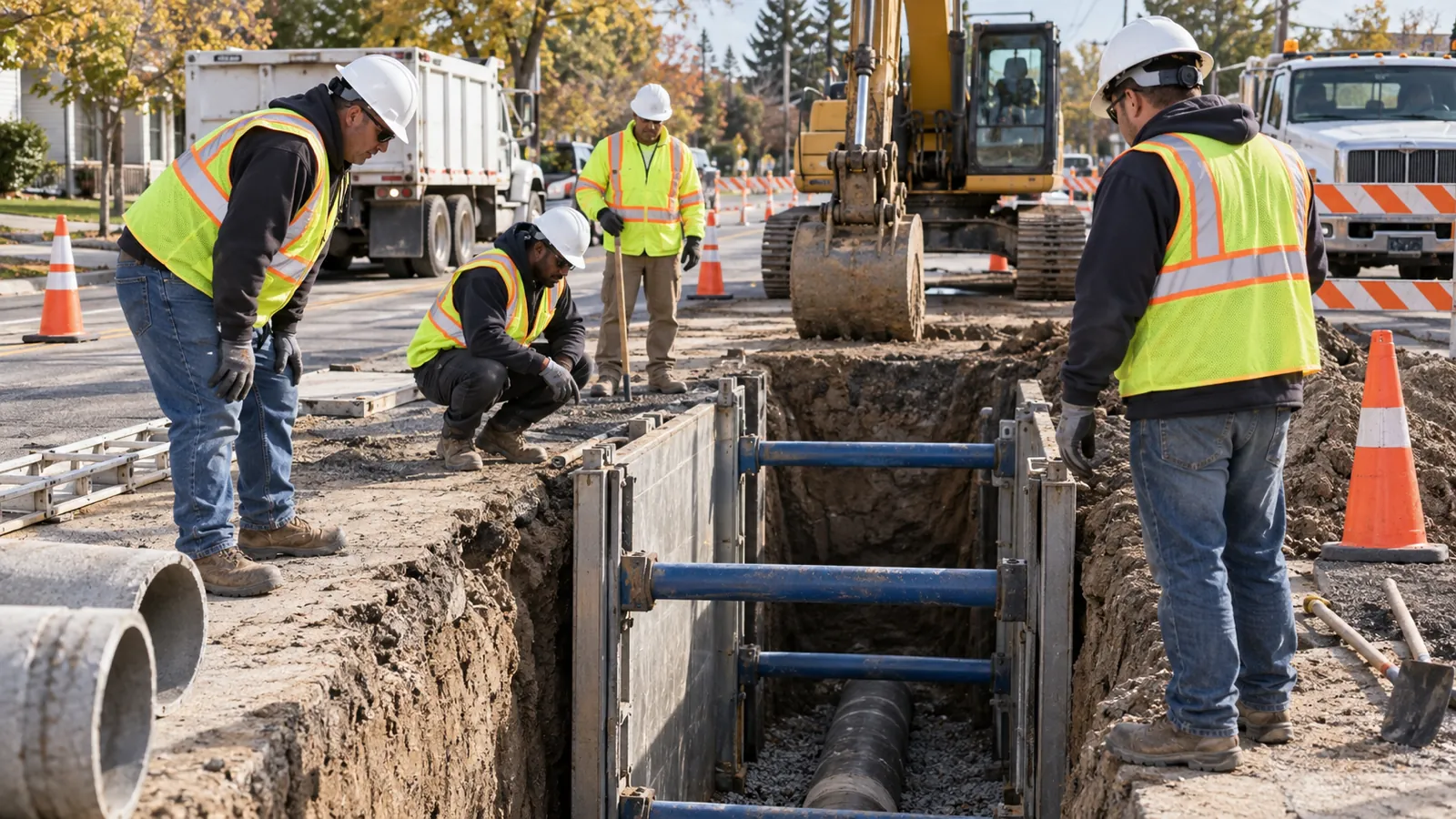
A municipal water leak, a storm drain repair, a sewer service cut, or a small utility patch can feel very different from a large construction excavation. The job may be measured in hours instead of weeks. The crew may be working from a service truck instead of a full project trailer. The work area may sit in a residential street, beside parked vehicles, around traffic control, under pressure from residents, or near public infrastructure that has to be restored quickly. Because the job looks routine, it is easy for supervisors and crew members to treat the excavation as a maintenance task first and a trenching hazard second.
That is exactly where many public works excavation risks begin. OSHA excavation expectations do not disappear because a trench is short, familiar, or opened by a municipal crew. If workers enter an excavation, the employer still has to evaluate the hazards, provide safe access and egress where required, protect workers from cave-in hazards, control water and changing conditions, keep spoil and equipment from adding unnecessary load to the edge, and ensure a Competent Person is able to identify hazards and take prompt corrective action.
Short-duration utility work can compress all of those decisions into a tight window. A crew may arrive to fix a broken service line before the morning commute, open pavement, expose a pipe, make repairs, backfill, patch the road, and move to the next call. The work may be familiar, but the soil, depth, weather, nearby traffic, underground congestion, and vibration can change from block to block. A job that begins as a shallow pothole can become a trench. A repair that starts with dry soil can encounter seepage. A spot that looked stable during setup can be affected by passing trucks, nearby structures, or old fill.
For municipal employers, the compliance question is not whether the work is public or private. The question is whether the people planning, supervising, and performing the job understand excavation hazards well enough to pause at the right time, choose the right protective approach, and document the decisions that matter before entry. That is a training question as much as it is a field supervision question.
OSHA-aligned Excavation, Trenching & Shoring Safety Training helps crew members recognize the hazards they are likely to encounter during utility repair work. Competent Person for Excavation, Trenching & Shoring Training goes deeper for the employees expected to inspect conditions, classify soils, evaluate protective systems, and stop or correct unsafe work. Municipal operations often need both levels because a safe program depends on trained workers and qualified decision-makers.
Why This Matters on Excavation Jobsites
Public works crews handle excavation conditions that can be deceptively complicated. A private contractor may mobilize for a planned project with drawings, preconstruction meetings, and a full staging plan. A municipal crew may be dispatched because a resident has low water pressure, a sinkhole appeared near a curb, a catch basin collapsed, or a hydrant lead failed. The work is urgent, visible, and often surrounded by the public. That urgency can make it tempting to focus on restoring service before fully controlling the excavation.
Trench safety has little patience for familiar routines. Soil can fail suddenly, and even a small excavation can become dangerous when workers kneel, bend, climb, or lean into the opening to repair a pipe or fitting. Older utility corridors may contain layered pavement, disturbed backfill, previous patches, abandoned lines, and mixed soils that do not behave like undisturbed ground. A crew may expose water, sewer, gas, electric, communication, stormwater, or unknown utilities in the same small cut. Each discovery can change the hazard picture.
Municipal trench work also tends to happen in places where space is limited. Spoil piles may be placed too close to the edge because the lane is narrow. Equipment may work near the trench because there is nowhere else to stage. Traffic control devices, plates, saw-cut edges, curbs, sidewalks, and nearby structures may all compete for room. If the crew does not understand how edge loading, vibration, and access affect trench safety, a quick repair can become a high-risk excavation.
Water is another common problem. Utility repairs often begin because water is already present. A broken line, leaking valve, storm inlet failure, or saturated subgrade can weaken the excavation walls before the crew starts digging. Dewatering may be needed, but removing water does not automatically make the excavation safe. The Competent Person still has to evaluate soil stability, sloughing, seepage, tension cracks, bottom heave, and whether the protective system remains appropriate.
The public setting adds pressure. Residents may ask when service will return. Drivers may push around traffic control. Supervisors may want the street reopened before peak traffic. Other departments may be waiting for the repair to finish. Those pressures are real, but they cannot replace excavation safety decisions. A trained crew is better prepared to explain why a trench box must be set, why workers cannot enter yet, why a ladder must be repositioned, or why conditions require a new inspection.
Short-duration work also creates documentation challenges. If a city, county, utility district, or public authority relies on informal habits, it may be difficult to show that crews inspected the excavation, confirmed protective system decisions, checked access and egress, controlled spoil piles, reviewed utility conflicts, and responded to changing conditions. Good documentation does not need to turn every repair into a paperwork exercise, but it should capture the decisions that prove the employer treated the excavation as a serious hazard.
The consequences of getting this wrong are severe. A trench incident can injure workers, endanger rescuers, interrupt public service, close roads, trigger investigations, create liability, and damage community trust. A preventable event can also expose gaps in training, supervision, equipment availability, and municipal excavation procedures. The better approach is to train crews before the emergency call arrives, so the field team already knows what must happen when the pavement opens.
What Employers and Supervisors Should Know
Municipal employers should start by separating speed from informality. A utility repair can be fast and still be controlled. The crew can mobilize efficiently and still identify underground utilities, select appropriate protective equipment, set traffic control, keep spoil back, provide access, and verify conditions before entry. The problem is not speed itself. The problem is speed without a shared safety process.
Supervisors should know which employees are expected to act as the Competent Person for excavation work. That person must be able to identify existing and predictable hazards, recognize conditions that are hazardous or dangerous to employees, and take prompt corrective measures. In a municipal setting, the Competent Person may be a foreman, utility supervisor, lead worker, or another designated employee. The title matters less than the authority and training behind the role.
Crew members should understand that the Competent Person is not simply filling out a form. The role includes field judgment. Soil conditions have to be evaluated. Protective systems must match the excavation conditions. Access and egress must be placed and maintained. Water, vibration, adjacent loads, utilities, and changing weather must be considered. If conditions change, the inspection decision changes too.
Municipal repair crews should also be trained on the difference between observing a hazard and correcting a hazard. A worker may notice cracks, sloughing soil, water collecting in the bottom, a ladder that is too far from the work area, or a spoil pile crowding the edge. That observation only improves safety if the worker knows to communicate it and if the supervisor has authority to act. Training should make reporting normal, not awkward.
Employers and supervisors should pay close attention to the following areas:
- Dispatch planning: Crews should know what information to gather before excavation, including location, suspected utility type, emergency conditions, traffic exposure, known soil or pavement issues, and whether special equipment may be needed.
- Utility locating and exposure: Crews should understand that municipal familiarity with an area does not replace careful locating, safe exposure methods, and ongoing awareness of unknown or abandoned lines.
- Protective system readiness: Trench boxes, shoring equipment, hydraulic systems, sloping or benching plans, and manufacturer guidance should be available before workers need them, not improvised after the trench is already open.
- Access and egress: Ladders, ramps, or other safe means must be planned so workers are not climbing pipe, shields, pavement edges, or equipment to enter and exit the excavation.
- Spoil and equipment placement: Spoil, tools, plates, compactors, excavators, service trucks, and repair materials should be positioned so they do not increase trench wall stress or create falling-object hazards.
- Traffic and public protection: Traffic control should protect workers from vehicles while also keeping the excavation work zone organized enough for safe access, inspection, and equipment movement.
- Water control: Crews should know how leaks, seepage, stormwater, groundwater, and dewatering can affect soil stability and whether entry should be delayed.
- Communication: Public works repair jobs often involve operators, laborers, inspectors, supervisors, traffic control staff, and sometimes contractors. Everyone should know who is making excavation safety decisions.
Training should also address the municipal tendency to rely on experience alone. Experienced public works employees are valuable because they know the system, the neighborhoods, the repair history, and the practical realities of field work. But experience without current excavation safety training can become overconfidence. A worker who has repaired similar lines for years may still encounter a different soil profile, deeper cut, nearby structure, or water condition that changes the protective system decision.
Supervisors should not assume that every employee understands OSHA Subpart P expectations because they have worked around excavation before. Many workers learn by watching the previous crew. That can pass along good habits, but it can also preserve shortcuts. Formal OSHA-aligned training gives the employer a common baseline and helps crews understand why certain actions are required even when the job appears simple.
Competent Person training is especially important for municipalities because repair work may happen across scattered locations with limited direct oversight. A supervisor cannot be everywhere at once. The field lead at the excavation must know when to proceed, when to stop, when to call for additional equipment, and when conditions exceed the original plan. That is not a paperwork role. It is a safety-critical decision role.
How Training Supports a Safer Excavation Program
OSHA-aligned excavation safety training supports municipal employers by giving crews a shared language for trench hazards. Instead of treating each repair as a one-off problem, trained workers learn to recognize repeating categories of risk: cave-ins, utility strikes, hazardous atmospheres where applicable, water accumulation, falling materials, mobile equipment exposure, access and egress problems, and changing conditions. That shared language helps crews communicate faster in the field.
Crew-level Excavation, Trenching & Shoring Safety Training should help workers understand what to watch for before and during entry. Workers should know why they cannot assume a shallow cut is safe, why disturbed backfill matters, why a trench shield must be used correctly, why no one should work outside the protection of a shield when protection is required, and why a ladder or ramp is part of the safety setup rather than an afterthought. This kind of training is practical because it connects directly to what workers see during a repair.
Competent Person for Excavation, Trenching & Shoring Training supports the employees responsible for higher-level decisions. Those employees need to understand inspection duties, soil classification concepts, protective system selection, manufacturer limits, sloping and benching limits, shoring and shielding considerations, water hazards, and the authority to remove workers from danger. They also need to understand that a Competent Person inspection is not a single moment at the beginning of the day. Inspections are tied to conditions, and conditions can change quickly during public works excavation.
For municipal operations, training should be paired with practical program controls. A training class can improve knowledge, but the employer still needs procedures, equipment, and supervisory expectations that let workers use that knowledge. If a crew is trained to recognize the need for a trench box but the box is unavailable, the system will still fail. If a Competent Person is trained to stop work but feels pressure to reopen a road at any cost, the authority is not real. If workers are trained to report water or cracking but supervisors dismiss the concern, the training message weakens.
A stronger municipal excavation program often includes:
- A clear rule for when a Competent Person must be assigned to a repair excavation.
- A pre-entry inspection checklist sized for field use, not buried in a binder.
- Ready access to trench shields, shoring equipment, ladders, pumps, plates, barricades, and traffic control resources.
- A process for escalating when the repair is deeper, wetter, wider, more congested, or more unstable than expected.
- Refresher training for seasonal crews, new hires, transferred employees, and employees returning to excavation work after time away.
- Supervisor coaching so safety expectations survive schedule pressure and public complaints.
Training also helps public works departments standardize expectations across crews. Without a common baseline, one crew may set a shield as soon as the cut reaches a certain depth while another crew waits until after the pipe is exposed. One supervisor may insist on moving spoil back while another accepts a narrow margin. One employee may know how to recognize Type C soil conditions while another only notices when the wall begins to move. A consistent training program reduces those differences.
Training can also support better contractor oversight. Municipalities often use contractors for larger repairs, emergency support, paving, utility locating, bypass pumping, or specialty shoring. Public owners and supervisors still need enough excavation safety knowledge to recognize when contractor activity creates concern near municipal employees or public infrastructure. Training helps municipal staff ask better questions, set clearer expectations, and avoid assuming that another party has controlled every hazard.
The goal is not to turn every utility repair into a classroom exercise. The goal is to make safe decisions ordinary. Before workers enter, the crew should already expect a Competent Person inspection. They should already understand that protective systems are planned, not optional. They should already know where ladders go, how spoil piles are controlled, how water changes the job, and why a change in conditions means another look. Training makes those expectations normal before the pressure of an active repair begins.
Employers should also be careful with language around training outcomes. Excavation, Trenching & Shoring Safety Training and Competent Person training can support OSHA-aligned practices, hazard recognition, and better decision-making. Training alone does not guarantee compliance, and it should not be presented as a credential from OSHA or as approval or endorsement by OSHA. Compliance depends on applying the training through field conditions, equipment, supervision, documentation, and corrective action.
Key Takeaway
Municipal utility repair trenches deserve the same seriousness as larger excavation projects because the hazards do not shrink just because the job is familiar or short. Public works crews often face tight streets, damaged utilities, disturbed soils, water, traffic, public pressure, and changing conditions in a compressed work window. Those conditions make training more important, not less.
Employers should make sure crew members understand excavation hazards before they arrive at the repair site, and they should make sure designated Competent Persons have the training and authority to inspect conditions, select protective measures, and stop unsafe entry. When the right people are trained, short-duration utility repairs can move faster with fewer surprises because crews know what must be controlled before anyone gets into the trench.