
The Compliance Question
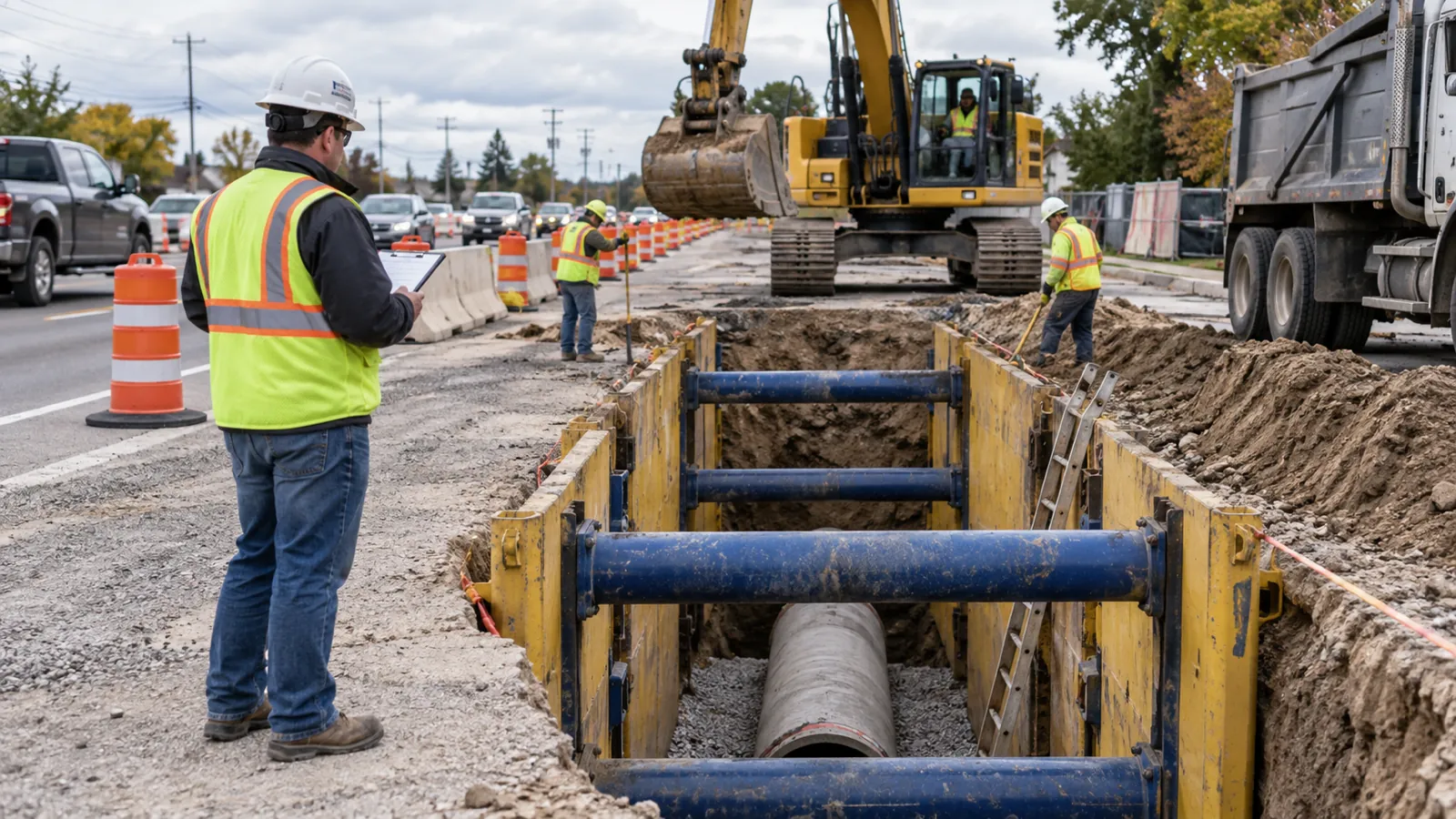
Roadway excavation work asks crews to manage two serious hazards at once. The trench or excavation must be evaluated for cave-in potential, protective systems, access, spoil placement, utilities, water, inspections, and changing ground conditions. At the same time, workers may be operating beside live traffic, delivery trucks, dump trucks, public works vehicles, backing equipment, pedestrians, cyclists, and drivers who do not understand the jobsite layout. For employers, this is not a separate traffic problem sitting beside an excavation problem. It is one work area where vehicle exposure can affect the safety of everyone near the trench.
The practical compliance question is simple: before workers enter or work near a roadway excavation, have supervisors trained the crew to control both the excavation hazards and the traffic exposure around it? A safe trench can become a dangerous workplace if vehicles are allowed to pass too close, if spoil is placed where it blocks sight lines, if crews climb in and out near moving equipment, or if public traffic is routed through a work zone without clear separation.
OSHA excavation requirements include attention to vehicular traffic, falling loads, spoil placement, means of access and egress, inspections by a competent person, and protection from cave-ins. Roadway work also depends on a traffic control plan that gives drivers, workers, and pedestrians clear direction. The details vary by project, agency, location, and traffic volume, but the training issue remains steady: crews must know who controls the excavation, who controls traffic exposure, when entry pauses, and what conditions require correction before work continues.
This is especially important for utility contractors, municipal public works crews, pipeline repair teams, site contractors, and general contractors managing subcontractors in public rights-of-way. Roadway excavation jobs are often short, urgent, and crowded. A crew may open pavement in the morning, expose a line before lunch, adjust trench protection after soil conditions change, receive trucks throughout the day, and restore traffic flow before the shift ends. That pace can tempt teams to treat traffic control as cones and signs only. In reality, it is a working system that must be inspected, maintained, and coordinated with excavation safety decisions.
Training helps supervisors and Competent Persons ask better questions before the first worker steps near the edge. Are vehicles separated from the excavation? Are workers protected from traffic and equipment? Is spoil located so it does not surcharge the trench wall or block visibility? Are ladders, ramps, or other access points placed where workers do not have to step into a traffic path? Are spotters, flaggers, and equipment operators using agreed signals? Is the protective system compatible with the available work space? Has the crew discussed what changes if traffic control devices are struck, moved, or ignored?
Those questions sound ordinary, but they are the difference between a crew that reacts to hazards and a crew that has a plan.
Why This Matters on Excavation Jobsites
Traffic exposure changes the way excavation hazards show up. In an open field, the Competent Person may focus on soil type, trench depth, water, spoil distance, nearby vibration, utilities, and the protective system. In a roadway, those same issues remain, but the work area is compressed by lanes, shoulders, sidewalks, driveways, parked vehicles, equipment staging, and public access. There may be less room to slope, bench, store excavated material, position a trench box, or maintain clean access and egress.
Vehicle movement can also create changing conditions. Heavy trucks, buses, loaders, compactors, and nearby traffic can add vibration and surcharge loads. A dump truck parked too close to an excavation can increase pressure near the edge. Passing vehicles can distract workers, push air and debris through the work area, or create a line-of-fire exposure for crews handling tools and materials. Even a well-built protective system does not remove the need to control traffic around the excavation.
Roadway excavations also bring more people into the hazard zone. A crew may include equipment operators, laborers, pipe layers, inspectors, flaggers, utility locators, municipal representatives, truck drivers, and subcontractors. Some of them may be trained in excavation safety, some may be trained in traffic control, and some may only be present briefly. Without a shared plan, the work zone can drift into confusion. One person thinks the flagger controls access. Another thinks the Competent Person controls all entry. A truck driver follows an old route. A worker moves a cone to make room for a spoil pile. A pedestrian walks through an opening because the barrier line was broken for a delivery.
These are not paperwork problems. They are operational problems with real consequences:
- A worker can be struck by public traffic or backing equipment while checking the trench edge.
- Spoil can be placed too close because the crew is trying to keep a lane open.
- A ladder can be located where workers exit into a vehicle path.
- A protective system can be delayed because there is not enough room to stage panels, shields, or hydraulic shoring.
- A trench inspection can miss traffic-related changes such as vibration, edge cracking, shifted barriers, or new surcharge loads.
- Emergency access can be blocked by parked trucks, stockpiled material, or poorly planned staging.
The Competent Person must be able to identify existing and predictable excavation hazards and take prompt corrective measures. On a roadway excavation, that means the inspection should look beyond the trench wall. It should include how the work zone is functioning around the excavation: vehicle routes, pedestrian routes, spoil placement, equipment swing areas, access points, lighting, visibility, communication, and changing public conditions.
Productivity also depends on getting this right. A clear work zone lets the crew move with confidence. Trucks know where to enter and leave. Operators know where people should not stand. Workers know which access point to use. Supervisors can pause entry without debating authority. The job is less likely to lose time to near misses, damaged traffic control devices, blocked access, or rework caused by poor staging.
What Employers and Supervisors Should Know
Employers should treat roadway excavation safety as a coordinated plan, not as two separate checklists. Excavation controls and traffic controls affect each other. If the traffic setup leaves no room for safe spoil placement, the excavation plan is incomplete. If the trench box can only be set by swinging over a lane where workers are standing, the equipment plan is incomplete. If the crew can only reach the ladder by stepping around a barricade into moving traffic, access and egress planning is incomplete.
A strong pre-entry discussion should cover both roles and boundaries. The Competent Person is responsible for excavation hazard recognition and corrective action within the scope of the employer's program. Traffic control responsibilities may involve supervisors, qualified flaggers, public agencies, or traffic control subcontractors. The crew does not need a confusing chain of command. They need to know who has authority to stop entry, who can adjust the traffic control layout, who communicates with operators and truck drivers, and who confirms that conditions are acceptable before work resumes.
For many employers, the most useful training starts with the layout. A supervisor can walk the crew through the work zone and ask them to identify:
- The excavation edge and the restricted area around it.
- The selected protective system or the reason one is not required for that specific condition.
- The access and egress points workers will use.
- The vehicle travel paths for public traffic, dump trucks, service trucks, and mobile equipment.
- The location of spoil piles, pipe, plates, shoring components, trench boxes, pumps, and tools.
- The areas where workers are prohibited from standing.
- The communication method for backing, lifting, trench entry, and emergency changes.
That conversation should happen before the work area becomes crowded. Once trucks arrive and pavement is opened, crews tend to solve problems in the moment. Training gives them a shared framework before pressure builds.
Supervisors should also understand how traffic exposure can influence common OSHA excavation concerns. Spoil must be controlled so material does not fall or roll into the excavation and so it does not create unnecessary pressure at the edge. Workers must be protected from falling loads and should not be beneath loads handled by lifting or digging equipment. Means of egress must be arranged so employees can leave the trench without unnecessary delay. Inspections are required before work begins and as needed throughout the shift when conditions change. Public traffic, equipment vibration, rain, utility work, and moved barriers can all create reasons to recheck the excavation.
The traffic-control side needs equal discipline. Cones, drums, barricades, signs, flaggers, temporary markings, and barriers are only effective if they are placed, maintained, and respected. A cone line that has been pushed aside for deliveries may no longer separate workers from vehicles. A flagger without a clear escape path is exposed. A sign hidden behind a dump truck does not guide drivers. A pedestrian route that leads people toward a trench edge creates a new hazard. Training should make workers comfortable reporting these conditions immediately rather than stepping around them.
Employers should also watch for the handoff moments. Many roadway excavation incidents are set up during transitions:
- When the crew opens the excavation and shifts from pavement removal to trench work.
- When a dump truck arrives and the spoil plan changes.
- When the protective system is installed or moved.
- When public traffic patterns change during peak hours.
- When a utility representative, inspector, or subcontractor enters the work area.
- When lighting fades or weather reduces visibility.
- When the crew plates the excavation or prepares for restoration.
Each transition deserves a quick reset. The question is not whether the original plan was good. The question is whether the current field condition still matches the plan.
Training should also address documentation. For roadway excavation work, documentation does not need to become a binder exercise to be useful. A practical record may include the daily excavation inspection, the name of the Competent Person, protective system notes, soil and water observations, access and egress checks, traffic control setup confirmation, corrections made, and any stop-work decisions. If a public agency, general contractor, or owner requires additional traffic control documentation, supervisors should know how that document connects to the excavation plan.
How Training Supports a Safer Excavation Program
OSHA-aligned excavation training helps workers understand the hazards that make trenching and excavation work different from ordinary site activity. It gives crews language for cave-in hazards, protective systems, soil conditions, spoil placement, access and egress, utilities, hazardous atmospheres, water accumulation, inspections, and emergency planning. That foundation matters on roadway projects because the crew must make decisions quickly while the work area is active.
Competent Person training goes deeper. The designated Competent Person needs to understand how to recognize excavation hazards, evaluate conditions, and take prompt corrective measures. On roadway excavation projects, that role often includes recognizing when traffic exposure has changed the excavation risk. For example, a protective system may be in place, but a truck staged near the edge, vibration from passing traffic, or a relocated spoil pile may still require action. A trained Competent Person is more likely to pause, reassess, and correct conditions before workers continue.
Crew-level training is also essential because the Competent Person cannot see everything at every moment. Workers need to know what to report. They should recognize when a barrier has shifted, when public traffic is too close, when a ladder location has become unsafe, when spoil is creeping toward the edge, when an operator cannot see a ground worker, or when a pedestrian route is unclear. A crew that understands the plan can help maintain it.
For employers building an excavation safety program, roadway traffic exposure should be built into job planning rather than treated as an afterthought. Training can support that program in several practical ways:
- It gives supervisors a consistent pre-job briefing structure.
- It helps crews understand why traffic control and trench protection must be coordinated.
- It clarifies the difference between general awareness training and Competent Person responsibilities.
- It improves communication between excavation crews, equipment operators, flaggers, inspectors, and subcontractors.
- It supports better documentation of inspections, changes, and corrective actions.
- It helps managers evaluate whether a crew is ready for roadway trenching work or needs additional supervision.
Training alone does not guarantee compliance, and it does not replace project-specific engineering, traffic control planning, or employer oversight. It does, however, make the employer's safety expectations more visible. Workers learn what safe setup looks like. Supervisors learn what must be verified before entry. Competent Persons learn when changed conditions require action. Managers gain a stronger basis for assigning the right people to the right tasks.
The best programs make this practical. A training discussion for roadway excavation should not stop at definitions. It should use examples the crew will recognize: a dump truck that wants to back beside a trench, a cone line moved for driveway access, a trench shield staged in a narrow lane, a ladder positioned too close to traffic, a spoil pile placed where it blocks a flagger's view, or a pedestrian path that crosses near the excavation. When workers can connect the rule to the job they are about to perform, training becomes part of the work rather than a separate event.
Employers may also benefit from role-based training. Laborers need to understand entry rules, access, reporting, and line-of-fire hazards. Operators need to understand worker locations, swing radius, backing procedures, and spoil placement. Supervisors need to coordinate production, traffic control, and excavation safety. Competent Persons need to inspect, identify hazards, and take corrective action. Owners and operations managers need to schedule work in a way that allows safe setup, not just fast mobilization.
This is where Excavation, Trenching and Shoring Safety Training and Competent Person for Excavation, Trenching and Shoring Training can support a stronger field program. The goal is not to turn every worker into an engineer or traffic-control designer. The goal is to make sure the people planning, supervising, entering, and supporting the excavation understand the hazards well enough to prevent avoidable exposure.
Key Takeaway
Roadway excavations demand more than a trench inspection and more than a row of cones. They require a coordinated plan for excavation hazards, vehicle exposure, spoil placement, access, protective systems, communication, and changing conditions. Employers should make sure supervisors and crews understand how traffic exposure can affect trench safety before workers enter or work near the excavation.
The right training helps crews recognize when the plan is working and when it needs to stop and reset. For construction companies, utility contractors, municipal public works departments, and excavation crews, that is a practical investment in safer production. Get the right people trained before roadway trenching work begins, especially the supervisors and designated Competent Persons who will be expected to make field decisions when traffic, equipment, soil, and schedule pressure all meet at the same excavation.
Sources
OSHA 29 CFR 1926 Subpart P, Excavations
https://www.osha.gov/laws-regs/regulations/standardnumber/1926/1926SubpartP
OSHA 29 CFR 1926.651, Specific Excavation Requirements
https://www.osha.gov/laws-regs/regulations/standardnumber/1926/1926.651
OSHA Highway Work Zones Publications
https://www.osha.gov/publications/bytopic/highway-work-zones
Federal Highway Administration Manual on Uniform Traffic Control Devices