
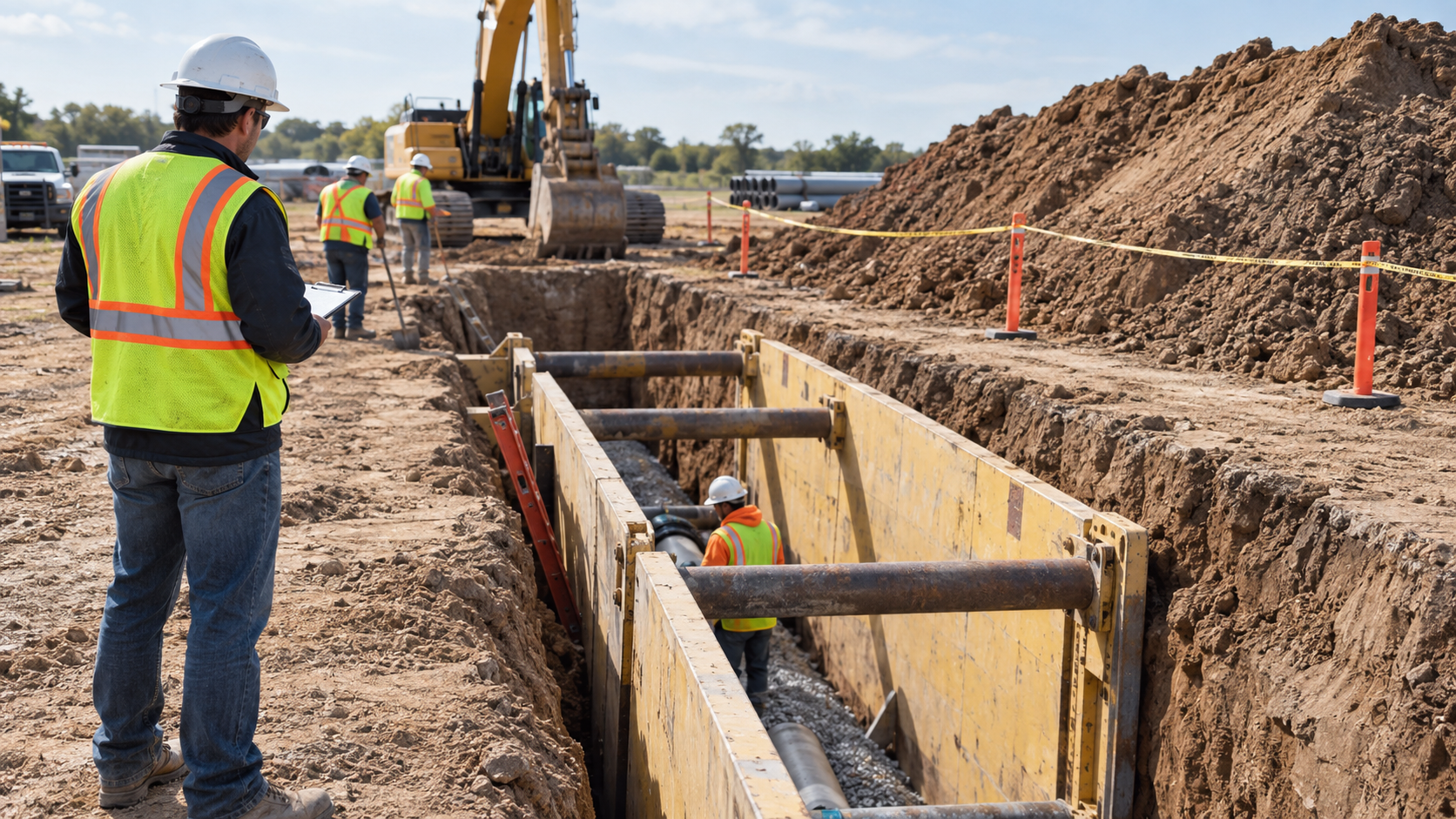
The Compliance Question
When an excavation crew opens a trench, the soil coming out of the ground becomes part of the safety
plan. The question is not only whether a protective system is installed. Employers and supervisors
also have to ask where the excavated material, pipe, bedding stone, plates, traffic control devices,
and equipment will sit while people are working near or inside the trench.
Spoil pile placement can look like a housekeeping issue, but on a trenching job it directly affects
cave-in risk, access, visibility, drainage, and the ability of a Competent Person to evaluate
changing conditions. A pile that is too close to the edge can add weight to the trench wall, create
loose material that rolls back into the opening, and make it harder for workers to climb out
quickly. A pile that blocks a walkway or ladder can also turn a controlled excavation into a rushed,
cluttered work area.
OSHA-aligned excavation training should help crews understand why the two-foot rule for keeping
spoil and materials back from the edge matters, how surcharge loads affect soil behavior, and why
the Competent Person has to look at the entire excavation setup before entry. The goal is practical
judgment. Workers do not need to become geotechnical engineers, but they do need to recognize when
the job layout is adding avoidable pressure to a trench wall.
Why This Matters on Excavation Jobsites
Cave-ins remain one of the most serious hazards in excavation work because soil can fail suddenly
and with enough force to trap, crush, or bury a worker before a crew can react. Protective systems
such as trench shields, shoring, sloping, and benching are chosen to control that hazard, but the
surrounding jobsite can either support the plan or undermine it. Spoil piles are one of the most
common surrounding conditions crews create themselves.
A clean spoil layout helps the Competent Person inspect the trench edge, identify tension cracks,
monitor water accumulation, and confirm that access and egress remain clear. It also gives equipment
operators, spotters, and pipe crews a predictable work area. When spoil creeps toward the edge,
inspections become harder. The lip of the excavation can be hidden, workers may step too close to
the opening, and loose chunks can fall back into the trench.
Surcharge loads are not limited to excavated soil. A pallet of bedding material, stacked trench
plates, a loaded dump truck, a parked excavator, a roller, concrete barriers, or even stockpiled
pipe can add stress near the excavation. Vibration from equipment or traffic may further change
conditions. Training should make this visible to crews because the person who notices a layout
problem early may be the person who prevents entry under unsafe conditions.
Productivity also depends on spoil control. If the crew has to stop repeatedly to move piles, clear
ladders, or rebuild access routes, the job slows down. A better plan sets spoil zones, equipment
paths, truck staging, and material delivery points before the trench is opened. That planning
supports both safety and schedule because workers are not improvising around a growing pile of soil
after the excavation is already active.
What Employers and Supervisors Should Know
Employers should treat spoil placement as part of the excavation plan, not as an afterthought left
to whoever is operating the excavator. The plan should identify where excavated material will go,
how close equipment may operate, where workers will access the trench, how pipe or structures will
be staged, and who has authority to pause work if the layout changes. That authority usually rests
with the designated Competent Person, but the crew also needs enough training to recognize and
report hazards.
A practical pre-entry discussion can cover simple questions. Is spoil at least two feet from the
edge? Is the distance measured from the nearest loose material, not only from the base of the pile?
Are ladders clear? Can workers travel along the trench without walking between the edge and a spoil
pile? Is water being directed away from the opening? Are trucks or heavy equipment adding load near
unsupported ground? Has rain, vibration, or previous excavation disturbed the soil?
Foremen and supervisors should also remember that the answer can change during the shift. A pile
that started in a safe location may spread as more soil is removed. A delivery truck may park where
it was not expected. A utility repair may expand the trench and reduce the available laydown area. A
Competent Person inspection should account for those changes, especially before workers enter, after
a hazard-increasing event, and whenever conditions differ from the original plan.
Spoil placement should also be coordinated with underground utility work. When crews expose gas,
water, sewer, communications, or electrical lines, the excavation may need extra room for support,
bedding, pipe handling, and repair materials. If the spoil pile occupies that space, workers may be
pushed closer to the edge or forced to stand where equipment has poor visibility. A trained
supervisor can anticipate those pinch points and set a layout that keeps the repair area, access
route, and spoil zone separate.
Documentation does not need to be complicated, but it should show that the hazard was considered. A
daily excavation inspection form can include a line for spoil and material setback, surcharge loads,
traffic exposure, water control, and access. If the crew moves a pile, relocates stone, or changes
equipment staging, the correction can be noted. That record helps safety managers see patterns
across jobs and helps supervisors prove that the inspection was more than a quick glance into the
trench.
- Keep spoil, tools, and materials back from the excavation edge unless an engineered plan controls
the load. - Maintain access and egress paths that are not blocked by soil, pipe, stone, or
equipment. - Include spoil placement in the daily inspection conversation, especially after rain,
vibration, or traffic changes. - Train operators and laborers to understand why a neat pile can
still be unsafe if it is too close to the trench. - Document corrective actions when spoil or
materials are moved to restore safe conditions.
How Training Supports a Safer Excavation Program
OSHA-aligned Excavation, Trenching and Shoring Safety Training helps workers connect everyday
jobsite choices to the requirements and hazards of Subpart P. A worker who understands soil weight,
edge protection, access, and protective systems is more likely to speak up before a small layout
issue becomes a serious exposure. That is especially important on utility, municipal, road, and
pipeline jobs where the work area may be narrow and the pressure to keep moving can be high.
Competent Person for Excavation, Trenching and Shoring Training goes deeper into inspection duties,
soil classification, protective system selection, changing conditions, and corrective action. Spoil
placement fits directly into that role because the Competent Person must be able to evaluate the
excavation and the area around it. Training should make clear that a trench shield does not
automatically make every surrounding condition acceptable. The shield is one control within a larger
setup.
Employers can use training to build a common language across supervisors, operators, laborers, and
safety staff. Instead of saying only, move that pile, a trained supervisor can explain the surcharge
concern, point to the access problem, and document the correction. That creates more consistent
decisions across crews and makes it easier to onboard newer workers before they are placed around
active excavations.
Role-based training also helps crews understand where their responsibilities meet. The operator may
control where soil is placed, the laborer may notice loose material rolling back into the trench,
the foreman may coordinate truck staging, and the Competent Person may decide whether entry is
allowed. When each role understands the same hazard, the crew is less likely to treat a concern as
somebody else’s problem. That is how a written excavation safety program becomes a field practice.
Training alone does not guarantee compliance, and it does not replace site-specific planning,
competent inspections, engineering input when required, or employer enforcement. It does support
better decisions. The more clearly crews understand why spoil placement matters, the less likely
they are to treat it as a minor housekeeping preference.
Key Takeaway
Spoil piles are created by the work itself, which makes them easy to overlook. They are also one of
the most visible signs of whether an excavation crew is planning the full jobsite or focusing only
on the hole in the ground. Keeping soil and materials back from the edge, protecting access routes,
monitoring changing loads, and empowering the Competent Person to pause entry are practical steps
that reduce trenching risk.
Employers who want stronger excavation safety programs should make spoil placement part of daily
inspections, pre-task planning, and crew-level training. Getting supervisors, operators, laborers,
and designated Competent Persons trained helps everyone understand the same hazard before the trench
is active and before a preventable layout problem becomes an emergency.
Sources
OSHA 29 CFR 1926 Subpart P
https://www.osha.gov/laws-regs/regulations/standardnumber/1926/1926SubpartP
OSHA Trenching and Excavation Safety
https://www.osha.gov/trenching-excavation
NIOSH Workplace Safety and Health Topics: Trenching and Excavation