The Compliance Question
Excavation work often moves fast. A crew may open a trench in the morning, set a shield, start pipe work, adjust the grade, and expect to backfill before the end of the shift. That pace creates pressure on supervisors and foremen to keep people moving, especially when equipment is rented, traffic control is in place, utilities are waiting, or a public works repair needs to be finished before service complaints begin.
The compliance question is not whether the crew wants the work to continue. The question is whether the excavation still meets the conditions that made entry acceptable in the first place. OSHA Subpart P requires employers to protect workers from cave-ins, hazardous atmospheres, falling loads, water accumulation, unstable nearby structures, and other recognized excavation hazards. Those expectations do not stop after the first inspection of the day. A trench can change because of rain, vibration, surcharge loads, utility conflicts, equipment movement, soil sloughing, changing depth, or a protective system that no longer matches the actual excavation.
That is why stop-work decisions are a real part of excavation safety. They are not a sign that the job is poorly planned. They are a sign that the employer has given the right people enough authority, training, and practical judgment to pause entry before a manageable problem becomes an emergency. A Competent Person must be capable of identifying existing and predictable hazards and must have authority to take prompt corrective measures. In trenching work, that authority matters only if the supervisor knows when to use it.
Many employers train crews on protective systems, ladders, spoil piles, and soil classification, but stop-work authority can remain vague. Workers may hear that safety comes first, while daily production habits send a different message. A new foreman may hesitate to pull people out of a trench because the shield is already in place. A utility crew may continue working around seepage because they have seen water before. A contractor may treat minor sloughing as normal because the job is almost finished. These are exactly the moments when role-based excavation training becomes practical instead of theoretical.
The goal is not to stop work over every inconvenience. The goal is to make sure supervisors, Competent Persons, and crews understand the difference between a normal field adjustment and a condition that requires people to leave the excavation until it is reassessed. OSHA-aligned Excavation, Trenching and Shoring Safety Training helps crews recognize the hazards. Competent Person for Excavation, Trenching and Shoring Training goes deeper into the judgment, documentation, and corrective action responsibilities that should guide stop-work decisions.
Why This Matters on Excavation Jobsites
Excavation hazards are unforgiving because conditions can deteriorate faster than a crew can react. A trench wall that looked stable during layout can crack after vibration. A shield that was adequate for one section may not protect workers if the excavation is widened, deepened, or altered around a crossing utility. A ladder may be present but no longer positioned within practical reach after the crew advances. Spoil may start two feet back and slowly creep toward the edge as trucks cycle through the site. These shifts are not dramatic at first, which is why trained supervision is so important.
Stop-work decisions matter because they interrupt momentum at the point where people are most likely to rationalize risk. Workers may be focused on finishing a tie-in, setting bedding, trimming grade, or clearing a blockage. Supervisors may be balancing schedule, traffic, public inconvenience, subcontractor coordination, and owner pressure. A trained Competent Person has to look past that pressure and ask whether the excavation still provides safe access, adequate cave-in protection, stable edges, controlled water, protected utilities, and a plan for changing conditions.
The consequences of waiting too long can be severe. Cave-ins can occur without enough warning for workers to escape. Water can undermine trench walls or conceal changes at the bottom of the excavation. Nearby loads can add pressure that the original protective system decision did not account for. A damaged utility can introduce electrical, gas, communication, or service hazards that change the job immediately. Even a small failure can trigger rescue hazards, schedule delays, damaged infrastructure, regulatory scrutiny, and difficult questions about whether supervisors had the authority and training to pause entry earlier.
Stop-work judgment also affects productivity. It may seem faster to keep working through a questionable condition, but a short pause for reassessment can prevent a much longer interruption later. Pulling workers out while a trench is re-inspected, a shield is repositioned, spoil is moved, pumps are adjusted, or an engineer is consulted is usually less costly than responding after a collapse, near miss, utility strike, or injury. The best excavation programs treat stop-work decisions as planned controls, not surprises.
This matters for general contractors, utility contractors, pipeline crews, municipal public works departments, and any employer that assigns people to trenching tasks. The smaller or shorter the job, the easier it is to underestimate the need for formal decision points. Short-duration work can still involve deep cuts, unstable soil, live utilities, vehicle traffic, adjacent pavement, and limited access. A crew repairing a water service or storm line may face the same Subpart P hazards as a longer construction project, just under more time pressure.
Training helps create a shared language. Instead of telling a crew to "be careful," supervisors can name the specific condition that requires a pause. Instead of debating whether the trench "looks fine," the Competent Person can refer to inspection triggers, protective system limits, soil changes, access and egress spacing, spoil pile control, water accumulation, and other concrete factors. That clarity makes it easier for workers to accept a pause and easier for management to support it.
What Employers and Supervisors Should Know
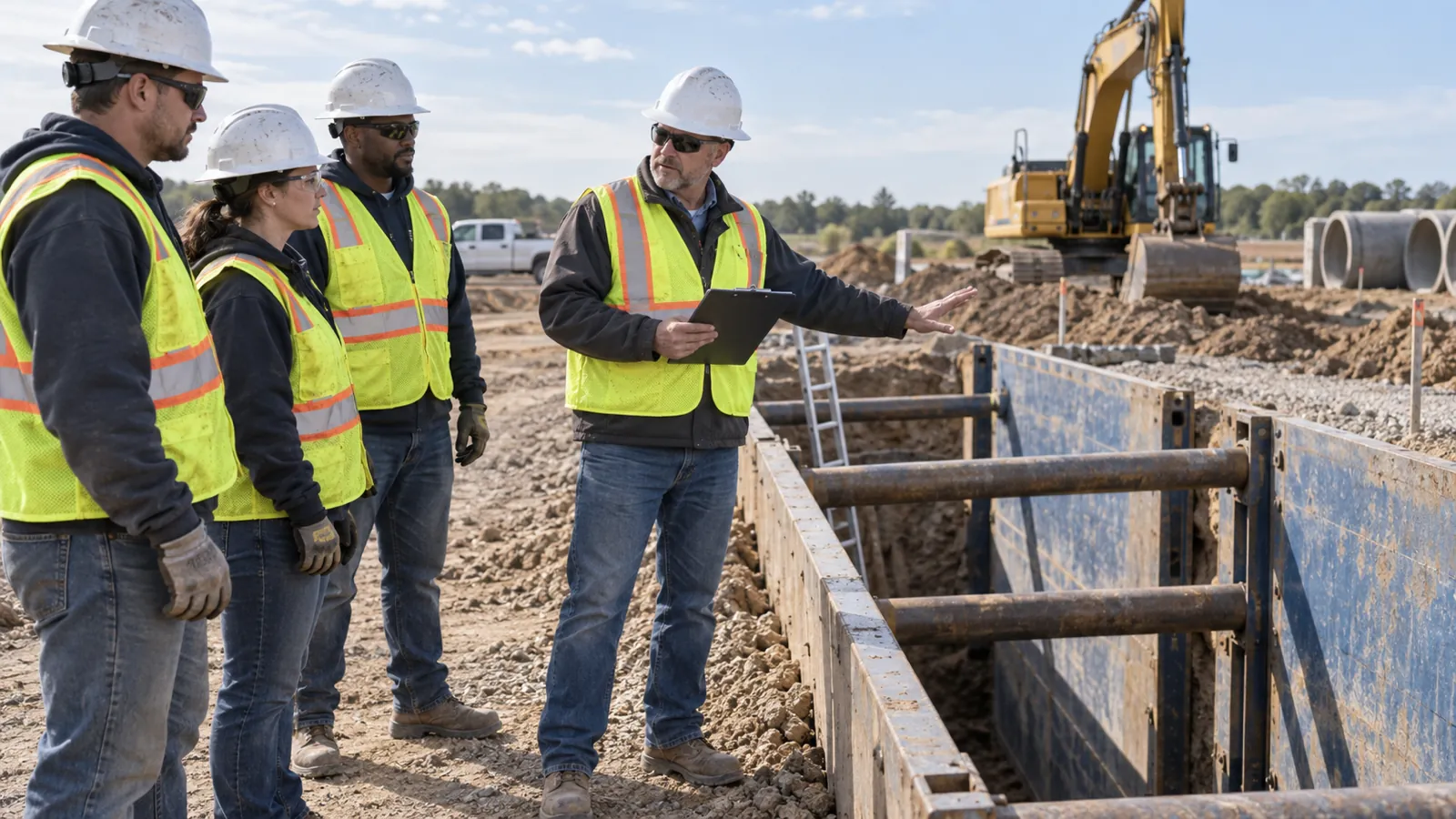
Employers should begin by treating stop-work authority as a defined responsibility, not an informal slogan. If a Competent Person is expected to remove workers from an excavation, the employer should make that authority clear before the job starts. The crew should know who has that authority, what conditions can trigger it, how the work will be reassessed, and who must approve re-entry. This reduces hesitation when conditions change in the field.
Supervisors should also understand that daily excavation inspections are not a one-time formality. OSHA expects inspections by a Competent Person before the start of work and as needed throughout the shift, especially after events that can increase hazards. Those events can include rain, vibration, blasting, surcharge loads, water accumulation, equipment movement near the edge, changes in soil, signs of distress, or any alteration to the excavation or protective system. Training should help supervisors recognize these triggers in ordinary jobsite language.
Common reasons to pause entry include:
- Visible cracking, sloughing, bulging, raveling, or tension cracks near the excavation.
- Water entering the trench, collecting at the bottom, or changing soil stability.
- Spoil piles, equipment, materials, or traffic loads encroaching on the edge.
- A trench shield, shoring system, slope, or bench configuration that no longer matches the excavation depth, width, soil, or work location.
- Missing, damaged, poorly placed, or obstructed access and egress.
- Utility marks, exposed utilities, damaged services, or unexpected underground obstructions that change the plan.
- Adjacent structures, sidewalks, pavement, poles, or foundations that may be undermined or affected.
- Weather, vibration, or nearby activity that changes conditions after the initial inspection.
- Workers entering outside the protected area of a shield or working where the protective system does not extend.
- Any confusion about who has inspected the trench and whether re-entry has been authorized.
The Competent Person does not need to prove that a collapse is imminent before pausing work. The purpose of the role is to identify existing and predictable hazards and take prompt corrective measures. If a condition is uncertain, the safe decision is to remove workers from exposure while the condition is evaluated. That might involve reclassifying soil, repositioning a shield, adjusting slope or bench geometry, moving spoil, improving water control, obtaining manufacturer guidance, consulting a registered professional engineer where required, or revising the work method.
Documentation should support the decision-making process without turning field safety into paperwork theater. A useful record notes what was inspected, what changed, what corrective action was taken, and when re-entry was allowed. For employers, this helps show that stop-work authority is active and organized. For crews, it reinforces that pauses are based on observable conditions, not personal preference.
Supervisors should be careful with language. Telling workers that a trench is "probably okay" or "just for a minute" weakens the safety program. Excavation hazards do not become acceptable because the task is brief. A better approach is direct and specific: workers stay out until the shield is reset, the spoil is moved, water is controlled, the access point is restored, the utility conflict is resolved, or the Competent Person completes a new inspection. Specific instructions are easier to follow and easier to enforce.
Employers should also plan for the operational side of a pause. If the only person who can authorize a change is unreachable, the crew may feel pressure to improvise. If pumps, trench boxes, ladders, barricades, or traffic control resources are not available, the Competent Person may identify a hazard but lack practical means to correct it. A strong excavation safety program connects authority with resources. Training should therefore address not only what to look for, but what steps the supervisor can actually take when a stop-work condition appears.
How Training Supports a Safer Excavation Program
OSHA-aligned excavation safety training gives workers and supervisors a practical foundation for recognizing hazards before they become emergencies. Crew-level training should explain why trenches fail, how protective systems are selected, why access and egress matter, how spoil placement affects stability, what water and weather can change, and why workers must stay within protected areas. When crews understand those basics, stop-work decisions feel less arbitrary.
Competent Person training should build on that foundation with deeper attention to inspection, hazard recognition, soil conditions, protective systems, corrective actions, and the authority to remove workers from exposure. A Competent Person needs more than awareness. The role requires field judgment. That judgment is developed by discussing realistic scenarios: a trench that has been open overnight, a shield that no longer covers the active work area, seepage after a service line repair, a pavement edge cracking near the cut, a ladder blocked by pipe sections, or a subcontractor placing materials too close to the edge.
Training also helps align managers and field leaders. A Competent Person cannot function effectively if project managers reward speed while treating safety pauses as personal failure. Owners and operations leaders should understand that a pause can be the correct professional decision. When management supports stop-work authority, supervisors are more likely to act early. When management only supports it after an incident, the program is already behind.
Role-based training is especially useful. Laborers need to know when to report changes and stay out of unsafe areas. Equipment operators need to understand how their movement, spoil placement, and loading near the edge can affect trench stability. Foremen need to know how to organize work so access, protection, and inspections keep pace with production. Competent Persons need to know how to evaluate conditions and require corrective action. Managers need to know how to provide resources and respect field safety decisions.
An effective training program should connect classroom material to the employer's actual work. A utility contractor may need extra focus on crossing utilities, emergency repairs, and changing trench geometry. A municipal public works crew may need examples involving water main breaks, storm inlet repairs, road shoulder excavations, and traffic exposure. A site contractor may need emphasis on production excavation, adjacent loads, subcontractor coordination, and changing soil across a large project. The core OSHA-aligned principles remain consistent, but examples should feel familiar to the people making decisions.
Training does not guarantee compliance by itself. Employers still need job planning, competent supervision, protective equipment, inspections, documentation, and enforcement. But training gives those systems a much better chance of working under pressure. It helps people notice the condition, name the hazard, understand the consequence, and accept the pause before someone is hurt.
For excavation, trenching and shoring work, the best safety culture is not the loudest one. It is the one where a worker can point out a crack, a foreman can stop entry without debate, a Competent Person can require a correction, and management can support the decision because everyone understands why it matters. That is the practical value of preparing supervisors before conditions turn unsafe.
Key Takeaway
Stop-work decisions are part of a functioning excavation safety program. They protect workers when trench conditions change, when protective systems no longer match the work, when access is compromised, or when the Competent Person needs time to reassess a hazard. Employers should make that authority clear, train crews to recognize triggers, and support supervisors who pause entry for safety reasons.
The right training helps crews and leaders make better decisions before the moment becomes urgent. Excavation, Trenching and Shoring Safety Training helps workers understand the hazards they may see in the field. Competent Person for Excavation, Trenching and Shoring Training helps designated leaders apply inspection judgment, corrective action, and stop-work authority. For employers, getting the right people trained is one of the most practical ways to keep excavation work moving without ignoring the conditions that can make trench entry unsafe.