The Compliance Question
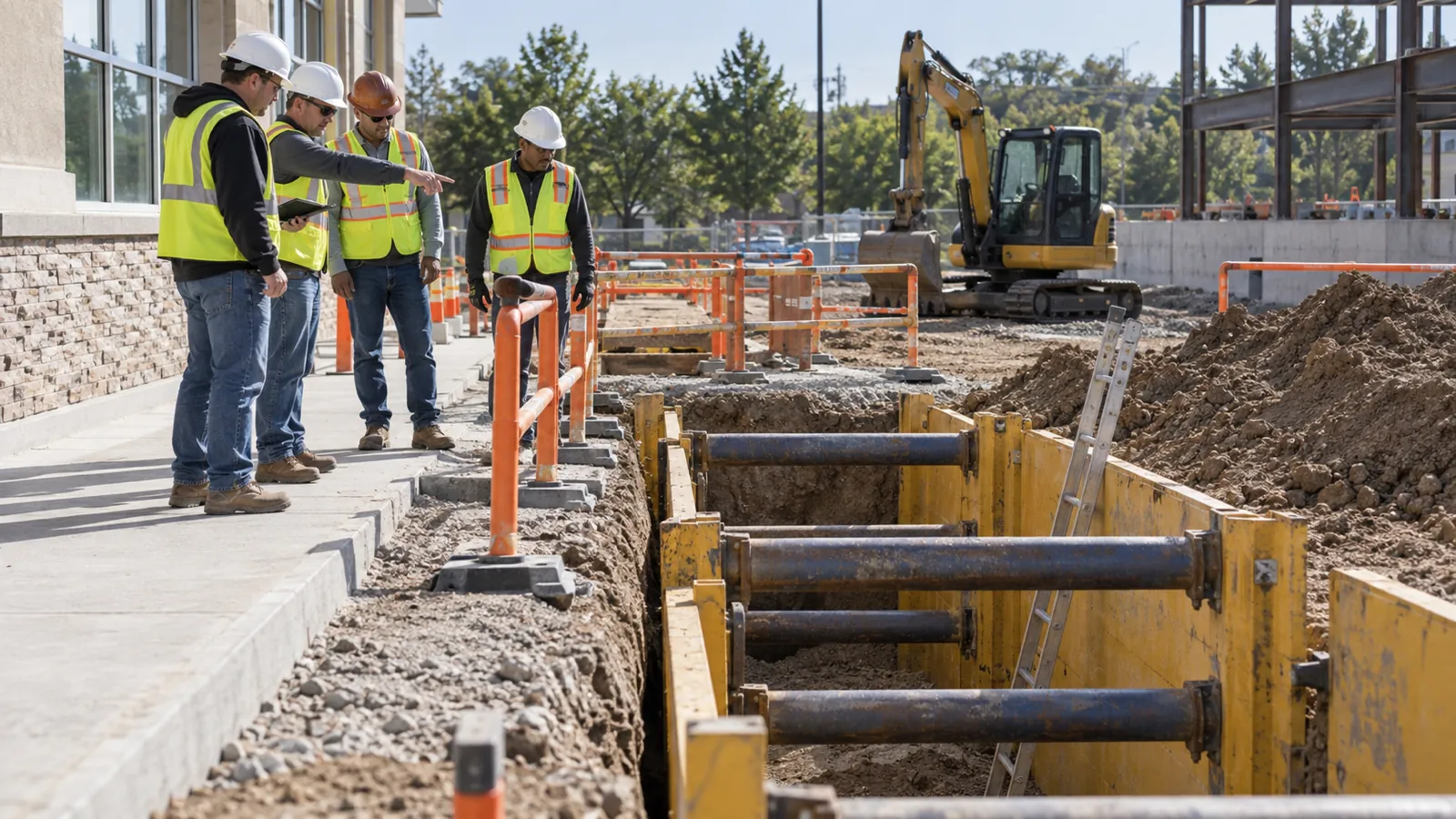
Before an excavation crew starts work, it is natural for supervisors to focus on the trench itself. They look at depth, width, soil, spoil piles, access, and the protective system. Those checks matter, but they do not tell the whole story. OSHA excavation safety also requires employers to look at the area around the excavation. Surface encumbrances and nearby structures can turn a routine dig into a dangerous job if they are ignored before workers enter.
A surface encumbrance is not just an inconvenience sitting near the work area. It can be a sidewalk section, pavement edge, utility pole, fence, curb, sign base, temporary material stack, equipment pad, retaining wall, tree, light standard, or other object that may affect workers if excavation removes supporting soil or changes the load path. Adjacent structures create similar concerns. A building wall, footing, driveway, vault, manhole, roadway, slab, or other improvement near the excavation can shift, crack, settle, or transfer load toward the trench when soil is disturbed.
The compliance question for employers is practical: has someone with the right knowledge and authority evaluated what could be affected by the excavation before workers are exposed? If the answer is no, the job is not ready for entry. A trench may have a shield, ladder, and clean access point, but the crew can still face serious hazards if a nearby sidewalk collapses into the excavation, a wall loses bearing, a utility pole shifts, or mobile equipment is allowed to surcharge the edge.
This is where the Competent Person role becomes more than a title on a safety plan. OSHA Subpart P expects inspections by a Competent Person and requires protective steps when conditions create hazards. The person making the call must understand excavation hazards, soil behavior, protective systems, changing site conditions, and the authority to stop work or require correction. Surface encumbrances and adjacent structures are a clear test of whether that role is being used as an active jobsite control or treated as paperwork.
For owners, project managers, safety coordinators, and supervisors, the best time to control these hazards is before entry. Once workers are in the trench, the margin for reaction is smaller. A small crack, a vibrating sidewalk panel, a leaning post, or a piece of undermined pavement may look minor from the surface, but it can signal that the excavation has changed the support conditions around the work. Training helps teams recognize those warning signs early and understand when the answer is not to hurry, but to stop, reassess, and correct.
Why This Matters on Excavation Jobsites
Excavation work changes the ground. That sounds obvious, but it is easy to underestimate what that change means for objects and structures next to the cut. Soil provides support, confinement, drainage paths, and bearing. When soil is removed, loosened, saturated, vibrated, or overloaded, conditions around the excavation can change quickly. A surface feature that was stable in the morning may become a hazard by afternoon if the trench advances, rain enters the excavation, equipment traffic increases, or material is stored too close to the edge.
One of the most important jobsite questions is whether the excavation could undermine or destabilize something nearby. That question applies to more than buildings. Sidewalks, curbs, poles, hydrants, retaining walls, guardrails, shoring from another phase of work, temporary fencing, and utility structures can all create exposure. If those items fall, move, or shed material into the excavation, workers below may have little time to escape. If the item supports another load, failure can also affect pedestrians, traffic, property, or the public.
Adjacent structures deserve special attention because their risk may not be visible from the trench bottom. A footing may be close to the excavation wall. A slab may bridge over loosened soil. A roadway may transmit repeated vibration and wheel loads. A masonry wall may be old, cracked, or already under stress. A utility vault or manhole may be surrounded by disturbed backfill. If the crew does not identify those conditions before digging, the excavation plan may be based on assumptions that are wrong.
Surface encumbrances can also interfere with protective systems. A trench box may not fit correctly where a foundation projection, pipe chase, or utility structure intrudes into the excavation. A sloped excavation may be limited by property lines, sidewalks, or traffic lanes. A shoring system may need to resist loads that were not considered when the job was planned. In those cases, the decision is not simply whether the trench is deep enough to require protection. The decision is whether the selected protective method is suitable for the actual surroundings.
The hazard is not always dramatic. Many excavation incidents start with small controls being missed. A spoil pile creeps closer to the edge. A skid steer parks where it should not. A concrete panel is left unsupported. A temporary fence base rests near a vertical cut. A curb section is undermined. A nearby wall shows cracking after excavation advances. Each item may seem manageable by itself, but together they can overload the excavation edge or expose workers to falling material.
This matters for compliance because OSHA excavation requirements are built around prevention. Employers are expected to protect workers from cave-ins, falling loads, hazardous atmospheres, water accumulation, inadequate access, and other predictable hazards. Surface encumbrances and adjacent structures fit that prevention mindset. If a hazard can be identified before entry, the employer should not wait until the crew is already exposed.
It also matters for productivity. A stop-work decision made before entry may feel disruptive, but it is usually less disruptive than a failed edge, damaged utility, cracked structure, emergency evacuation, or enforcement action. Crews work better when expectations are clear: inspect the area, control the edge, keep loads back, protect or remove encumbrances, and escalate structural concerns before digging continues. That is not delay for its own sake. It is disciplined excavation management.
For municipal public works crews, utility contractors, site development teams, and general contractors, these checks are especially important because excavation often happens in tight, active environments. Work may take place next to occupied buildings, traffic lanes, sidewalks, existing utilities, retaining walls, or older infrastructure. The tighter the site, the more important it becomes to treat the surrounding surface and structures as part of the excavation hazard profile, not as background scenery.
What Employers and Supervisors Should Know
Employers should start with a simple principle: if excavation may affect the support of an object, surface feature, or structure, the condition needs to be evaluated and controlled before workers are allowed in the trench. The correct control will depend on the site. It may involve removal, relocation, bracing, underpinning, barricading, set-back distances, engineered support, revised excavation geometry, or a different protective system. The important point is that the decision should be deliberate.
Supervisors should not rely only on the original plan if field conditions do not match it. Drawings may show a building, sidewalk, or utility, but they may not reveal old backfill, undocumented repairs, poor drainage, abandoned structures, or actual bearing conditions. The Competent Person inspection should compare the planned excavation against what is visible at the site. If the excavation is next to a structure or encumbrance that could be affected, the crew needs a clear answer before entry.
Useful pre-entry questions include:
- What surface features are within the likely influence area of the excavation?
- Could the excavation remove support from a sidewalk, curb, slab, wall, pole, vault, pavement edge, or other object?
- Are there signs of settlement, cracking, leaning, loose material, water movement, or prior disturbance?
- Will equipment, traffic, stored pipe, spoil, or temporary materials add load near the excavation edge?
- Does the selected protective system account for nearby loads and limited space?
- Is an engineer, utility owner, property owner, or controlling contractor needed before work proceeds?
- Has the crew been told what conditions require stopping work and notifying supervision?
These questions are useful because they move the inspection from a checklist mentality to a hazard recognition process. A checklist can remind people what to look for, but trained judgment is needed to decide whether the condition is acceptable. That judgment becomes especially important when a trench is near a building, roadway, manhole, catch basin, retaining wall, or buried structure.
Employers should also define who has authority to make corrective decisions. If the Competent Person sees that a nearby wall may be undermined, that person must be able to stop work and require action. If the person can only report the issue while production continues, the role is weakened. OSHA's definition of a Competent Person includes the ability to identify hazards and the authority to take prompt corrective measures. Training should reinforce both sides of that responsibility.
Surface encumbrance control is also a communication issue. The excavation crew, equipment operators, truck drivers, foremen, and other trades need to understand where they may travel, stage materials, and place spoil. A protective system can be compromised when other workers unknowingly add loads near the edge or disturb a control that was put in place. Pre-task briefings should identify restricted areas and explain why they matter.
Documentation can help, but only if it reflects real field decisions. A strong excavation inspection record should note more than the date and weather. It should capture the presence of nearby structures or encumbrances, observed concerns, corrective actions, and any restrictions placed on equipment or material staging. If an engineer or other qualified person is consulted, that should also be documented. Records do not make the trench safe by themselves, but they help show that hazards were considered and decisions were made.
Supervisors should pay close attention when conditions change. Rain can soften soil or wash out support. Vibration from traffic or compactors can affect trench walls and adjacent structures. Excavation progress can bring the cut closer to a footing or buried structure. Dewatering can change soil behavior. Equipment routes may shift during the day. A safe morning inspection does not automatically cover the entire shift if the site changes.
Crew-level training should make these hazards visible to workers who may not be responsible for the final protective-system decision. Laborers, operators, spotters, and utility workers should know that cracks, loose pavement, leaning posts, exposed roots, undermined sidewalks, falling debris, or newly appearing gaps are not minor details. They are reasons to alert the supervisor and stay out of the hazard area until the Competent Person reassesses the condition.
Competent Person training should go deeper. It should connect the visible clues to OSHA Subpart P expectations, soil conditions, protective systems, inspection duties, and stop-work authority. The goal is not to turn every supervisor into an engineer. The goal is to help the designated person recognize when normal field controls are enough, when conditions require escalation, and when the excavation should not be entered.
How Training Supports a Safer Excavation Program
OSHA-aligned excavation training helps employers build a common language around trench hazards. When a crew understands terms such as protective system, surcharge load, daily inspection, changing conditions, soil classification, access and egress, and Competent Person, jobsite conversations become more precise. Instead of saying that something looks off, workers can explain that a sidewalk appears undermined, spoil is too close to the edge, or equipment is adding load near the trench.
That shared language matters when multiple employers are on the same site. A general contractor may control access and sequencing. A utility contractor may perform the excavation. A municipal inspector may be present. A subcontractor may need to work near the trench. Without clear expectations, one group can create hazards for another. Training gives supervisors a better way to coordinate controls, communicate restrictions, and document decisions.
Training also supports better planning before mobilization. If the team knows that surface encumbrances and adjacent structures must be addressed, they are more likely to ask the right questions during preconstruction review. Is the trench near an occupied structure? Will a sidewalk need temporary closure or support? Can spoil be staged far enough back? Is there room for sloping, or will shielding or shoring be needed? Could a structural engineer or registered professional engineer be required? Are there old utilities, vaults, or foundations in the work zone?
For field leaders, the most valuable training often focuses on decision points. A supervisor does not need a lecture full of abstract rules. The supervisor needs to know what to look for, what to ask, when to stop, and who to call. Competent Person for Excavation, Trenching and Shoring Training should help that supervisor connect OSHA requirements to actual jobsite conditions: a trench beside a roadway, a utility cut near a building, a sidewalk panel spanning disturbed soil, or a trench box placed where nearby loads may affect the edge.
Training should also clarify that compliance is not achieved by one document or one class alone. Employers still need site-specific planning, competent inspections, suitable protective systems, adequate supervision, and corrective action when conditions change. Training supports those controls by preparing people to use them correctly. It helps reduce the chance that a crew treats the surrounding area as separate from the trench hazard.
When employers train both workers and designated Competent Persons, the program becomes stronger. Workers are more likely to report early warning signs. Competent Persons are more prepared to evaluate the condition and make corrective decisions. Supervisors are better equipped to explain why a restriction matters. Managers are more likely to understand why a job may need engineering input, revised sequencing, or additional protection before the schedule can continue.
The business case is direct. Excavation incidents can involve injuries, fatalities, damaged property, utility disruption, public exposure, enforcement, insurance costs, and lost production. Preventing those outcomes starts with trained people who understand that the hazard area includes the trench and the ground around it. Surface encumbrances and adjacent structures are not side issues. They are part of the excavation system.
Employers choosing training should look for content that addresses real trenching scenarios, not only definitions. The training should discuss OSHA Subpart P, hazard recognition, protective systems, inspections, soil conditions, access and egress, water, utilities, adjacent loads, and the Competent Person role. It should also help learners think through practical examples, because the hardest excavation decisions are often made in imperfect field conditions.
Key Takeaway
Before workers enter an excavation, supervisors should look beyond the trench wall. Sidewalks, slabs, poles, pavement edges, nearby buildings, retaining walls, vaults, utilities, stored materials, and equipment loads can all affect trench safety. If excavation work could remove support, create falling material, add load near the edge, or expose workers to structural movement, the condition needs to be controlled before entry.
The safest excavation programs treat these checks as part of everyday planning and inspection. They give the Competent Person authority to act, train crews to recognize warning signs, and make sure supervisors know when to escalate for engineering or other support. OSHA-aligned Excavation, Trenching and Shoring Safety Training and Competent Person training help employers put those expectations into practice. The right people, trained before the dig begins, are far more likely to see the hazard while there is still time to correct it.