
The Compliance Question
When an excavation project begins, most planning conversations naturally focus on production: where the trench will be opened, what utilities must be exposed, what equipment will be staged, how traffic will be managed, and how quickly the crew can complete the work. Those questions matter, but they do not answer one of the most important safety questions on the job: if something goes wrong in or around the trench, what exactly happens next?
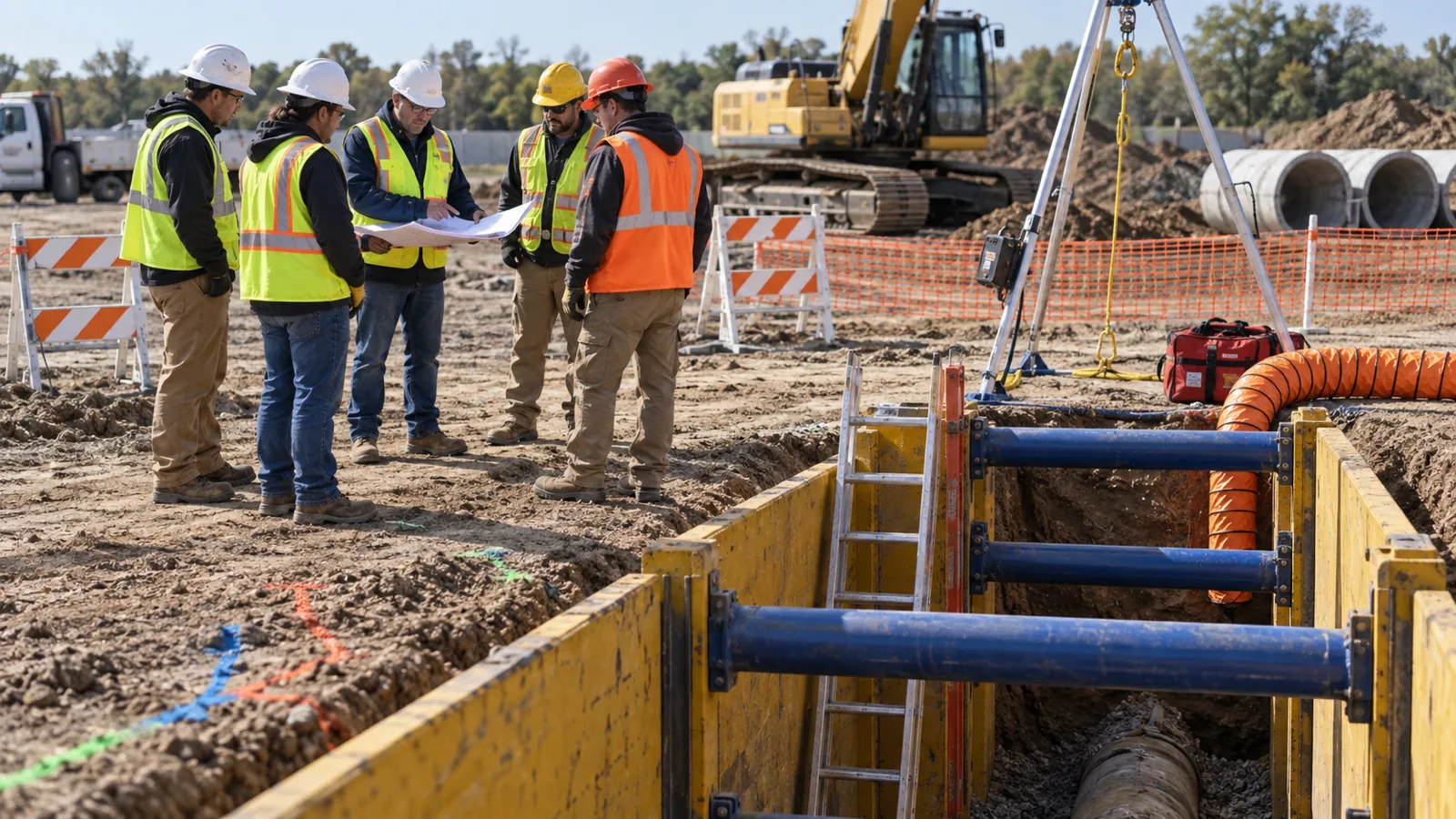
Trench emergencies are unforgiving because the first few minutes can decide whether a bad condition becomes a catastrophic event. A cave-in, water accumulation, hazardous atmosphere, falling material, struck-by exposure, or injured worker inside an excavation cannot be handled safely with improvisation. The response has to be planned before entry, understood by the crew, and supported by a Competent Person who has the authority to stop work and remove employees when conditions are unsafe.
For employers, the compliance question is not simply whether emergency phone numbers are posted somewhere in the trailer. The better question is whether the excavation safety program gives supervisors and crews a practical, jobsite-specific plan for preventing emergencies, recognizing warning signs, stopping entry, calling for the right help, and keeping untrained employees from becoming additional victims. In trenching and excavation work, rescue planning begins with hazard control. The best emergency response is the one made unnecessary by competent inspection, proper protective systems, safe access and egress, and disciplined entry decisions.
OSHA Subpart P places clear expectations on employers to protect workers from excavation hazards. Those expectations include protective systems when required, daily inspections by a Competent Person, safe means of access and egress, protection from water accumulation, protection from loose rock or soil, and employee instruction in recognizing and avoiding unsafe conditions. Emergency preparation belongs inside that same system. It should not be treated as a separate binder topic that no one discusses until after an incident.
A strong rescue plan also protects supervisors from making rushed decisions under pressure. When a worker is trapped, injured, or exposed to a hazard inside a trench, the natural human instinct is to go in and help. That instinct is understandable, but it can be deadly if the trench is unstable, if the protective system has shifted, if water or atmosphere hazards are present, or if equipment and spoil loads continue to affect the excavation. Crews need training before the emergency so they understand that unplanned entry can turn one victim into several.
Excavation, Trenching and Shoring Safety Training and Competent Person for Excavation, Trenching and Shoring Training help employers build that discipline into everyday work. Training does not replace a site-specific emergency plan, and it does not guarantee compliance by itself. It gives the right people a clearer understanding of what must be checked, who has authority, what hazards can change quickly, and why rescue planning has to be discussed before anyone enters the trench.
Why This Matters on Excavation Jobsites
Excavation emergencies are different from many other jobsite emergencies because the work area itself may be unstable. A trench can look manageable from the surface while hiding tension cracks, sloughing soil, unsupported utilities, water seepage, vibration effects, or surcharge loads near the edge. If a worker is down inside that space, the hazard may still be active. The same condition that injured one employee can endanger anyone who rushes in without a controlled response.
This is why emergency planning has to begin with trench prevention controls. Before entry, the Competent Person should evaluate soil conditions, confirm the selected protective system, inspect adjacent areas, check for water, review access and egress, and look for hazards from equipment, traffic, utilities, overhead loads, and stored material. These checks are not paperwork for paperwork's sake. They are the foundation that reduces the chance of a rescue being needed at all.
Supervisors also need to understand how quickly an excavation can change. Rain can soften sidewalls or create runoff that undermines a previously acceptable condition. Nearby traffic or compacting equipment can add vibration. A utility conflict can force a crew to widen, deepen, or shift the trench in a way that changes the protective-system assumptions. Spoil piles can creep closer to the edge as work continues. A pump failure can allow water to collect where employees are working. An emergency plan that was discussed only during preconstruction may no longer fit the conditions at mid-shift.
Access and egress are especially important in rescue planning. A ladder, ramp, stairway, or other safe means of egress is not only a normal entry and exit requirement. It may also be the fastest way for a worker to leave when conditions begin to deteriorate. If access is blocked by pipe, equipment, mud, materials, or a shifted shield, the crew may lose critical time. Supervisors should treat access and egress as part of emergency readiness, not as a minor setup detail.
Communication is another practical concern. Crews should know who calls emergency services, who meets responders at the site entrance, who shuts down equipment, who controls traffic, who accounts for workers, and who keeps unassigned personnel away from the trench edge. In municipal work, roadway utility work, pipeline repairs, and crowded commercial jobsites, responders may need clear directions to the excavation, information about hazards, and space to stage equipment. The plan should account for the reality of the jobsite, not just the address.
Employers should also plan for the risk of well-intended but unsafe rescue attempts. Many workers have strong loyalty to their crew. In an emergency, that loyalty can push people toward immediate action before hazards are controlled. Training should make the company's expectation clear: employees do not enter an unsafe trench for rescue unless they are trained, equipped, authorized, and the entry can be made under a controlled rescue plan. The first response may be stopping work, calling emergency services, removing workers from exposure, and stabilizing the area.
Liability and operational risk follow the same pattern. A company that cannot show how it trains crews, assigns Competent Person duties, inspects excavations, controls entry, and plans emergency response may struggle to explain its safety program after an incident. Documentation alone will not make a trench safe, but a clear documented process helps prove that safety expectations were communicated and that supervisors had a consistent standard to follow.
Productivity also depends on preparation. A crew that has not planned emergency access, equipment shutdown, traffic control, utility support, or responder coordination may lose time trying to solve these issues during a high-stress event. A crew that has discussed them ahead of time can react with more order. That calm matters because trench emergencies are already stressful enough without confusion over basic roles.
What Employers and Supervisors Should Know
Employers should begin by treating rescue planning as part of excavation planning, not as a generic emergency action item copied from another job. A trench in a quiet subdivision, a downtown utility repair, a water main replacement beside live traffic, and a deep excavation near existing structures all create different response challenges. The plan should match the depth, soil, protective system, crew size, access points, equipment, traffic exposure, utilities, and expected duration of the excavation.
Supervisors should also know the difference between rescue planning and rescue improvisation. Rescue planning asks hard questions before entry. Can workers exit quickly? Are ladders or ramps located where employees will actually be working? Is the protective system installed and used according to its limits? Is there water in the trench or a realistic chance water could enter? Could the atmosphere become hazardous because of equipment, contaminated soil, nearby utilities, or confined spaces connected to the excavation? Who has authority to order evacuation? Who contacts emergency services? Where will responders stage?
Useful planning topics include:
- Site address, entrance location, and directions that emergency responders can actually use.
- The name and contact method for the supervisor and Competent Person.
- The depth, approximate length, soil conditions, and protective system in use.
- Access and egress locations, including ladders, ramps, or stairs.
- Equipment that must be shut down or moved away from the trench edge.
- Traffic control needs and who will keep vehicles away from responders.
- Utility hazards, including gas, electric, water, sewer, communications, and overhead lines.
- Water hazards, pumping arrangements, and runoff controls.
- Accountability procedures for confirming who is in and out of the excavation.
- Instructions that untrained workers must not attempt an unsafe entry rescue.
The Competent Person plays a central role because excavation conditions must be evaluated before employees enter and as conditions change. OSHA's definition of a competent person includes the ability to identify existing and predictable hazards and the authority to take prompt corrective measures. In excavation work, that authority must be real. A person who sees a hazardous condition but cannot stop the job, remove employees, or require correction is not functioning effectively in the role.
Crew-level employees also need clear training. They should know when to report cracks, sloughing soil, water, shifting shields, damaged shoring, undermined pavement, unsupported utilities, blocked ladders, unusual odors, equipment near the edge, or changes after rain and vibration. They should understand that reporting a concern is part of the work, not an interruption of the work. A crew that waits for the supervisor to notice everything leaves too much to chance.
Employers should avoid vague rescue language. A statement such as "call 911 if there is a problem" may be necessary, but it is rarely sufficient. Emergency services may not have immediate trench rescue capability in every location. Some jurisdictions have specialized technical rescue teams, while others may need additional resources or mutual aid. Employers should understand local response capability before work begins, especially for deeper, longer, complex, or higher-risk excavations.
Supervisors should also plan how to preserve stability during response. Equipment vibration, nearby loads, spoil pile placement, water movement, and traffic can continue affecting the trench during an emergency. Keeping people and equipment back from the edge may be one of the first protective steps. The site should be controlled so employees, subcontractors, inspectors, and bystanders do not crowd the excavation or interfere with responders.
Documentation should support the plan without turning it into a slow ritual. A practical excavation emergency plan might be part of the pre-task briefing, job hazard analysis, excavation permit, daily inspection form, or competent person checklist. The format matters less than whether it is actually reviewed and understood. The best plan is the one supervisors can explain in plain language to the crew at the trench.
Employers should also consider language, literacy, and crew composition. A rescue plan that only one supervisor understands is fragile. Temporary workers, subcontractors, municipal crew members, new operators, and laborers working around the excavation need instructions they can act on. If a crew uses multiple languages, the briefing should account for that. In an emergency, people will not have time to decode unclear instructions.
Finally, employers should make rescue planning part of the decision to train people for excavation duties. General awareness training helps workers recognize hazards and follow safe entry rules. Competent Person training goes deeper into inspection duties, soil classification, protective systems, changing conditions, and corrective action. Supervisors who assign excavation work need enough understanding to support the Competent Person rather than pressure that person to accept unsafe conditions.
How Training Supports a Safer Excavation Program
OSHA-aligned excavation training helps employers turn emergency planning from an abstract concern into a field habit. Workers learn that trench safety is not just about the moment of entry. It starts with pre-job planning, utility coordination, soil evaluation, protective-system selection, access and egress, water control, inspections, and communication. Rescue planning sits across all of those topics because an emergency response will only be as strong as the controls already in place.
For crew members, training can clarify the signs that should trigger a stop-and-report response. A worker may not be responsible for classifying soil or approving a protective system, but that worker should know that water entering a trench matters, that material near the edge matters, that a ladder too far away matters, and that a shifting trench box or damaged shore is not normal. When crews understand the why behind these rules, they are more likely to speak up before conditions worsen.
For supervisors, training supports better planning conversations. Instead of asking only whether the crew has the tools to complete the work, a trained supervisor is more likely to ask whether the trench has been inspected, whether the protective system matches the conditions, whether emergency access is clear, whether local responders can reach the site, whether employees understand the no-unplanned-entry expectation, and whether changing conditions require a new inspection.
For Competent Persons, role-specific training is especially important. The Competent Person must be prepared to identify hazards, evaluate protective measures, understand the limits of shoring, shielding, sloping, or benching, and take corrective action when conditions are unsafe. That includes ordering employees out of the excavation when there is evidence of cave-in potential, protective-system failure, hazardous atmosphere, water accumulation, or other dangerous conditions. In rescue planning, that authority is essential because hesitation can put more workers at risk.
Training also helps employers avoid a narrow view of emergency response. Rescue planning is not only about equipment such as tripods, harnesses, pumps, radios, barricades, or retrieval systems. Equipment can be useful only when it matches the hazard, the site, and the capability of the people expected to use it. Training helps employers ask whether workers are authorized and competent to use equipment, whether the equipment is appropriate for trench conditions, and whether outside emergency services are needed for technical rescue.
Another benefit is consistency across jobsites. Many excavation employers move crews from one project to another, often with different soils, layouts, utilities, municipalities, general contractor rules, and public exposures. A consistent training foundation gives crews a common language for discussing excavation hazards and emergency readiness. That common language makes daily briefings more effective because people already understand the key terms and expectations.
Training should also reinforce that emergency planning is a living part of the job. A plan reviewed in the morning may need to be revisited after rain, a utility conflict, a change in depth, a new spoil location, a damaged protective component, or a change in traffic control. Supervisors should not treat the first briefing as permission for the rest of the day. The plan should be updated when the excavation changes.
Employers can use training to support better documentation as well. Daily inspection forms, pre-task plans, and job hazard analyses are more useful when the people completing them understand the hazards they are recording. A checklist that says "rescue plan reviewed" should reflect a real conversation, not a checkbox filled after the fact. Workers should be able to explain where they exit, who they notify, what they do if conditions change, and why they should not attempt an unsafe entry rescue.
Excavation, Trenching and Shoring Safety Training can support broad crew awareness, while Competent Person for Excavation, Trenching and Shoring Training supports the deeper decision-making duties assigned to specific employees. Together, those training paths help employers build a program where rescue planning is tied to prevention, inspection, communication, and authority. That is the kind of program that can stand up better under jobsite pressure.
No training course can remove the employer's responsibility to evaluate each jobsite, follow applicable OSHA requirements, provide appropriate protective systems, and coordinate emergency response. But training can make those responsibilities more understandable and more repeatable. It gives supervisors and crews a better chance to recognize risk before the trench becomes an emergency.
Key Takeaway
Trench rescue planning should happen before excavation work begins, not after a worker is already in trouble. Employers should make sure crews know how to prevent emergencies, how to recognize changing conditions, how to exit quickly, who has authority to stop work, who contacts responders, and why unplanned rescue entry can be dangerous. Supervisors and Competent Persons need enough training to connect emergency readiness with daily inspections, protective systems, access and egress, water control, utility hazards, traffic exposure, and jobsite communication.
The practical takeaway is simple: do not wait for a trench emergency to discover whether the crew has a plan. Get the right people trained before the work starts, review the emergency response expectations at the excavation, and make sure the Competent Person has the knowledge and authority to act when conditions change. A prepared crew is not just more compliant. It is better positioned to protect workers when the jobsite stops behaving like the plan on paper.