
The Compliance Question
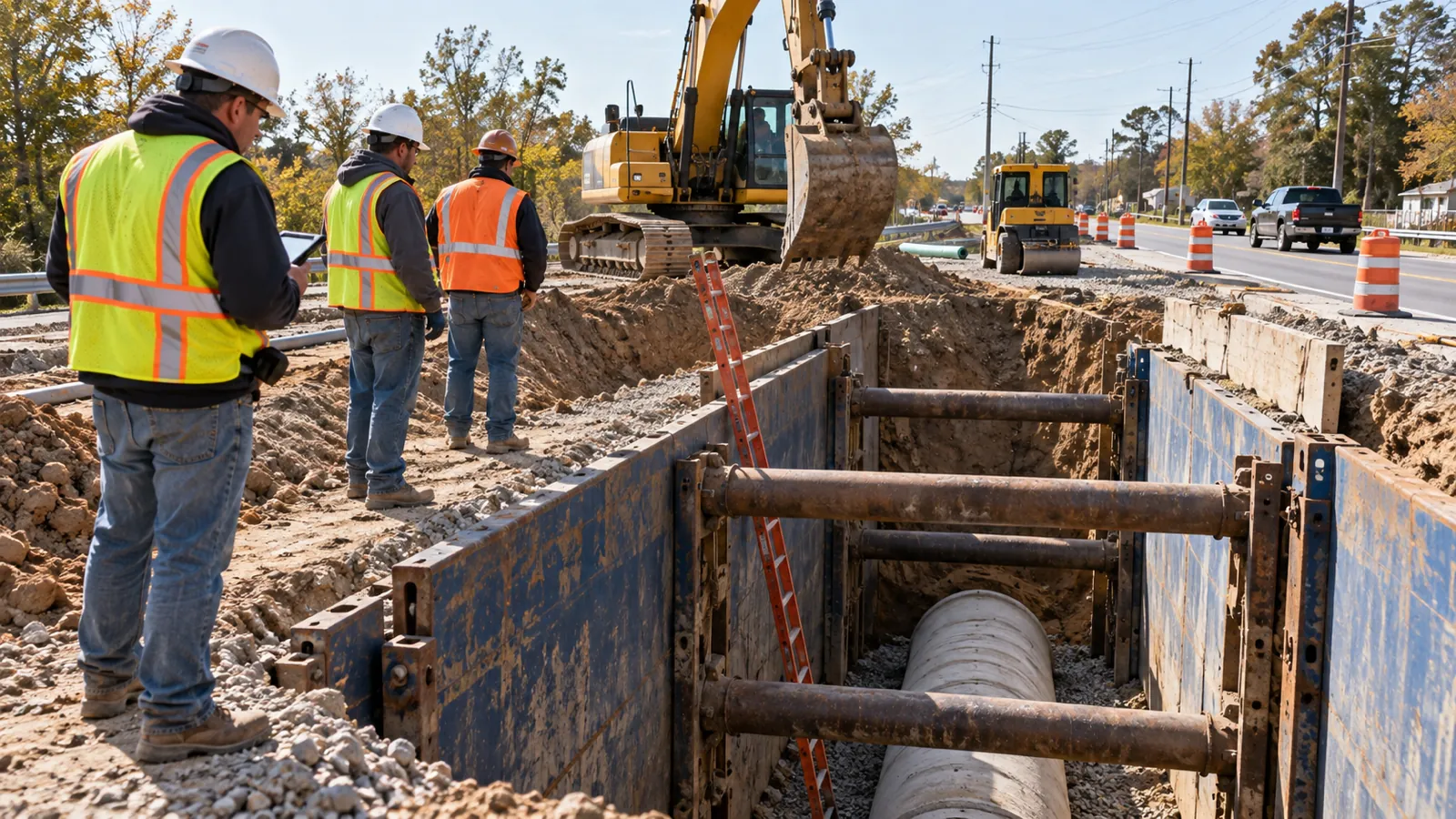
An excavation does not exist in isolation. Even when the trench has been laid out correctly, the spoil pile is controlled, access is planned, utilities are marked, and a protective system is selected, nearby activity can still change the risk profile of the job. A loaded dump truck idling beside the trench, a compactor working along a shoulder, traffic passing near a utility cut, equipment swinging over the excavation, or materials staged too close to the edge can all add stress to soil that workers depend on to remain stable.
That is why employers and supervisors need to treat vibration and adjacent loads as more than background conditions. They are active trench safety factors. OSHA excavation requirements are built around the idea that workers must be protected from cave-ins, falling loads, hazardous atmospheres, water accumulation, and other recognized excavation hazards. A Competent Person must be able to identify existing and predictable hazards and has to have the authority to take prompt corrective action. When nearby activity affects the excavation, that responsibility becomes practical and immediate.
The compliance question is not only whether the trench is deep enough to require protection. The better question is whether the excavation remains safe for entry after the surrounding jobsite begins to move. Soil may look acceptable during the morning inspection, then behave differently once trucks start hauling, a roller begins compacting, traffic control shifts closer to the cut, or equipment starts placing pipe near the edge. Conditions can also change after rain, dewatering, freezing and thawing, undermined pavement, previously disturbed fill, or utility crossings that interrupt the soil profile.
For employers, this topic matters because it connects planning decisions to field behavior. It is easy to write a safety plan that says equipment and materials should be kept away from trench edges. It is harder to train supervisors, operators, spotters, and crews to recognize when a routine task is adding load, vibration, or movement to the excavation. The difference between those two levels of control is often the difference between a program that sounds compliant and a jobsite that actually protects people.
Vibration and adjacent loads deserve deliberate attention before work starts and throughout the shift. The crew needs to know which equipment can operate near the excavation, where trucks may stage, how far spoil and pipe should be kept from the edge, when traffic or compaction creates added concern, and who has authority to stop entry while the Competent Person reassesses the condition. Without that shared understanding, the safest plan can be undermined by ordinary production pressure.
Why This Matters on Excavation Jobsites
Trench stability depends on the relationship between soil conditions, excavation geometry, protective systems, water, weather, nearby structures, and jobsite activity. Vibration and adjacent loads matter because they can change that relationship without producing an obvious warning. A trench wall may not announce that it is becoming less stable. Small cracks, sloughing, raveling, water seepage, bulging, or settlement near the edge can be easy to miss if the crew is focused on production.
Adjacent loads include more than large machines. Spoil piles, pipe bundles, trench plates, road boxes, pallets, traffic barriers, excavator mats, loaded pickup trucks, concrete debris, and stored materials can all add weight near the excavation. The closer that weight is to the edge, the more seriously it should be evaluated. Even when the material is not directly on the lip of the trench, the added pressure can affect the surrounding ground, especially where soil is previously disturbed, saturated, layered, or unsupported.
Vibration creates a different but related concern. Road traffic, hoe rams, compactors, pile driving, saw cutting, milling, jackhammers, and heavy equipment movement can transmit energy through the ground. In some soils, vibration can contribute to loss of strength or movement. In others, vibration may expose weaknesses that were already present, such as cracks behind the trench wall, voids around utilities, loosened backfill, or unsupported pavement. The point is not that every vibration source automatically makes a trench unsafe. The point is that vibration has to be noticed, evaluated, and controlled instead of treated as noise in the background.
This is especially important on utility and municipal work, where excavations are often opened in streets, rights-of-way, alleys, easements, plants, and developed areas. Crews may be working near live traffic, old pavement, unknown fill, existing structures, buried utilities, and limited staging space. The protective system may be sound, but the surrounding conditions can still change. A trench box, hydraulic shoring system, or sloped excavation must be used within the limits of its design and the actual field conditions. Nearby loads and vibration can affect whether that system remains appropriate.
The consequences are not limited to cave-in risk. Adjacent activity can also create falling object hazards, struck-by exposure, access and egress problems, and communication breakdowns. For example, a truck backing near a trench edge may distract workers, block a ladder, or add surcharge load at the same time. A compactor operating beside an open trench may affect soil stability while also creating noise that interferes with verbal warnings. A stack of pipe placed too close to the excavation may roll, slide, or restrict emergency access. These overlapping hazards are why excavation safety has to be managed as a whole jobsite system.
Competent Person inspections are central to this process. A pre-shift inspection is necessary, but it is not the finish line. OSHA expects inspections by a Competent Person daily and as needed throughout the shift, including after events that could increase hazards. Vibration, added loads, weather changes, water intrusion, equipment movement, traffic changes, or signs of soil movement can all justify stopping and reassessing before workers continue entry. That does not mean every pause has to become a long delay. It means the crew must understand that conditions are allowed to change the plan.
Employers also need to recognize the liability and operational risk tied to uncontrolled adjacent loads. If a trench incident occurs, investigators will not look only at the written safety program. They will examine the work area, the protective system, inspection practices, soil conditions, crew training, authority of the Competent Person, equipment placement, spoil placement, access routes, and whether known hazards were corrected. A company that trains its people to notice and control adjacent loads is better positioned to prevent injuries and explain how decisions were made.
Productivity improves when these expectations are clear. Crews lose time when equipment has to be moved repeatedly because staging was not planned. Supervisors lose control when operators are not told where they may travel or load. Competent Persons face avoidable conflict when they must stop work after unsafe staging has already become normal. Planning for vibration and nearby loads at the start helps the project move more steadily because everyone understands the boundaries before the pressure rises.
What Employers and Supervisors Should Know
Employers should begin with a simple principle: anything that adds weight, movement, impact, vibration, or obstruction near the excavation should be evaluated before workers enter. That evaluation should happen during planning, during the daily inspection, and whenever jobsite activity changes. The person making that call must understand excavation hazards and must have authority to correct them.
The Competent Person should consider several practical questions before entry:
- What soil type or soil behavior is expected, and has the soil been disturbed before?
- Are there layered soils, fissures, cracks, water seepage, sloughing, or signs of previous backfill?
- What protective system is being used, and is it appropriate for the actual depth, width, soil, and load conditions?
- Where will spoil, pipe, bedding stone, trench plates, and tools be staged?
- Where will excavators, loaders, trucks, compactors, and smaller machines travel or park?
- Will road traffic, compaction, demolition, saw cutting, or other vibration sources affect the excavation?
- Are nearby structures, sidewalks, curbs, pavement, poles, vaults, or utilities supported?
- Could equipment or materials block ladders, ramps, rescue access, or visibility?
- What signs would trigger an immediate stop and reassessment?
Those questions should not live only in a safety office. They need to be translated into instructions the crew can use. Operators need defined travel paths and swing limits. Laborers need to know where pipe and materials can be staged. Foremen need to recognize that adding a truck near the trench edge is not just a logistics choice. Spotters need authority to speak up when equipment drifts into a restricted area. Workers in the trench need to know that unusual vibration, falling material, soil movement, water, or changing conditions should be reported immediately.
The two-foot spoil pile rule is a useful starting point, but employers should avoid treating it as the only concern. OSHA requires excavated or other materials and equipment to be kept at least two feet from the edge of excavations or otherwise retained so they cannot fall or roll into the excavation. In many field conditions, the safer decision may require more distance, different staging, a physical barrier, or engineering input. Heavy equipment and traffic loads may require special consideration beyond a basic housekeeping rule.
Protective system selection also matters. A trench shield is designed to protect workers inside the shield, not to prevent every possible soil movement around the excavation. Shoring systems must be installed and used according to tabulated data, manufacturer instructions, or engineering design as applicable. Sloping and benching must match soil classification and space limitations. If added loads or vibration are present, supervisors should confirm that the selected method remains suitable. When the answer is uncertain, the work should stop until the Competent Person, manufacturer guidance, tabulated data, or a registered professional engineer can support the decision.
Supervisors should also watch for changing site patterns. A trench may begin in a quiet area and later become crowded with deliveries, inspectors, subcontractors, traffic control devices, and equipment waiting for access. The first inspection may be accurate for the morning setup but incomplete for the afternoon work sequence. That is why excavation planning should include staging maps, exclusion zones, equipment routes, and communication rules. These do not need to be complicated documents, but they must be clear enough for the field team to follow.
Documentation should support the decision process. Employers may choose to document the daily excavation inspection, soil classification basis, protective system used, water controls, access points, spoil and equipment placement, nearby structures, traffic exposure, and corrective actions. Documentation should be honest and useful, not just a checkbox exercise. If a compactor was moved away from the trench, if a truck route was changed, if pipe storage was relocated, or if the Competent Person stopped entry after cracks appeared, those are meaningful safety controls worth recording.
Crew-level training and Competent Person training serve different but connected roles here. Crew-level excavation safety training helps workers recognize hazards, follow site controls, use access and egress properly, stay out of restricted areas, and report changing conditions. Competent Person training goes deeper into inspections, soil evaluation, protective systems, hazard recognition, and corrective authority. Employers need both perspectives because the Competent Person cannot personally see every movement on a busy jobsite. A trained crew extends awareness across the work area.
How Training Supports a Safer Excavation Program
OSHA-aligned excavation, trenching, and shoring training helps employers turn rules into field decisions. Vibration and adjacent loads are a good example because they require judgment, not memorization alone. Workers can memorize that spoil should be kept back from the edge, but training helps them understand why that distance matters, when additional controls may be needed, and how other jobsite activity can create a similar or greater concern.
Effective training should teach workers to see the excavation as a changing environment. Before entry, the crew should understand the depth and layout of the trench, the protective system, the access points, the expected work sequence, and the limits placed on equipment and material staging. During work, they should know what changes require attention: new cracks, falling soil, water, vibration, heavy traffic, equipment repositioning, nearby compaction, damaged shoring components, shifting spoil, or blocked egress. This kind of awareness helps workers participate in safety without replacing the authority and responsibility of the Competent Person.
Competent Person for Excavation, Trenching, and Shoring Training should prepare designated personnel to evaluate hazards in context. That includes understanding soil classification, recognizing signs of distress, assessing water and weather impacts, reviewing protective system options, applying manufacturer or tabulated data, and enforcing corrective actions. It also includes communication skills. A Competent Person may need to tell an operator to move equipment, tell a supervisor that staging has to change, or stop workers from entering until the hazard is corrected. Training gives that person a stronger foundation for making those calls confidently.
Employers should use training to clarify roles before conflict appears. The operator should not have to guess whether a loaded truck can stage beside the trench. The foreman should not have to debate whether a roller can compact next to an open cut while employees are inside. The crew should not wait until soil falls into the excavation before speaking up. A role-based training plan can define who inspects, who authorizes entry, who controls equipment movement, who watches traffic exposure, who maintains access, and who documents corrective actions.
Training also supports better pre-job planning. Before a project begins, supervisors can review likely vibration and adjacent load sources: traffic lanes, haul routes, compaction operations, demolition, pipe staging, bedding material delivery, trench plate handling, utility poles, manholes, vaults, pavement edges, and nearby structures. When those issues are discussed early, the employer can adjust the sequence, bring the right protective system, coordinate traffic control, assign spotters, create exclusion zones, or consult engineering support when needed.
For municipal crews and utility contractors, this is especially valuable because the work is often repetitive. Repetition can create confidence, but it can also normalize shortcuts. A crew that has opened similar trenches for years may become comfortable with trucks near the edge, compactors close to the cut, or materials staged wherever space is available. Training can interrupt that pattern by reminding experienced workers that familiar tasks still require fresh inspection and hazard evaluation every day.
Training alone does not guarantee compliance, prevent every incident, or replace site-specific engineering. It does, however, give employers a stronger system for recognizing hazards and responding before conditions become dangerous. When workers understand the reason behind a control, they are more likely to respect it. When supervisors understand the inspection logic, they are more likely to plan for it. When Competent Persons understand their authority, they are more likely to use it when the jobsite changes.
An excavation safety program should make this expectation visible. Toolbox talks can include examples of nearby load hazards. Pre-task plans can identify equipment routes and material staging zones. Inspection forms can include prompts for vibration, traffic, and adjacent loads. Supervisors can walk the work area with operators before the trench is opened. Crews can be told that stopping entry for reassessment is a normal part of safe excavation work, not a failure to produce.
The best excavation programs do not depend on one person noticing everything at the last second. They create a shared jobsite language around trench hazards. Vibration and adjacent loads should be part of that language because they are common, easy to overlook, and often created by the work itself. When the team recognizes those hazards early, the Competent Person has more time and support to correct them.
Key Takeaway
Vibration and adjacent loads can change excavation risk even when the trench looked acceptable at the start of the shift. Nearby equipment, traffic, compaction, staged materials, spoil, pipe, and other jobsite activity can affect soil stability, protective system decisions, access, and worker exposure. Employers should plan for these conditions before entry, train crews to recognize them, and make sure the Competent Person has both the knowledge and authority to stop work and require corrective action when conditions change.
The right training helps turn excavation safety from a checklist into a working field practice. Crew-level excavation, trenching, and shoring safety training helps workers recognize and report changing conditions. Competent Person training helps designated personnel evaluate hazards, inspect the excavation, control entry, and make practical decisions about protective systems and jobsite activity. When employers get the right people trained, they give the entire crew a better chance to identify trench hazards before they become emergencies.