Before crews enter a changing excavation, the Competent Person must verify that soil, protective systems, access, and nearby loads still support safe work.
Excavations rarely remain identical from the first cut to the last connection. A trench may widen around a fitting, step down near a manhole, transition from a slope to a shield, or be altered to clear an existing line. Those changes can be necessary for production, but they also change the way soil is supported and the way workers enter, work, and leave. Employers need a repeatable way to recognize the change, stop when needed, and confirm that the revised arrangement is acceptable before people work inside.
This is where role-based training matters. General crew members need to understand what changed and what they must report. Supervisors need to coordinate equipment, access, spoil, and traffic around the revised excavation. A designated Competent Person needs the knowledge and authority to inspect the condition, identify hazards, and take prompt corrective action. OSHA 29 CFR 1926 Subpart P provides the regulatory framework, but a safer program depends on turning that framework into field decisions that crews can understand.
Why This Matters on Excavation Jobsites
The geometry of an excavation is a control, not merely a shape on a grading plan. A uniform trench can be evaluated one way, while a stepped section, a short vertical face, or a transition beside a trench box may create a different load path. The soil does not know where one production task ends and another begins. Cracks, sloughing, tension fissures, water, vibration, and nearby loads can affect the full excavation.
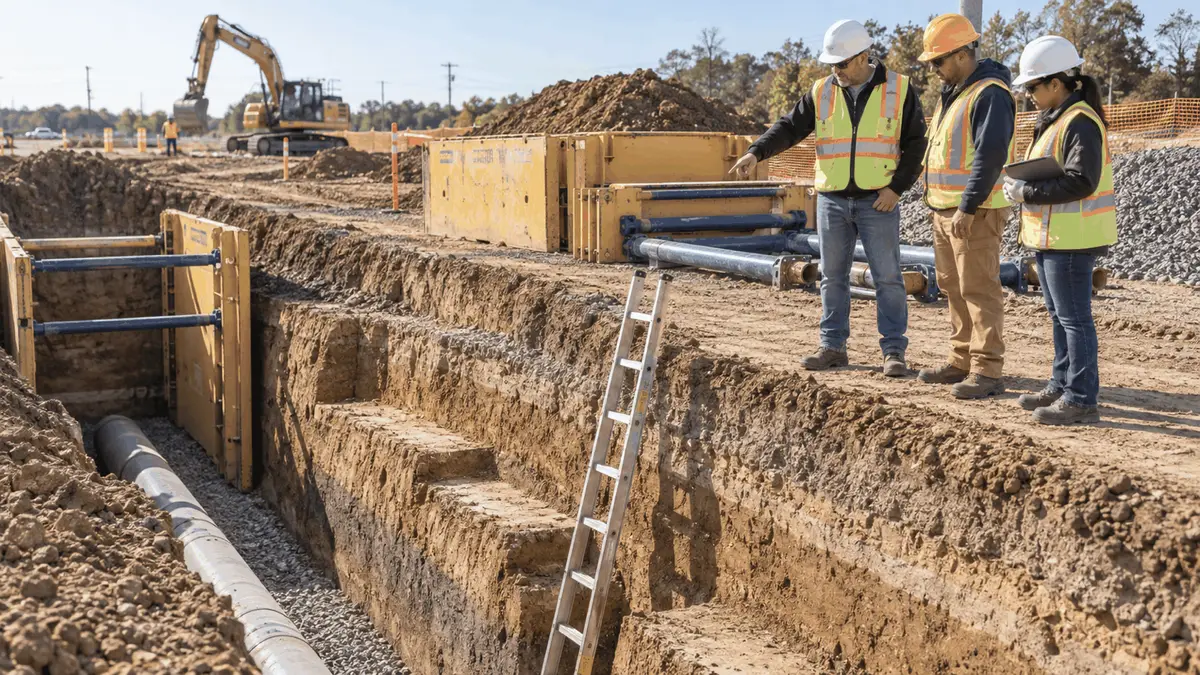
When a crew treats a transition as a small detail, the site can accumulate several risks at once. A worker may climb into a section that is deeper than the protected portion. A ladder may no longer provide safe access to the work location. Spoil may be placed beside a widened cut, adding surcharge at the edge. A machine may travel close to a newly sloped face. A trench shield may be moved without confirming that its placement still protects the work area. Each issue can turn a planned change into an unplanned exposure.
The employer also has to consider work sequencing. Excavation may be open while pipe is being lowered, bedding is being placed, a utility is being supported, or a connection is being made. Workers may focus on the task and assume the earlier inspection still applies. A training program should teach that a changed configuration is a new inspection decision, even when the work is on the same project and in the same soil.
Changing geometry can affect the following controls:
- Soil classification and the assumptions used to select sloping, benching, shoring, or shielding.
- Protective-system limits, including the area actually protected from cave-in exposure.
- Access and egress locations, ladder placement, and the distance workers must travel.
- Spoil piles, materials, equipment, and traffic that may load the edge.
- Existing foundations, pavement, utilities, and structures that can influence stability.
- Water accumulation, rain runoff, leaking lines, or pumping that can weaken soil.
- Atmospheric hazards when the excavation is deep, enclosed, near a sewer, or connected to another space.
- The ability of the Competent Person to see the entire work area during inspections.
The practical consequence is that productivity should be planned around safe control changes, not used as a reason to skip them. A short pause to inspect a new transition can prevent a longer shutdown, damaged utility, rescue, injury, or regulatory response.
What Employers and Supervisors Should Know
An employer should define who has authority to evaluate excavation changes and who must notify that person. The role should not be implied only by seniority. A Competent Person is expected to be capable of identifying existing and predictable hazards and authorized to take prompt corrective measures. Training should connect that authority to the actual project workflow.
Before work begins, supervisors can establish a change trigger list. The list should include any change in depth, width, bench, slope, shield position, shoring member, soil condition, water condition, access route, adjacent load, or work sequence. It should also include events such as heavy rain, freeze and thaw, vibration from nearby equipment, utility exposure, a struck line, or a complaint from a worker who sees movement.
When a trigger occurs, the supervisor should make the change visible to the crew. A simple briefing can state what changed, which area is restricted, who will inspect it, and what workers must do while the decision is pending. That prevents a common failure mode in which one crew knows about the change while another crew enters using yesterday's assumptions.
The Competent Person's field review should be systematic. Useful questions include:
- What is the depth and width at each work location, not only at the easiest portion to view?
- Does the selected protective system cover the entire area where a worker could be exposed?
- Is a bench or slope transition stable, continuous, and appropriate for the soil and depth?
- Are there unsupported faces, overhangs, loose material, tension cracks, or signs of sloughing?
- Has water changed the soil, collected at the bottom, or created a flow path?
- Are spoil, pipe, pallets, trucks, or excavators close enough to add a load or vibration?
- Does a ladder or ramp reach the actual work area and remain usable after the change?
- Are utilities, foundations, pavement, or adjacent structures supported and protected?
- Does the work create a confined or hazardous atmosphere that requires additional controls?
- Has the inspection result and any corrective action been communicated and recorded?
The record does not need to replace judgment. Its purpose is to show what was observed, what was corrected, and what conditions must be watched. A useful form identifies location, depth, soil observations, protective system, water, access, adjacent loads, weather or activity changes, worker briefing, and the Competent Person's decision. The employer should keep records according to its program and applicable requirements, while recognizing that a completed form does not make an unsafe condition acceptable.
Supervisors also need to control the edges during the inspection. Workers should not stand below a face that is being evaluated, climb over a shield, or enter the restricted section to help measure it. Equipment operators need clear instructions about where to park and how to approach the excavation. If the safe inspection cannot be completed from outside, the employer must use a method that does not create the exposure the inspection is supposed to control.
How Training Supports a Safer Excavation Program
OSHA-aligned training gives employers a common language for recognizing hazards, but it should be assigned by role. A worker-level course can explain cave-in hazards, protective systems, access and egress, spoil placement, water, utilities, and the duty to stop and report. That knowledge helps workers notice when the field no longer matches the briefing.
Competent Person training should go further. The learner needs practice thinking through soil conditions, protective-system selection, inspection intervals, changing configurations, and corrective actions. A strong course should make clear that the Competent Person does not merely sign a checklist. The person must evaluate conditions and have the authority to remove workers from an unsafe area, require a correction, or stop the task.
Employers can reinforce online learning with site-specific orientation and field verification. The orientation can identify project drawings, utility information, traffic controls, emergency contacts, spoil zones, ladder locations, and the process for reporting a change. A supervisor can then ask workers to point out the protected zone, the transition, the access route, and the boundary they must not cross.
Training is also useful for decision-making across contractors. A general contractor may control the site while a utility contractor controls the trench crew and an equipment operator controls the excavator. Each party needs to know who evaluates the excavation, who communicates the decision, and who can stop entry. Certificates of completion can help document course participation, but they do not replace experience, project-specific instruction, inspection, or employer responsibility.
Employers should refresh the topic when project conditions change or when an inspection, near miss, utility exposure, or stop-work decision shows that the process was not understood. The goal is not to create paperwork for its own sake. The goal is to make the safe response to a changing excavation familiar before the crew is under production pressure.
Key Takeaway
Bench and slope transitions deserve the same attention as a new excavation because they can change soil behavior, protective-system coverage, access, loads, and worker exposure. Employers should train crews to recognize change triggers, supervisors to coordinate the response, and Competent Persons to inspect and act with authority.
The right training plan supports a safer excavation program when it is combined with accurate utility planning, suitable protective systems, daily inspections, clear communication, and site-specific controls. Before entry, ask a practical question: does the actual geometry in front of the crew still match the protective decision that was made earlier? If not, pause the work and have the designated Competent Person evaluate the condition before anyone re-enters.