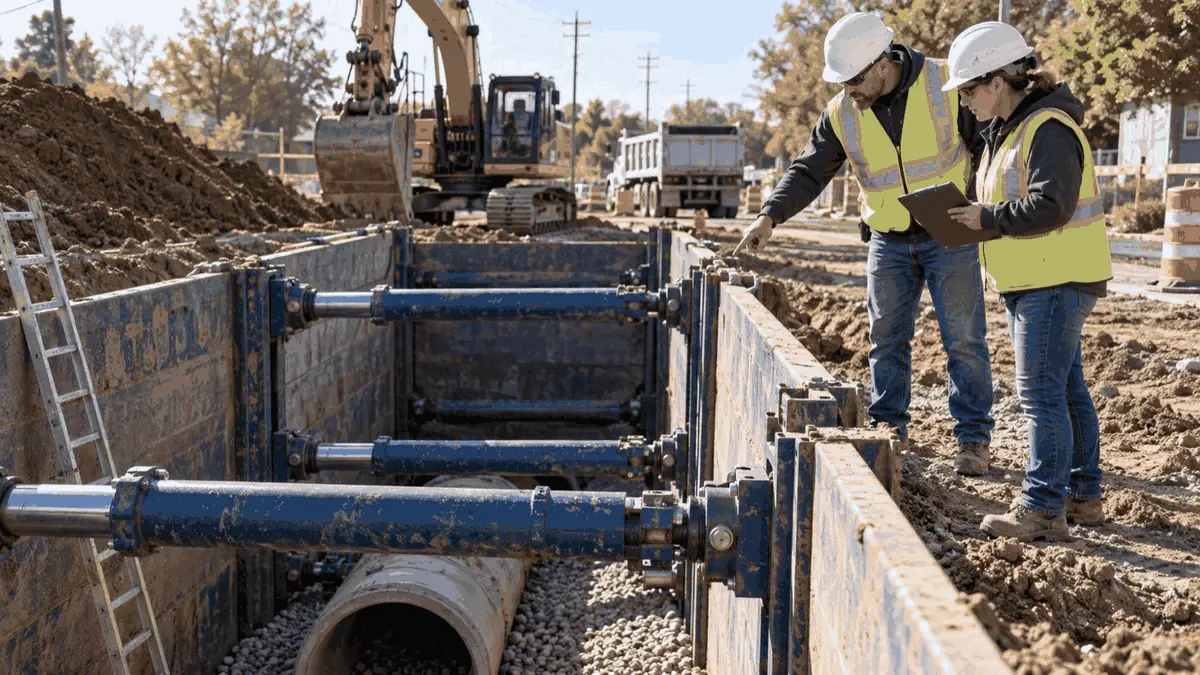
Before trench entry, supervisors need an inspection confirming the shoring matches the excavation, is installed correctly, and remains sound as conditions change.
An approved design or manufacturer table is important, but it is not the last step. A trench shield, hydraulic shoring system, timber system, or other protective system only provides its intended protection when the equipment is the right type and size, the components are complete, the installation follows the design, and the surrounding jobsite does not introduce unplanned loads or water. Employers must organize the work so the Competent Person can make those judgments before entry and whenever conditions change.
Why This Matters on Excavation Jobsites
Trench protection is a system, not a single piece of equipment. The soil, depth, width, weather, nearby traffic, spoil placement, utilities, groundwater, adjacent foundations, and construction sequence all affect the forces acting on the excavation. A shoring inspection that looks only at whether a shield is present can miss a missing pin, an unsupported end, a hydraulic cylinder that has lost pressure, or a load placed too close to the edge.
The consequence of a weak check can be sudden. A sidewall can move after a truck passes, a utility can leak water into the cut, or a crew can extend an excavation beyond the part protected by the system. These events can turn a previously acceptable condition into a stop-work decision. Planning the inspection takes time, but it is usually faster and less disruptive than evacuating a trench after movement, redesigning protection in the field, or investigating an incident.
OSHA’s excavation requirements in 29 CFR 1926 Subpart P address protective systems, access, water, hazardous atmospheres, inspections, and other conditions that affect employee exposure. The rule does not make a generic shield safe for every trench. Employers and Competent Persons must use the applicable design, manufacturer information, tabulated data, or accepted engineering practice for the conditions present.
Supervisors also need to consider workers who are not inside the trench. Equipment operators, laborers, spotters, utility locators, and traffic-control personnel can be exposed to edge collapse, falling loads, struck-by hazards, or unexpected contact with a protective system. A clear pre-entry briefing gives each person a role in keeping the system intact.
What Employers and Supervisors Should Know
The first question is whether the protective system covers the actual work area. Measure the depth and width, identify the planned worker locations, and compare those conditions with the selected system. A shield that fits one section may not protect a widened section, a bell hole, a connection, or an area beyond the shield end. If work progresses, the inspection must follow the crew rather than remain tied to the original excavation layout.
Before entry, the Competent Person should review these elements:
- The excavation dimensions, soil conditions, water conditions, weather history, and nearby loads.
- The protective-system selection and the source of the design information.
- The shield or shoring identification, capacity, component list, and condition.
- The installation sequence, spacing, depth of placement, and required clearances.
- The relationship between the protection and the excavation ends, corners, utilities, and work area.
- The location of ladders or ramps and whether workers can reach them without passing through an unprotected zone.
- The position of spoil, materials, vehicles, cranes, and other surcharge loads.
- Changes since the last inspection, including rain, vibration, thawing, excavation extension, or water entry.
Equipment condition deserves a close look. Check rails, uprights, wales, spreaders, pins, chains, hydraulic cylinders, hoses, feet, welds, and connection points for damage, deformation, leakage, corrosion, or missing parts. Do not improvise a replacement with a component that only appears similar. A substitute can change the load path or reduce the system’s rated performance.
Hydraulic systems should be installed and maintained according to the manufacturer’s instructions. Look for loss of pressure, damaged hoses, uneven loading, or cylinders that are not seated as required. Timber systems require the specified grade, dimensions, spacing, and connections. A field modification, cut, drilled hole, or added opening should be treated as a design question, not a minor convenience.
Shield systems also have limits. A shield is intended to protect workers if a cave-in occurs, but it does not prevent soil from collapsing outside the shield. Workers still need to remain inside the protected zone, and the space between the shield and the excavation wall may need to be controlled as specified. Never allow a worker to climb on a shield, work above its protected height, or enter a gap that the selected system does not address.
The ends of the excavation are often overlooked. A shield may protect the long sides while the crew works near an open end, a cross trench, or a sloped transition. Confirm how the design addresses those locations. Keep workers out of unprotected pockets, and sequence the work so the crew does not move beyond the system while installing pipe, bedding, formwork, or utility connections.
Access and egress are part of the entry decision. Ladders, ramps, or other safe means must be positioned so workers can leave without crossing an exposed section. A ladder that is blocked by stored material, too far from the work area, or unstable on the bottom is not a complete plan. Supervisors should also consider whether a worker can exit if the normal path is blocked by equipment, water, a damaged utility, or a sudden change in the trench.
Water control must be evaluated continuously. Rain, groundwater, leaking lines, and runoff can erode the face, soften soil, undermine equipment, or change the pressure on shoring. Pumps do not by themselves make entry acceptable. Identify the source, control the inflow, inspect for undermining, and reassess whether the protective system and work method still match the conditions.
Nearby activity can load the system. Trucks, excavators, cranes, compactors, roadway traffic, pile driving, blasting, and work on an adjacent foundation may transmit vibration or surcharge pressure. Establish an exclusion zone and a traffic plan. If the work must occur near a structure or heavy load, obtain the necessary engineering input and do not rely on a visual guess about what the soil can support.
Daily inspections should be documented in a way that helps the next person understand what was checked and what changed. A useful record identifies the excavation location, date and time, Competent Person, conditions observed, protective system, corrections made, and the release or stop-work decision. Documentation is not a substitute for field judgment, but it creates a handoff between shifts and helps employers identify recurring problems.
How Training Supports a Safer Excavation Program
OSHA-aligned excavation safety training helps workers recognize cave-in, struck-by, utility, water, access, and atmospheric hazards before they become emergencies. It gives laborers and operators a shared vocabulary for stop-work concerns and helps supervisors understand when a condition needs escalation.
Competent Person training should go further. The designated person needs practice applying the inspection process to soil classification, protective-system selection, changing conditions, and the limits of available data. The goal is not to memorize a checklist. The goal is to make a defensible field decision, communicate it clearly, and prevent entry when the protective system does not match the actual work.
Employers can reinforce training by defining who can authorize entry, who can move or modify protection, who can control traffic, and who must be contacted when the design information is unclear. Pre-task meetings should review the planned sequence, not merely announce that a trench shield will be used. Short refresher discussions after rain, utility exposure, or a near miss can connect classroom learning to the next job.
Training records and certificates of completion help employers track who received the relevant instruction, but the record should sit inside a broader program. Employers still need competent supervision, equipment inspection, site-specific planning, emergency arrangements, and follow-through when a worker reports a concern. Training supports employer compliance and safer decisions; it does not guarantee that every excavation is compliant or safe.
Key Takeaway
Before entry, supervisors should verify that the shoring or shielding system is complete, correctly installed, undamaged, properly matched to the excavation, and supported by safe access, water control, traffic control, and changing-condition inspections. If any part of that picture is uncertain, the next step is to pause entry and resolve the uncertainty.
The right people need the right level of training. General excavation safety training helps the full crew recognize hazards and follow the plan. Competent Person training helps the designated decision-maker inspect conditions, evaluate protection, and control entry. Together, those roles give employers a stronger foundation for a practical excavation safety program.
A strong inspection also includes a communication check. The person directing the excavation should tell the crew what was inspected, where the protected work zone begins and ends, what conditions require a pause, and who has authority to stop the job. This matters when a pipe crew, laborer, operator, and traffic-control worker see different parts of the same operation. Clear communication reduces the chance that one person assumes another person evaluated a change.
Employers should review the inspection process after a near miss, damaged component, unexpected soil movement, or change in production pressure. A rushed installation, a recurring missing part, or repeated water intrusion can indicate a planning problem rather than an individual mistake. Updating the job hazard analysis, equipment staging, or supervisor training can prevent the same weakness from appearing at the next excavation.