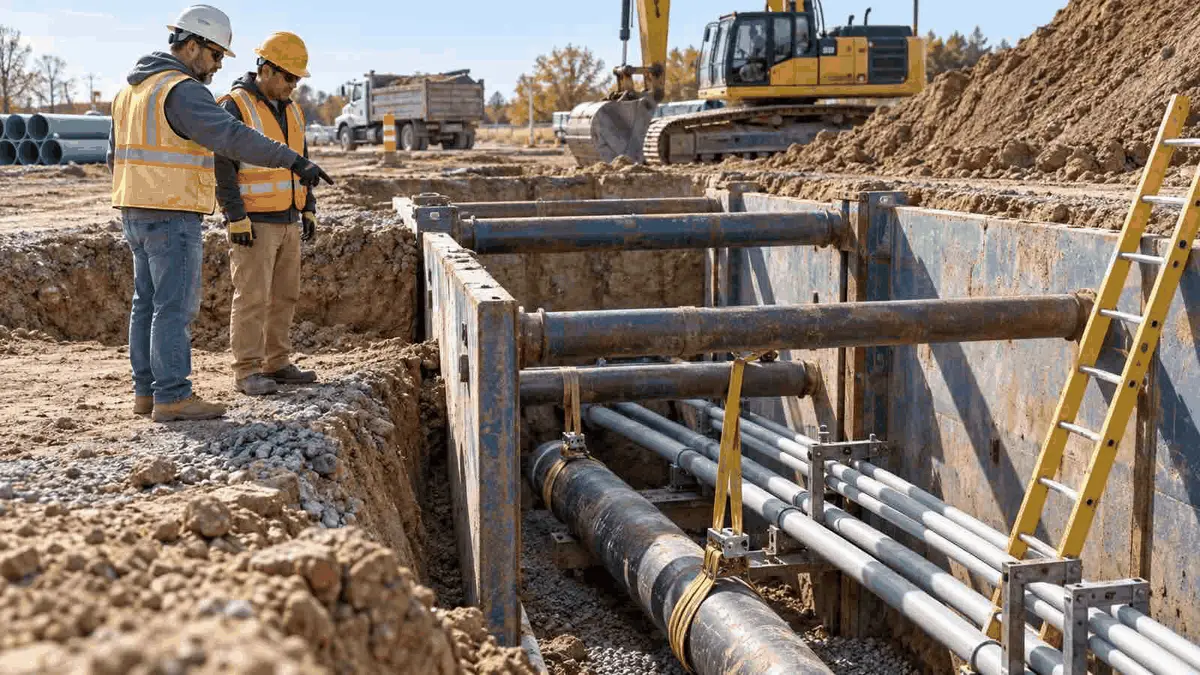
Utility crossing protection helps excavation supervisors control exposed services before entry, reducing cave-in, strike, and falling-load risk. A planned utility crossing is more than a locate mark on the ground. Once an excavation exposes a water line, gas service, electrical duct, communication conduit, sewer, or other installation, the employer has a changing jobsite condition that can affect cave-in risk, struck-by exposure, utility service, and the safety of the crew. The decision to continue should be based on field verification, competent-person judgment, and a clear method for supporting and protecting the service.
The question for many contractors is not whether utilities were located before digging. It is whether the crew has a repeatable process for what happens after the first exposure. Plans may show approximate alignments, but depth, material, joint condition, previous repairs, and actual loading can be different. Training should help workers recognize that an exposed service is not automatically stable, and that a quick visual check is not a substitute for an engineered support method when the condition requires one.
Why This Matters on Excavation Jobsites
An underground utility can become a suspended load when soil is removed around it. The surrounding soil may have helped carry the service before excavation began. As the trench widens or deepens, that support can disappear. A pipe may sag, a joint may separate, a conduit bank may shift, or a line may transfer load into the trench wall. Those changes can happen while the crew is focused on production, bedding, replacement, or the next bucket of material.
The hazard is not limited to a direct utility strike. A damaged gas line or electrical service can create fire, explosion, shock, or service-continuity hazards. A cracked water line can flood the excavation and weaken the soil. A sewer or process line can release contaminated contents. A communication duct can become a trip hazard or a falling object if it is left unsupported. Each condition can change the protective-system decision and the timing of safe entry.
29 CFR 1926 Subpart P requires employers to address hazards associated with excavations, including cave-ins, falling loads, water accumulation, hazardous atmospheres, and access. OSHA also defines a competent person as someone capable of identifying existing and predictable hazards and authorized to take prompt corrective measures. That authority matters at a utility crossing because the correct response may be to stop, isolate, support, redesign, or call the utility owner before work continues.
Utility crossings also affect access and egress. A ladder or ramp that was usable before the service was exposed may be blocked by a temporary support, a bypass line, or a protective structure. Workers may step over a pipe at the edge of a trench or squeeze through an opening that was not part of the original plan. Supervisors should treat the revised route as a new condition and keep the crossing from creating a fall, struck-by, or entrapment hazard.
Changing conditions create documentation and communication needs. A competent person should be able to explain which utility was exposed, where it is supported, who approved the method, what restrictions apply, and what signs require work to stop. A short shift briefing that names the service and the controls is more useful than a general instruction to be careful around utilities.
What Employers and Supervisors Should Know
Before excavation, employers should gather the available utility information, contact the owners when required, and plan for the difference between expected and actual conditions. The work plan should identify who will direct mechanical excavation near the mark, who will verify the exposure by hand methods when appropriate, and who has authority to pause work. The plan should also identify emergency contacts and the actions for a suspected strike.
When a service is exposed, the crew should pause long enough to characterize the condition. Useful questions include:
- What is the service, and has the utility owner confirmed its identity?
- Is the service carrying material, energy, or flow that could harm workers?
- Is it supported by undisturbed soil, a designed support, or nothing reliable?
- Has excavation removed soil from beneath a joint, connection, or bend?
- Could equipment, stored material, traffic, or a trench shield contact it?
- Will the planned protective system press against or transfer load to the service?
- Does the condition change the location of the ladder, walkway, or work area?
The support method should fit the service and the excavation. A pipe may need a cradle, sling, hanger, or engineered temporary support. A conduit bank may need protection from impact and separation from workers. A fragile line may require the owner’s direction before it is moved at all. Improvised lumber, a chain wrapped around a pipe, or a piece of equipment holding a line in place should not be treated as an approved support system simply because it appears stable for a few minutes.
Employers should distinguish between utility protection and trench protection. A support holding a pipe does not protect a worker from a cave-in. A trench shield does not automatically support a suspended utility. Shoring, shielding, sloping, benching, utility supports, and fall protection solve different problems and may need to work together. The competent person should verify that the selected system is installed according to its design, manufacturer instructions, tabulated data, or other accepted method.
The competent person should inspect after the initial exposure and again when conditions change. Warning signs include cracks, raveling, soil movement, new water, leaks, sagging, vibration, equipment relocation, a change in trench depth, a change in support, or a utility owner’s revised direction. Inspections should be completed before entry and as often as needed during the shift to identify hazards in time for corrective action.
Workers need a clear stop-work trigger. Examples include visible movement of the service, an unexplained odor, a damaged coating, a change in pressure or flow, a trench wall that starts sloughing, water entering the excavation, loss of communication with the utility owner, or uncertainty about whether a support is carrying the load. The response should move people away, control ignition and equipment when relevant, keep others out, notify the responsible parties, and re-evaluate before anyone returns.
The same process applies to short-duration work. A small repair excavation can expose the crew to the same utility and cave-in hazards as a large project. Short duration changes the production plan, not the physical behavior of soil or the consequences of a strike. Municipal crews and utility contractors should be especially careful when responding to emergency work, because incomplete information and time pressure can encourage informal decisions.
How Training Supports a Safer Excavation Program
OSHA-aligned excavation training gives workers a shared vocabulary for utilities, protective systems, competent-person decisions, and stop-work communication. General crew training helps employees recognize that an exposed service is a changing hazard and report conditions before they become an incident. Supervisor training adds planning, coordination, and documentation responsibilities. Competent Person training should go deeper into soil conditions, protective-system selection, inspection duties, and the authority to correct hazards.
A useful training exercise can follow one utility from locate to backfill. The crew identifies the planned alignment, discusses how the service will be exposed, decides when mechanical excavation stops, and describes the support or protection method. The exercise then introduces a change, such as a lower-than-expected line, water seepage, a cracked joint, or a shield that cannot be placed as drawn. Workers practice the communication path and the decision to pause.
Employers can reinforce training with field tools. A utility exposure card can record the service, owner contact, support method, protective-system impact, access route, inspection times, and restrictions. A pre-entry briefing can identify the crossing with a drawing or photograph. A handoff between shifts can state what was found, what remains temporary, and what must be checked before work resumes. These tools support employer compliance, but they do not replace field judgment or engineering when the condition exceeds the crew’s authority.
Training should also address emergency actions without suggesting that a worker should approach a damaged utility. A suspected gas release, electrical contact, uncontrolled water flow, or contaminated discharge may require isolation by the owner or emergency responders. Workers should know how to warn others, keep clear, report the condition, and follow the site emergency plan. They should not improvise repairs or enter a compromised excavation to rescue equipment or materials.
The most effective program connects course content to the employer’s actual work. A pipeline contractor may need more emphasis on long exposed runs and multi-employer coordination. A municipal public works crew may need practice with emergency service calls and traffic control. A general contractor may need a process for coordinating utility owners, excavation subcontractors, and daily inspections. The training decision should match the role, the hazards, and the authority assigned to the person making the call.
Key Takeaway
Utility crossing protection is a jobsite control that must be revisited after soil is removed. Employers should train crews to stop at unexpected conditions, supervisors to coordinate support and access, and Competent Persons to evaluate how the exposure changes the excavation and protective system. OSHA-aligned Excavation, Trenching & Shoring Safety Training and Competent Person for Excavation, Trenching & Shoring Training can support that role-based approach, while the employer remains responsible for applying the training to the actual site.