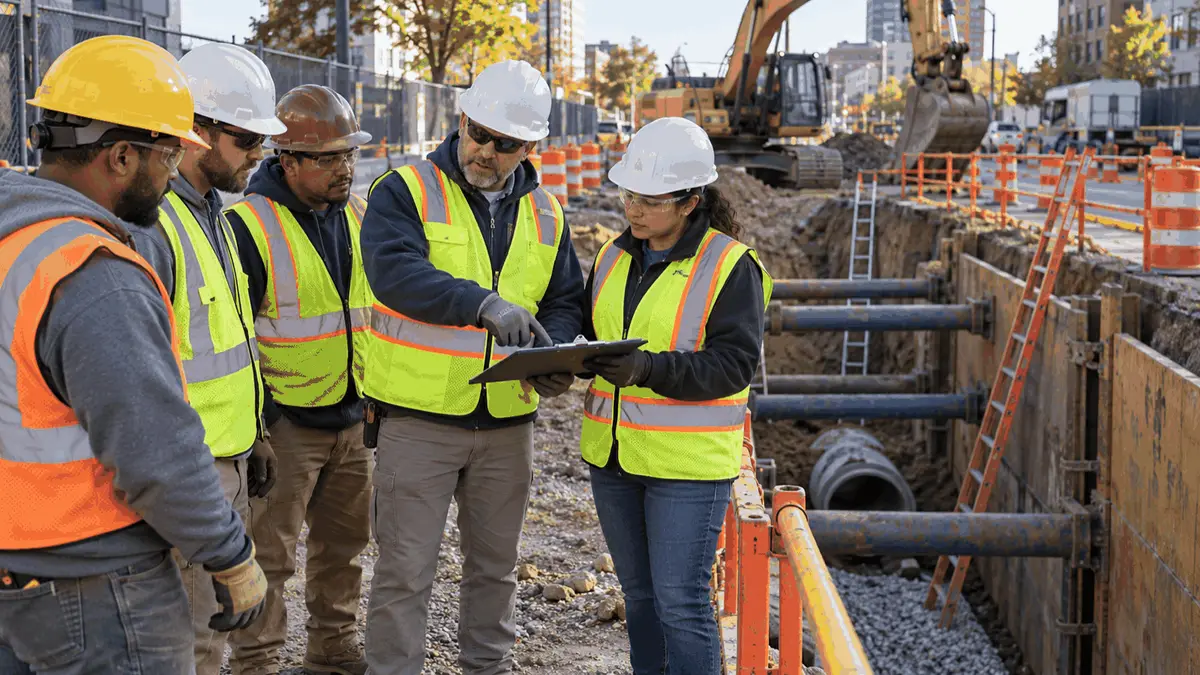
Daily excavation safety briefings help supervisors turn OSHA Subpart P responsibilities into clear crew actions before changing soil, equipment, and utility conditions create a new exposure. A short, specific briefing can connect the competent person’s inspection to the work each person will perform, but it does not replace the inspection, protective system decisions, or employer responsibilities required for the job.
The most useful briefing is not a generic reminder to be careful. It is a jobsite conversation about today’s excavation, today’s sequence, and today’s controls. Crews should know where the excavation is, who can authorize entry, how access and egress will work, what protective system is in place, what conditions require a stop, and how to report a change. Employers that train supervisors and designated Competent Persons to lead these conversations create a more repeatable excavation safety program.
Why This Matters on Excavation Jobsites
An excavation can look unchanged while its risk profile changes. A loader may work closer to the edge, a utility may be exposed, a rain event may soften the soil, a spoil pile may move, or a nearby road may add vibration and surcharge loading. A morning briefing gives the competent person a practical way to explain those conditions and gives workers a chance to identify information that may not be visible from the edge.
OSHA 29 CFR 1926 Subpart P places important duties on employers and competent persons, including evaluating conditions, selecting and maintaining protective systems, controlling hazards, and inspecting excavations as needed. A briefing does not make a protective system compliant by itself. Its value is that it helps the crew understand the decisions already made and the limits that must be respected.
The briefing also supports productivity. Workers who understand the planned access route are less likely to improvise a climb. Operators who know the setback for equipment and spoil are less likely to place loads where they can affect the excavation. Utility crews that understand the exposure around an existing service are more likely to stop when the field condition differs from the plan. Clear expectations reduce avoidable interruptions without treating production as more important than safe entry.
Supervisors should treat the briefing as a feedback loop. Ask workers what changed since the previous shift, what work will occur near the excavation, and what control is hardest to maintain. A worker may know that a ladder is blocked by pipe, that water is collecting at a low point, or that a delivery truck must cross near the edge. Capturing those observations before entry is more useful than discovering them after a close call.
Excavations also interact with hazards outside the cut. Traffic can strike people or equipment. Falling materials can reach workers below. Water can weaken soil and obscure footing. Nearby structures can be affected by the excavation. Atmospheric hazards may matter in unusual locations. The briefing should make these connections visible so that crew members do not reduce trench safety to the question of whether a shield is present.
What Employers and Supervisors Should Know
The first decision is who leads the briefing and who has authority to stop work. On some projects the competent person is the supervisor. On others, the competent person may inspect and communicate findings while a foreman coordinates production. The roles can be combined only when the individual has the knowledge, training, authority, and availability to perform every assigned duty.
Before workers enter, the briefing should address:
- The location, dimensions, depth, and planned sequence of the excavation.
- Soil information, visible signs of change, water, weather, and nearby vibration.
- The protective system, its limits, and any restrictions on moving or modifying it.
- Safe access and egress, including where ladders, ramps, or stairs are located.
- Spoil piles, equipment, materials, and traffic controls that must remain outside the controlled setback.
- Utility locations, exposed services, and the method for communicating a conflict.
- Conditions that require evacuation, reinspection, consultation, or a stop-work decision.
The conversation should be concrete. Instead of saying “stay away from the edge,” identify the marked boundary, the equipment path, and the person who will monitor encroachment. Instead of saying “use the ladder,” show the ladder and state which route workers will use if the primary route is blocked. Instead of saying “watch for water,” explain what pump, diversion, or inspection response is planned and who can authorize re-entry.
Employers should account for language, literacy, and experience. A crew can receive the same instruction in English and Spanish, use photographs or a simple site sketch, and repeat the stop-work signal in a way everyone understands. Language access is not a substitute for technical training, but it can make role expectations more usable in the field. Workers should be invited to restate the critical controls in their own words.
The competent person should connect the briefing to the inspection record. If the inspection finds cracking, sloughing, bulging, loose rock, hazardous atmosphere, or another concern, the response should be explained and recorded according to the employer’s program. If the condition changes during the shift, a second briefing may be necessary. A signature sheet alone does not prove that conditions were evaluated or that workers understood the plan.
Briefings should also cover the work outside the excavation. Concrete trucks, vacuum trucks, cranes, compactors, and delivery vehicles can impose loads or vibration. A worker performing layout near the edge may need a different exclusion zone than a worker inside a shield. Utility exposure may require a different sequence from ordinary digging. The briefing should match the actual task rather than rely on a one-size-fits-all form.
Emergency planning belongs in the discussion. Workers should know how to communicate an incident, where to assemble, how to keep untrained people out of the excavation, and who contacts emergency services. They should not be told to enter an unstable excavation for a rescue unless a qualified and authorized response plan supports that action. Training should reinforce that a rapid response begins with preventing a second victim.
How Training Supports a Safer Excavation Program
OSHA-aligned excavation training can help employers build a shared vocabulary for soil classification, protective systems, inspections, access and egress, utilities, and changing conditions. General crew training can explain what workers must recognize and report. Competent Person training can go deeper into hazard evaluation, protective-system selection, inspection authority, and the decisions that determine whether entry is allowed.
Training is most useful when it is assigned by role. A laborer needs to understand entry limits, warning signs, and how to report a change. An operator needs to understand edge loading, utility exposure, and interaction with workers on foot. A foreman needs to coordinate sequence, access, traffic, and communication. A designated Competent Person needs the technical basis and authority to inspect, correct, and stop work. One course may not satisfy every role in a project’s written program.
After training, employers should connect lessons to site procedures. Update the daily briefing template, define inspection triggers, identify who reviews changes, and make sure supervisors know how to document corrective action. Use observations from briefings and near misses to improve the next training cycle. A certificate of completion can show participation, while the employer’s procedures and field actions show how training is being applied.
Short briefings can also support contractor coordination. When several employers share an excavation, the controlling contractor should make responsibilities clear. Each employer needs to communicate the hazards its work creates, and workers should know whether a change must be reported to a foreman, competent person, project manager, or another designated contact. A coordinated briefing reduces the chance that one crew removes a control another crew depends on.
Key Takeaway
Daily excavation safety briefings are a practical bridge between Subpart P requirements and crew-level behavior. The briefing should be specific to the excavation, led by people with the right authority, connected to the competent person’s inspection, and updated when conditions change. Employers should train the people who inspect, supervise, operate, and enter so each role understands both its responsibility and its limits.
The right training decision is usually role-based. Start with the hazards and duties present on the project, then provide general excavation safety training for exposed workers and deeper Competent Person training for those who evaluate conditions and control entry. Training supports a safer program, but it works best with inspections, protective systems, planning, documentation, and a workplace where stopping for a changed condition is expected.
Supervisors can improve the quality of these conversations by preparing from the field rather than from memory. Walk the excavation before the crew gathers, compare the planned sequence with the actual work, and identify the one or two changes most likely to affect entry. A briefing that names those changes is easier to remember than a long list of every possible hazard. Repeat the critical limits when a new crew arrives, an activity changes, or the excavation is left and re-entered.
The record should be useful after the shift. Note who attended, what conditions were discussed, what corrective actions were assigned, and whether a follow-up inspection occurred. Do not use documentation to create a false sense of security. Use it to identify recurring problems, such as blocked ladders, incomplete barricades, unclear utility markings, or equipment repeatedly approaching the edge. Those patterns can guide coaching, planning, procurement, and future training.