Foundation-adjacent excavations require employers to verify support, soil movement, protective systems, access, and changing conditions before workers enter cut. The review should continue as the excavation advances.
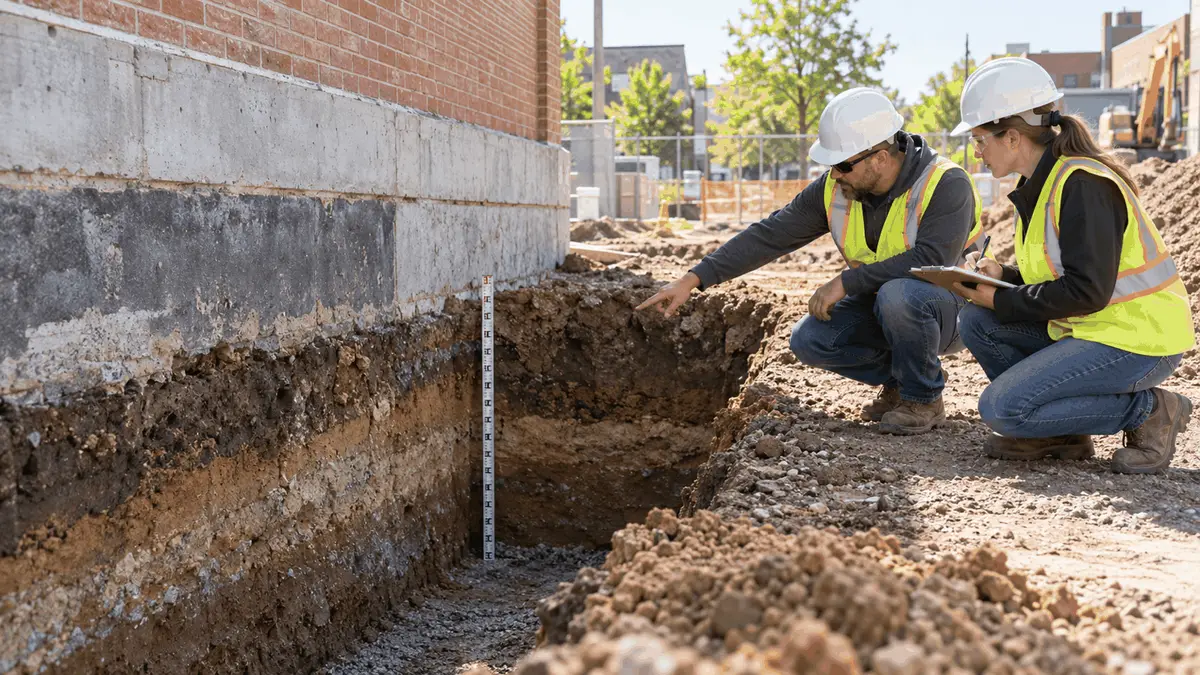
An excavation beside a footing, retaining wall, pavement, or buried structure can change the risk profile even when the trench is shallow and the soil looks firm. The important question is not simply whether a worker can step into the cut. It is whether excavation work could undermine an adjacent structure, create surcharge loading, change the soil classification, or allow loose material to move into the work area. That question belongs in the planning conversation before equipment removes soil, and it remains active while the excavation changes.
The competent person, project supervisor, and employer each have a practical role. The competent person evaluates conditions and protective systems, the supervisor coordinates the work sequence and crew decisions, and the employer provides the time, equipment, engineering support, and training needed to act on those evaluations. A certificate of completion can support that program, but it does not replace site-specific judgment or the professional design that may be required.
Why This Matters on Excavation Jobsites
Excavating near a foundation can transfer forces in ways that are not obvious from the surface. Removing soil may take away lateral support, expose a footing, create a vertical face below the base of a wall, or route water toward the structure. Vibration from compactors, trucks, breakers, and nearby traffic can add another variable. A spoil pile or parked machine near the edge can increase the load on soil that already has less support than it did before excavation.
OSHA 29 CFR 1926.651(i) addresses the stability of adjoining buildings, walls, and other structures. Where excavation operations endanger stability, support systems such as shoring, bracing, or underpinning are required to protect employees and the structure. Excavation below the level of a foundation or retaining wall also has specific conditions that must be satisfied. In some situations, stable rock or a registered professional engineer's approval may be relevant, but the crew should not treat a convenient assumption as a protective system.
The risk extends beyond a possible cave-in. Workers may face falling concrete, loose soil, damaged utilities, water inflow, hazardous atmospheres, vehicle exposure, and limited access. An undermined sidewalk or wall can fail outside the excavation and strike people who are not even inside the cut. That is why a competent-person inspection covers the excavation, adjacent area, and protective system, not only the trench bottom.
Schedule pressure can make this issue worse. A crew may be asked to expose a service, install a pipe, or place a form before the next trade arrives. If the excavation changes faster than the plan, the safest decision may be to pause, isolate the area, and obtain a revised control. A short stop-work decision can prevent a much longer shutdown, emergency response, investigation, or repair.
Employers should also account for the people who work around the excavation. Operators need a clear boundary and spotter plan. Laborers need to understand where they may stand while material is lifted. Supervisors need a way to communicate changes to subcontractors and visitors. Competent Persons need authority to keep people out until conditions are corrected. These are training and management decisions as much as they are excavation details.
What Employers and Supervisors Should Know
Start with the relationship between the excavation and the adjacent structure. Obtain available drawings, utility information, foundation details, previous soil reports, and project specifications. Walk the surface with the people who understand the building, roadway, or utility system. Look for cracks, settlement, leaning walls, open joints, patched pavement, wet areas, or changes in drainage. These observations do not prove instability, but they help identify questions that deserve engineering review.
Before entry, the competent person should verify a practical control set:
- The excavation limits and depth are marked, including the anticipated final grade.
- Foundation bases, wall faces, pavements, utilities, and other adjacent features are located as accurately as possible.
- The protective system is selected for the actual soil, depth, geometry, loads, and nearby structures.
- Shoring, bracing, underpinning, sloping, benching, or shielding is installed as designed and used within its limits.
- Spoil, equipment, materials, and traffic are kept away from the edge or controlled with retaining measures.
- Ladders, ramps, stairs, or other access points are positioned so workers do not climb against an unsupported face.
- Water, rain, groundwater, leaking services, and surface runoff have a control plan.
- Barricades and exclusion zones protect workers from falling material, vehicles, and public access.
- The crew knows who can stop the job and how a change will be communicated.
The inspection should be repeated when the excavation progresses, when support is installed or moved, after rain, after vibration or nearby loading, after a utility is exposed, and whenever a worker reports a concern. A record should identify the location, time, conditions, people involved, findings, corrective actions, and release decision. A checklist is useful only when the person completing it compares the written plan to what is actually in the ground.
Protective systems require disciplined installation. A shield is not a substitute for every other control, and it does not make an unsupported structure safe. Shoring components need to be installed, inspected, and removed in the sequence specified by the design or manufacturer's information. If the excavation geometry no longer matches the plan, the crew should stop and reassess instead of improvising a brace, moving a shield beyond its rating, or asking workers to enter a narrow gap.
Access and egress deserve special attention near foundations. A ladder may be technically present but poorly placed if workers must pass beneath an overhang, step around a brace, or walk along a wet footing. Routes should remain usable as the work advances. Keep the area around ladders clear, prevent materials from falling into the route, and coordinate lifting so no one has to choose between a safe exit and production.
Utilities and water can change the foundation risk at the same time. A damaged water line can erode soil beneath a footing. A sewer or storm drain can create a void. A gas or electrical service can add a separate emergency. The crew should know how to stop work, who controls the utility, and what conditions require evacuation. Water removal equipment should not be treated as proof that the excavation is ready for entry. Pumping can affect soil stability and may require a different plan.
How Training Supports a Safer Excavation Program
Role-based training helps an employer turn a standard into consistent field behavior. General crew training can cover cave-in hazards, edge protection, access, spoil placement, utility awareness, warning signs, and the obligation to follow the competent person's directions. Supervisor training can add planning, sequencing, subcontractor coordination, documentation, and stop-work communication. Competent Person training can focus on inspections, soil and protective-system decisions, changing conditions, and escalation to engineering support.
Training should connect concepts to the work the crew actually performs. A utility contractor may need repeated practice with exposed services, water, traffic, and narrow rights-of-way. A municipal crew may need a compact field routine that works during emergency repairs. A general contractor may need a coordination process for several subcontractors sharing one excavation. The goal is not to make a course certificate stand in for experience. The goal is to give people a common vocabulary and a repeatable way to recognize when the plan no longer fits.
Employers can reinforce learning with a short pre-task conversation. Ask what is adjacent, what is changing, where people will enter and leave, how material will be kept back, what the competent person will inspect, and what condition triggers a pause. Invite workers to point out differences between the drawing and the excavation. Capture concerns in the daily record and close the loop when the control is changed.
The same approach applies to small repairs and emergency callouts. A short trench for a valve or service connection can still interact with a footing, roadway, water source, or traffic lane. Train crews to slow down at the point where the expected condition changes, even when the production task seems routine. A clear escalation route lets a foreman obtain competent-person input, engineering support, or utility coordination without making the worker choose between schedule pressure and a safe decision.
An OSHA-aligned course can support onboarding, refresher planning, and group training for construction, utility, pipeline, and public works teams. It should be paired with site-specific procedures, equipment instructions, competent-person authority, and any required engineering design. Employers should retain completion records, define who holds each role, and review the program after incidents, near misses, significant changes, or repeated inspection findings.
Key Takeaway
Excavation near an existing foundation deserves a deliberate decision before anyone enters. Verify the structure, soil, loads, water, protective system, access, and communication plan, then inspect again as the job changes. Competent Person training and crew-level excavation safety training help the right people recognize the decision points, but employers still need to provide the site controls and authority that make those decisions effective. Choosing the right training path is one part of a broader program that protects workers, neighboring structures, and the project itself.