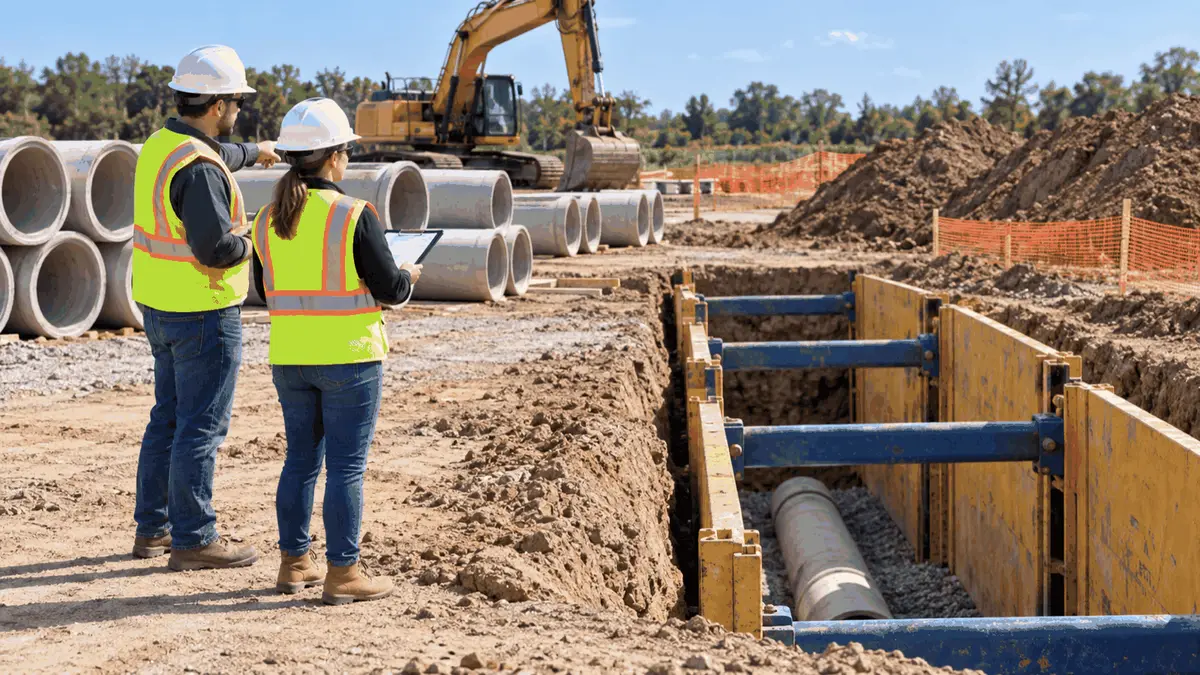
Before pumping starts, supervisors should verify the water source, discharge path, soil response, protective system, access, and reinspection steps.
Water control is often introduced as a quick production decision. A crew sees seepage, rainwater, a broken service, or groundwater collecting in an open excavation, and someone looks for a pump. The pump may be useful, but starting it without a plan can change soil support, create a discharge problem, damage a protective system, or place workers near an unstable edge. Dewatering is part of the excavation plan, not a substitute for the plan.
The practical question is whether the employer understands why water is present and how removing it will affect the excavation. A supervisor should coordinate the pump, hoses, fuel or power, discharge location, traffic, access, and inspection with the competent person. Training helps the crew recognize that changing water conditions can require a pause and a new evaluation before anyone enters.
Why Water Control Matters on Excavation Jobsites
Water can weaken or erode soil, conceal cracks, reduce footing, add weight to spoil, and obscure the bottom of an excavation. Flowing water can carry fines from a wall or create channels beneath a support component. Even shallow standing water can make a ladder landing slippery and can hide trip hazards, holes, or loose material.
The source matters because each source suggests a different response. Rainwater may be controlled with diversion, grading, temporary berms, or a pump. Groundwater may require a designed wellpoint, sump, or other method. A leaking water line may require isolation and utility coordination. Runoff from a higher work area may continue after a pump starts if the contributing path is not controlled.
Pumping can also change conditions outside the trench. If water leaves the soil too quickly, adjacent ground can settle or fines can migrate. A discharge that crosses a roadway can create a slip or traffic hazard. A hose placed across a walkway can cause a crew member to step toward the edge to get around it. The safe plan accounts for the whole route from source to discharge.
Workers may believe that a dry-looking bottom means the excavation is ready. Dryness alone does not confirm stable soil, adequate protection, safe access, or an acceptable atmosphere. The competent person still needs to inspect the excavation and its surroundings before entry and after a material change in conditions.
What Employers and Supervisors Should Know
The employer should identify who can authorize dewatering, who sets up the equipment, who monitors the excavation, and who decides whether work pauses. Those roles should be clear before water begins to collect. A worker assigned only to watch a pump should know how to report rising flow, hose movement, power loss, fuel problems, and signs of wall movement.
The competent person should consider the following questions:
- What is the likely source, and can that source be isolated, diverted, or reduced?
- Does the protective system remain suitable for the soil, depth, loading, and water condition?
- Will pumping affect nearby foundations, pavements, utilities, slopes, or occupied areas?
- Where will the water discharge, and what controls keep sediment or debris from leaving the site?
- Can hoses, cords, fuel, and pumps be placed without blocking access or loading the edge?
- What happens if the pump stops, the discharge backs up, or rain increases the flow?
- Does the crew need a standby pump, alarm, generator, or emergency shutdown method?
- How will workers communicate if noise, distance, or equipment blocks visual contact?
- What observations require the excavation to be cleared and inspected again?
OSHA 29 CFR 1926 Subpart P addresses hazards associated with excavations, including water accumulation and inspections. The standard does not provide a universal pump size or a one-distance-fits-all discharge rule. Employers should apply the standard, the competent person's evaluation, equipment instructions, and an engineered design when conditions require one.
Planning the Pump and Discharge Route
Equipment selection should follow the condition instead of driving it. A small portable pump may handle a limited rain event, while continuous groundwater may require a designed system. The plan should identify capacity assumptions, intake protection, power, fuel, noise, maintenance, and the effect of clogging. A pump that loses prime when sediment enters the intake may provide less protection than expected.
The intake should be placed so it does not undermine a wall, disturb bedding, or create a trip hazard. Workers should not reach into an excavation to reposition a running pump unless the task has been specifically evaluated and the protective system makes the work safe. A long hose or suction line needs support and protection from equipment traffic.
Discharge deserves equal attention. Directing water onto an adjacent slope, road, sidewalk, storm drain, or property can create new hazards and may involve site-specific environmental or local requirements. A sediment control measure may be needed before water leaves the work area. The crew should know whether the discharge location can receive the expected volume and whether it will remain safe during a storm.
The route should be marked and checked after equipment moves. Hoses and cords should not run across ladders, emergency paths, vehicle entrances, or the only clear route to a work zone. If crossing is unavoidable, the employer should provide a suitable crossing or reroute the line. A temporary arrangement that is safe at the start of a shift can become unsafe after a truck turns, a pile is moved, or mud builds up.
Inspection and Reentry Decisions
The competent person's inspection should cover the excavation, adjacent ground, protective system, water level, pump position, discharge path, access, and nearby loads. The inspection should be repeated when rain, vibration, equipment movement, water flow, freezing, thawing, or pumping changes the conditions.
Useful records identify the time, weather, water source or observation, pump setup, discharge location, protective system, access route, and decision made. A note such as "pumped out" is not enough to explain whether the excavation was inspected before workers reentered. A short checklist can help, but it should not replace judgment when the condition is unusual.
The crew briefing should explain what a change looks like and who has authority to stop work. Examples include muddy or cloudy discharge, a new crack, sloughing soil, movement of a trench shield, rising water, a blocked ladder, loss of power, or a pump intake that has shifted toward the wall. Workers should not wait for a supervisor to notice a condition that they can report immediately.
Reentry may need to wait until water is controlled, the excavation is inspected, and the planned protection and access are confirmed. If the pump cannot keep up, the work method may need to change. A crew should not remain in a trench while someone experiments with a different pump or tries to clear a blocked intake from an unsafe position.
Training Support for Dewatering Work
Excavation safety training can help supervisors connect Subpart P concepts to field decisions. A useful program covers soil and water indicators, protective systems, access and egress, equipment interaction, weather changes, inspections, and stop-work communication. It should also make clear what the training does not do: it does not replace an employer's site-specific plan, competent-person evaluation, manufacturer instructions, or engineering support.
Role-based practice is valuable. A supervisor can practice reviewing a pump layout. A competent person can practice documenting a reinspection after a rain event. An operator can practice isolating power and reporting a failed pump. A spotter can practice keeping traffic and discharge routes separated. These roles work together only when each person understands the boundaries of the assignment.
Employers should keep training records with the job briefing, inspection records, equipment checks, and corrective actions. The record should show what the worker was expected to do and how the lesson connects to the actual work. A certificate can support a training file, but field readiness still depends on the employer's process and the conditions at the site.
Key Takeaway
Dewatering is a control that changes excavation conditions. Before pumps start, supervisors should understand the source, protect the edge and walls, plan a safe discharge route, preserve access, assign monitoring responsibilities, and require reinspection before entry. When water cannot be controlled safely, the correct decision may be to change the work method or stop until the employer can evaluate the condition.
Sources https://www.osha.gov/laws-regs/regulations/standardnumber/1926/1926SubpartP https://www.osha.gov/trenching-excavation