
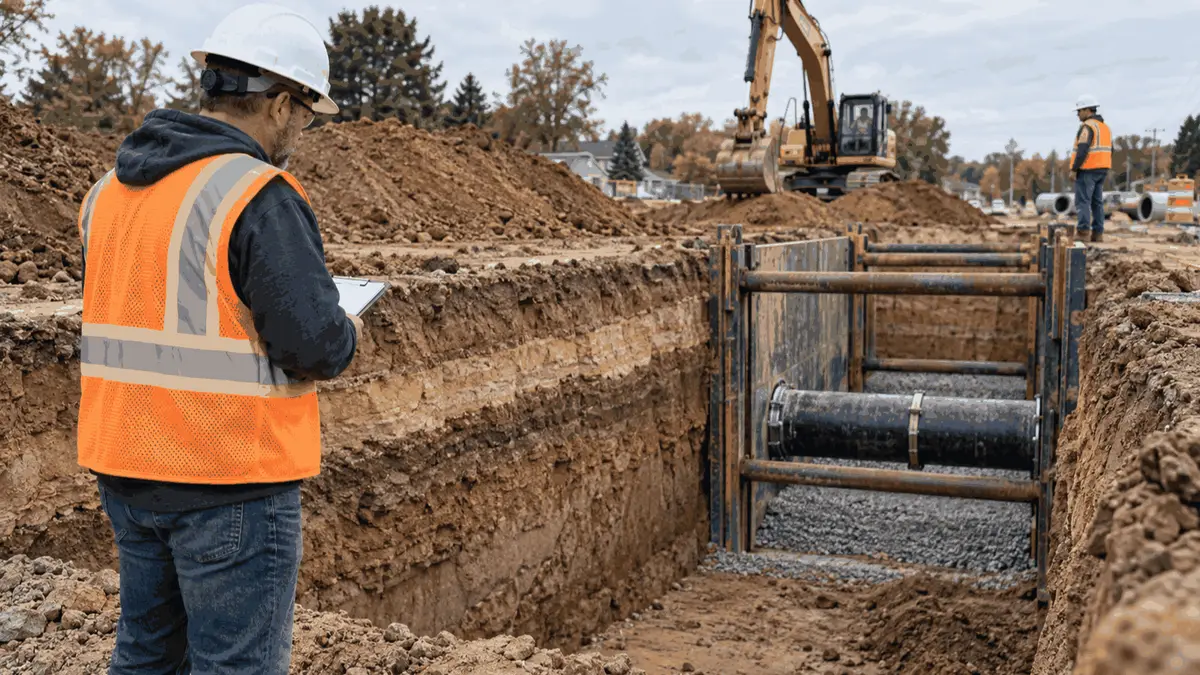
Before digging begins, soil classification records help competent persons connect field observations, protection choices, and changing conditions to the plan.
Why Soil Classification Matters on an Excavation Job
Soil is not a decorative detail around a trench. It is part of the temporary structure that workers depend on while the excavation is open. The material may stand briefly, crack after rain, slough when vibration reaches the edge, or lose strength when water moves through it. A classification decision gives the employer and competent person a disciplined way to describe those conditions before they choose sloping, benching, shoring, or shielding.
The practical value of a record is not that it turns a changing excavation into a fixed object. Its value is that it preserves the reasoning behind the initial plan and gives the next inspection something to compare. A short note about a uniform clay layer is less useful than a record that identifies the observed material, location, depth, moisture, layering, nearby loads, and the method used to reach the conclusion. The record should help a supervisor understand what was seen, what was assumed, and what would require the plan to be revisited.
Classification also matters when several crews share a site. The operator running the excavator, the foreperson placing pipe, the utility locator, and the person inspecting the excavation may each notice different conditions. A common record reduces the chance that one person treats a change in color or texture as harmless while another recognizes it as a sign of layered or disturbed material. Clear documentation supports a pre-task conversation without pretending that paperwork replaces field judgment.
A classification record is not a permit and does not make an excavation safe by itself. It is one part of the employer's planning, training, inspection, and protective-system process. The people making decisions still need to understand the excavation, the work sequence, the available protective system, and the conditions that can make the original decision unsuitable.
What Competent Persons Should Observe and Record
A useful record begins with the excavation's identity. Include the project area, station or reference point, date, time, approximate depth and width, planned work activity, and the person making the observation. If the work moves along a utility alignment, use a location convention that lets the crew connect the record to the portion of trench actually inspected. A generic note for an entire project can hide meaningful differences between a dry shallow cut and a deeper section near a roadway.
The record should describe the soil or rock observed at the face, sidewalls, and bottom. Note whether the material appears cohesive, granular, layered, fissured, previously disturbed, or mixed. Describe visible seams, lenses, fill, debris, roots, voids, or signs of erosion. The goal is not to make a laboratory claim from a quick glance. The goal is to capture the field evidence that supports the classification method and to identify when additional evaluation is needed.
Moisture deserves its own entry. A trench may be dry at the morning inspection and damp later because of a water line leak, precipitation, groundwater, irrigation, or a change in grade. Record seepage, standing water, dripping, saturated pockets, and any pumping or drainage controls. If water is being removed, note where the water is coming from and whether the removal method could affect the sidewall or the base. Water controls should be evaluated as part of the excavation plan, not treated as a separate housekeeping item.
Adjacent conditions can change the load on the soil. Record spoil piles, excavated material, equipment, materials, traffic, formwork, structures, pavement, and stored pipe near the edge. Note vibration sources such as breakers, compactors, road traffic, or pile-driving operations. Also record undermined sidewalks, walls, foundations, poles, and utilities. A soil description that ignores those loads is incomplete because the surrounding conditions can influence how the excavation behaves.
The record should identify the protective system selected or being considered, the applicable table, design, or manufacturer information used, and any limits that matter to the crew. If a shield is used, document its size, configuration, and relationship to the excavation. If sloping or benching is used, show the planned geometry and the observed conditions supporting it. If a design is supplied by an engineer, retain the design with the daily field documentation so the supervisor can compare the design assumptions with current conditions.
How the Record Supports Employer and Supervisor Knowledge
Employers need more than a completed form. They need a process that makes the form part of the work. Before excavation begins, the supervisor should explain who will classify the soil, who will inspect the excavation, how changes will be communicated, and what conditions stop work. The crew should know where the current record is kept and how to report a crack, slough, water change, damaged shield, or new load at the edge.
Supervisors should compare the classification record with the actual work sequence. A plan made before the trench reached a crossing may not address the next section. A record made before a storm may not describe the soil after the rain. A note made before a delivery truck began using the access road may not account for the added vibration. The right question is not whether the form is signed. It is whether the information still represents the section where workers will be present.
Training supports this process by giving workers a shared vocabulary. Workers do not need to become geotechnical specialists to report observable changes. They should be able to say that a sidewall is cracking, a seam is opening, water is entering, the spoil pile moved closer, or the shield is not positioned as planned. The competent person then evaluates the report and decides whether to revise the protection, remove workers, stabilize the condition, or obtain additional support.
Record review can also reveal weak planning. If every daily form says conditions are unchanged while photographs show different soil layers, the inspection process may be too general. If the protective system changes but the record does not explain why, the employer may not be able to reconstruct the decision. If multiple crews use different terms for the same material, a brief field coaching session may be more useful than another blank form.
Training Support for Soil Classification and Protective Systems
Training should match the responsibilities assigned to each role. Workers who enter excavations need practical awareness of access, egress, protective systems, spoil placement, water, atmosphere, and stop-work expectations. Equipment operators need to understand how digging sequence, bucket placement, and swing paths can affect sidewalls and people below. Supervisors need stronger decision support for inspections, changes in conditions, communication, and coordination with engineering or utility personnel.
A course can reinforce the concepts behind Subpart P and help a team recognize common warning signs, but course completion is not the same as field qualification for every decision. Employers still need to evaluate whether the person assigned to inspect and classify the excavation has the knowledge, experience, and authority required for the work. They also need to provide site-specific instruction when the project introduces unusual soil, adjacent structures, utilities, water, traffic, or protective equipment.
Useful training activities include reviewing a sample classification record, comparing two photographs of the same trench before and after rain, identifying adjacent loads on a site sketch, and practicing how a worker reports a change. The exercise should end with a decision: continue with the current plan, modify the plan, obtain a design, or keep people out until the condition is evaluated. This keeps the discussion connected to the actions that protect people.
Employers should retain attendance and completion records, but they should also connect training to the job hazard analysis, daily briefing, inspection process, and corrective actions. If a record shows repeated confusion about layered soil or water, the response should include coaching and plan improvement rather than simply assigning a general refresher.
Key Takeaway
Soil classification records are most useful when they describe the actual excavation, preserve the reasoning behind the protective-system decision, and make changes visible to the next supervisor and crew. Use them with competent-person inspections, protective-system information, training, and clear stop-work expectations. The document is a decision aid, not a substitute for field judgment or employer responsibility.
A clear record should also make room for unresolved questions. If the person classifying the soil cannot see a buried layer, confirm an adjacent load, or determine why water is entering, write that limitation down and assign follow-up. Uncertainty is useful information when it leads to a pause, a design review, a different inspection interval, or a request for competent technical assistance. It is less useful when a form forces the reviewer to choose a confident answer that the field evidence does not support.
Sources
OSHA, Excavation and Trenching https://www.osha.gov/trenching-excavation
OSHA, 29 CFR 1926 Subpart P Excavations https://www.osha.gov/laws-regs/regulations/standardnumber/1926/1926SubpartP
OSHA, 29 CFR 1926.651 Specific Excavation Requirements https://www.osha.gov/laws-regs/regulations/standardnumber/1926/1926.651