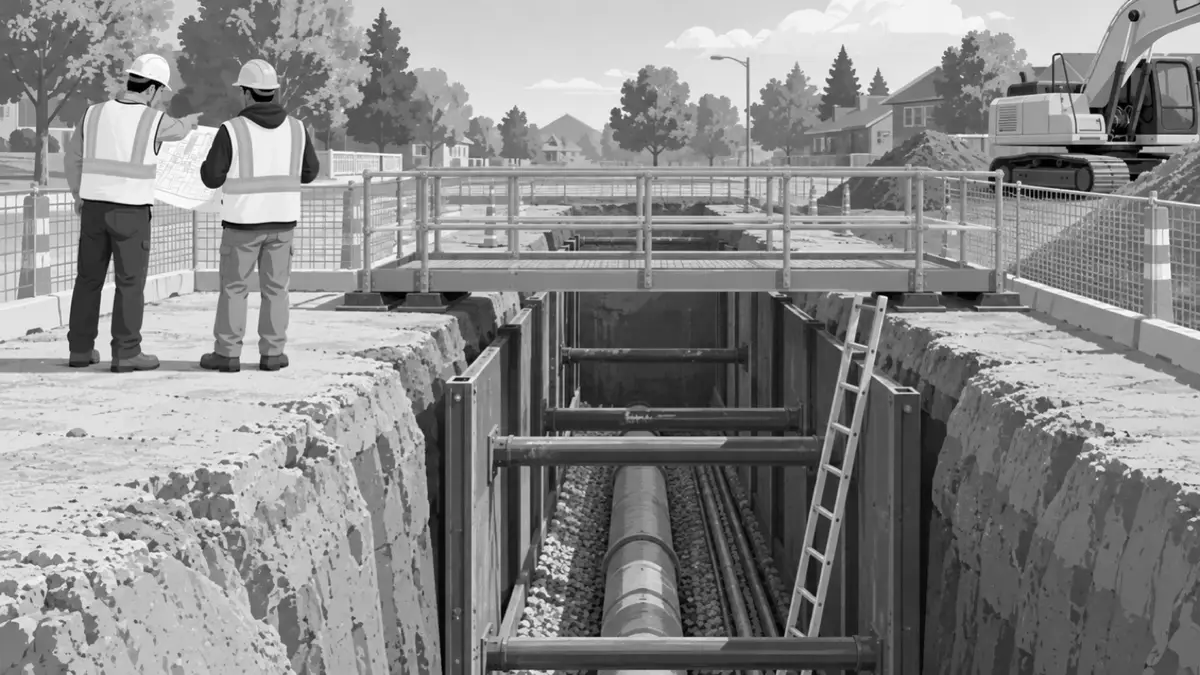
A safe trench crossing starts with a planned route, stable support, and a supervisor who can close the route when excavation conditions change.
Why This Issue Matters
Crews often need to move people, tools, pipe, and small equipment from one side of an excavation to the other. A shortcut across an unprotected edge can turn routine access into a fall or cave-in exposure. Even when the trench has an appropriate protective system, the crossing point can introduce a separate hazard through weak decking, missing guardrails, shifting soil, or traffic that transfers loads to the excavation.
The right question is not simply whether a bridge is present. The employer should be able to explain why the crossing is located there, what it is designed to carry, how it is secured, and how workers will approach it. A crossing should fit the excavation geometry, the protective system, the expected traffic, and the sequence of work. If the trench changes, the crossing plan may need to change with it.
OSHA Subpart P addresses access and egress, protection from cave-ins, and conditions around excavations. The standard is not a substitute for a site-specific plan. It gives employers a framework for controlling recognized hazards while the competent person evaluates the actual soil, depth, water, surcharge, adjacent work, and protective system in use.
Crossing decisions also affect housekeeping. Loose pipe, hoses, spoil, mud, and cords near a bridge create trip hazards and can make a worker step outside the intended path. A well-built crossing that is approached through clutter is still a poor access system. Training should connect the crossing itself to the route leading to it and the destination on the opposite side.
The issue is especially important on utility projects where a trench is opened, partially backfilled, reopened, and extended several times in one shift. The crossing that was safe in the morning may be too close to a new excavation face, may bear on disturbed soil, or may conflict with a relocated trench shield by afternoon. A repeatable inspection and communication routine helps the crew recognize that a crossing is part of the excavation system, not a permanent fixture.
Access routes should be coordinated with the rest of the site plan. A delivery truck, crane setup, dewatering hose, or temporary power line can change where workers walk and where loads are placed. Reviewing the crossing during the daily pretask meeting gives the supervisor a chance to connect the route with traffic control, housekeeping, and the day's excavation sequence.
Employer and Supervisor Knowledge
Before work starts, the employer should assign responsibility for selecting and checking crossing points. The competent person should understand the excavation layout, the protective system, the access requirements, and the loads created by people or equipment using the crossing. The supervisor should know who can remove a crossing, who can authorize a replacement, and how the crew will be notified when the route is closed.
The crossing should be wide enough and strong enough for its intended use. A narrow plank may not provide a stable route for a worker carrying material. A bridge intended for foot traffic should not quietly become a route for a loader, skid steer, or pallet of pipe. The plan should identify whether the crossing is for pedestrians only and should control equipment movement with physical barriers, signs, spotters, or a different route.
A supervisor should check the landing areas on both sides. The ground should be stable, reasonably level, and clear of material that could cause a worker to trip while stepping onto or off the bridge. The crossing should not land on a pile of spoil, a trench box component, or a surface that can settle when saturated. The approach should keep workers away from the edge unless the fall-protection controls for that condition are in place.
Where a crossing spans an excavation, employers should consider how it interacts with the protective system. It should not push against a trench shield, interfere with braces, rest on unsupported soil, or require workers to climb over the shield. If the crossing bears on structural components, the design and manufacturer instructions should support that use. If the crossing is field-built, its capacity and attachment should be evaluated by a qualified person appropriate to the risk.
Guardrails or other edge protection may be needed when the crossing exposes workers to a fall. The protection should be complete enough to prevent a person from stepping or sliding off the side. Openings, gaps, and loose ends deserve attention because a worker carrying a tool may not have a free hand to recover from a misstep. A handrail can also help workers maintain balance when mud, rain, or uneven access is present.
The daily inspection should include the crossing, its supports, fasteners, guardrails, landing areas, and the soil around those supports. The competent person should look for deflection, cracked or damaged components, movement, undermining, standing water, mud, ice, and changes caused by nearby vehicles. The check should happen before first use and after events that can alter conditions, such as heavy rain, excavation extension, equipment impact, or a change in traffic pattern.
Document the check in the same place as other excavation observations so a later shift can see what was reviewed.
The crew also needs a clear stop-work trigger. Examples include a bridge that shifts, a guardrail that becomes loose, a landing that begins to erode, a new crack near a support, or a change that places the crossing over an unsupported section. Workers should know to stop using the route, warn others, and contact the supervisor rather than trying to make a quick field repair.
Training Support for Crossing Controls
Training supports the judgment and communication needed to keep crossings useful. A general excavation course can help workers recognize cave-in hazards, protective systems, access requirements, and the role of the competent person. A supervisor-focused lesson can add planning exercises that require a crew to choose routes, identify loads, and respond to a crossing that becomes unavailable.
A practical briefing can use a site sketch. Mark the trench, protective system, spoil, traffic lane, ladders, crossing, and work areas. Ask workers to identify where they will enter, where they will cross, where they will carry materials, and what they will do if the crossing is closed. The exercise is valuable because it makes the route visible before the crew is under production pressure.
The briefing should distinguish between pedestrian and equipment crossings. Workers should not assume that a sturdy-looking bridge is rated for a vehicle. Operators should know whether they must use a separate ramp or remain on their side of the excavation. If a spotter is required, the employer should explain the signals, line of sight, and authority to stop the movement.
Training should also cover changing conditions. A rain event may soften a landing or wash soil from a support. A utility exposure may require the bridge to move. A trench shield relocation may eliminate the old route. The crew should practice the communication sequence: pause, protect the area, notify the supervisor, reassess the excavation, and reopen only after the competent person confirms the revised arrangement.
Material handling deserves its own conversation. Workers may use a crossing differently when they carry conduit, fittings, ladders, or tools. The load can block their view and change their balance. Supervisors should decide whether materials must be passed by hand, moved by a separate route, or staged at the destination. Keeping the crossing for walking only can prevent a gradual change in use that was never evaluated.
The plan should also address access during an emergency. A crossing may be closed because of an alarm, equipment movement, or a change in the excavation. The crew should know the alternate ladder or route and should never crowd a single bridge while trying to leave. A brief drill or discussion can reveal whether the alternate path is actually reachable, unobstructed, and compatible with the protective system.
Records should show who received the briefing, what site conditions were discussed, and what questions were raised. Records do not replace field observation, but they help employers identify recurring misunderstandings. If several workers believe a crossing can carry equipment when it is pedestrian-only, the issue is not solved by a signature. The employer should correct the instruction and verify understanding through demonstration or questioning.
Key Takeaway
A trench crossing is a small part of a larger excavation system, but it can create a serious exposure when it is improvised or ignored after site conditions change. Employers should plan the route, control its intended use, protect the edges, inspect the supports and landings, and give the competent person authority to close it.
The most useful field question is simple: what changed since the last person crossed here? If the answer includes a new cut, rain, traffic, equipment movement, water, spoil, or protective-system change, the crossing deserves a fresh review. Training helps crews turn that question into a routine action before someone steps onto an unstable route.
Sources
Occupational Safety and Health Administration, 29 CFR 1926 Subpart P - https://www.osha.gov/laws-regs/regulations/standardnumber/1926/1926SubpartP
Occupational Safety and Health Administration, Inspection Procedures for Enforcing the Excavation Standard - https://www.osha.gov/enforcement/directives/cpl-02-00-087