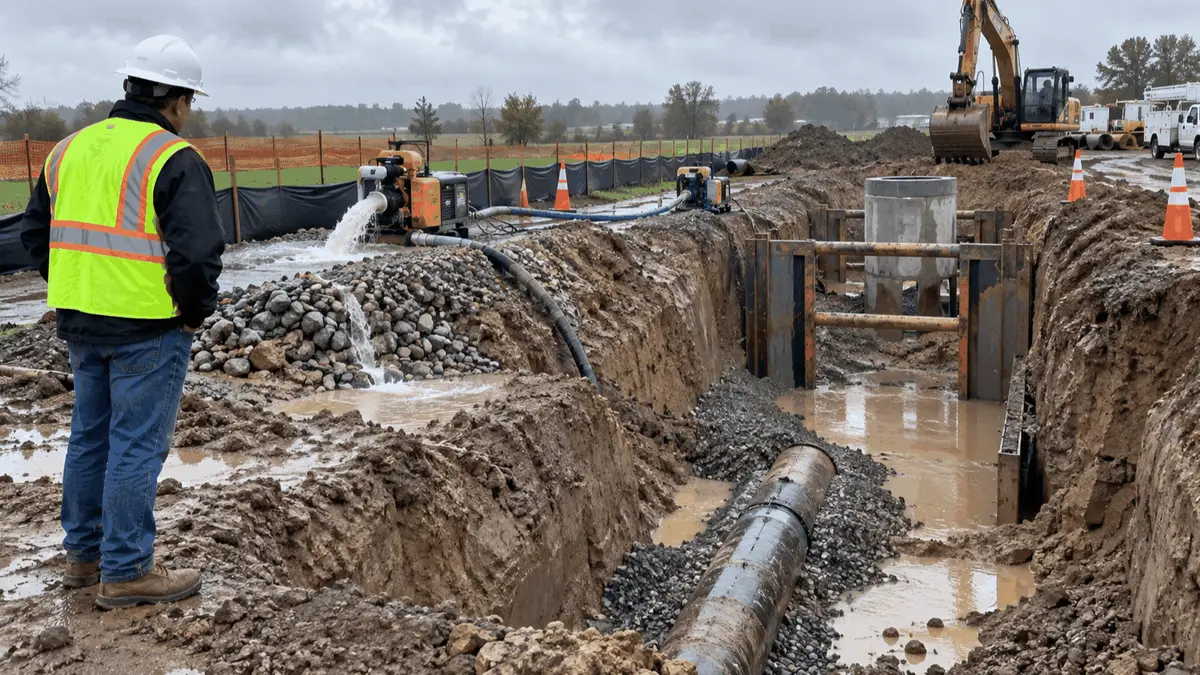
After rain, a competent person should reassess water, soil, protective systems, access, and nearby loads before allowing anyone to re-enter a trench.
Rainwater around an excavation is more than a housekeeping issue. Water can enter from the surface, collect at the bottom, soften or erode soil, obscure hazards, affect ladders and pumps, and change the way a protective system performs. A trench that appeared stable at the end of one shift may have different conditions after a storm, a failed diversion, or a blocked sump. The practical question is not whether the job received a certain amount of rain. The question is whether the conditions that support safe work are still present and understood.
This article gives employers and supervisors a repeatable way to organize a post-rain check. It does not replace the employer's site-specific safety program, the competent person's evaluation, engineered designs, manufacturer instructions, or applicable requirements.
Why the Issue Matters
Water changes the excavation environment in several ways at once. Surface runoff can flow toward the cut and add weight to the edge. Seepage can make a sidewall less competent. Standing water can hide undermined soil, loose material, utilities, or a damaged trench box component. Pumping can also create a new problem if discharge is routed back toward the excavation or erodes a slope. These effects can occur even when the trench appears only slightly wet.
The crew also interacts with the changed conditions. A worker carrying pipe may step around a puddle and approach an edge. A ladder may be displaced or its base may be submerged. A hose may cross an access path. Spoil piles may absorb water and become heavier. Mobile equipment may park closer to the edge because the normal route is soft. A useful inspection therefore considers the entire work area, not only the bottom of the trench.
OSHA's excavation rules address inspections, water accumulation, surface encumbrances, access, and protective systems under 29 CFR 1926 Subpart P. The rules establish a framework, but the site evaluation still depends on actual soil, geometry, weather, equipment, and work conditions. A post-rain inspection should be treated as a decision point before entry, not a formality completed after the crew is already working.
What the Competent Person Should Know
The person performing the inspection should know the planned excavation geometry, soil information, protective-system selection, utility layout, access plan, dewatering method, and work sequence. They should also know what changed during the weather event: rainfall duration, intensity, upstream drainage, pumping interruptions, nearby traffic, vibration, utility work, or movement of materials.
The inspection should connect observations to decisions. If water is collecting, the question is how it got there and whether the source is controlled. If the soil is sloughing, the question is whether the protective system and work limits still match the condition. If the trench box shifted, the question is whether workers can remain outside the hazard zone while the system is evaluated and corrected. A competent-person record should make the reasoning visible without pretending that a checklist alone makes the excavation safe.
The inspection should also consider the next task, not only the current appearance. Installing a pipe, entering a deeper section, bringing a loader alongside the cut, or removing a pump can change the exposure. A release for one limited activity should not be treated as a blanket release for every later step.
It is also important to define who can stop the work. Crew members should be able to report seepage, cracking, bulging, undermining, damaged shields, or unsafe access without waiting for a supervisor to notice. Supervisors should know who has authority to keep people out, call for equipment, revise the sequence, or obtain an engineering review. Clear authority reduces the pressure to treat a delayed repair as a reason to enter.
Conditions to Recheck
Begin outside the excavation. Look for water flowing toward the edge, ponding behind a curb, plugged drains, saturated soil, erosion channels, undermined pavement, and changes in nearby loads. Check whether haul routes, crane pads, spoil piles, pipes, and parked equipment are farther from the edge than the plan requires. Identify any new cracks, tension lines, sloughing, bulges, or settlement.
Then inspect the protective system from a safe position. Compare the installed shield, shoring, sloping, or benching with the planned configuration and manufacturer or design requirements. Look for bent members, missing pins, displaced panels, damaged spreaders, soil entering the shield, or a box that is no longer positioned as intended. Do not ask a worker to enter to confirm a problem. Repositioning, repair, or removal should follow a controlled method that protects the people doing the work.
Check water control equipment next. Confirm that pumps, generators, hoses, discharge points, and backup arrangements are working and do not create new trip, electrical, traffic, or erosion hazards. Pumping water out does not by itself restore the soil or protective-system condition. The inspection should address whether water is still entering, whether the excavation is stable while dewatering occurs, and whether the discharge will affect another part of the site.
Access and egress deserve their own review. Ladders, ramps, stairs, walkways, crossings, and handholds may be slippery, undermined, buried, or moved by runoff. The path should remain usable without requiring workers to climb on a shield, cross a hose, or walk along a soft edge. If the planned access no longer works, entry should wait while a safe alternative is installed and checked.
How Employers and Supervisors Can Support the Check
Employers can make post-rain inspections easier by planning them before the weather arrives. A useful plan identifies drainage routes, low points, pump locations, backup power, discharge destinations, protected material storage, and equipment parking limits. It also identifies which changes require the competent person to stop work, when an engineer must review the condition, and how the crew will be notified.
The daily briefing should explain observable triggers rather than only saying to be careful. Examples include water entering from the surface, new cracking, a change in sidewall shape, loss of a ladder, pump failure, movement of a trench shield, or a vehicle route that has shifted toward the edge. Workers should know where to stand while reporting the condition and how to keep others out of the affected area.
Records should be specific enough to support the next decision. Note the date and time, weather or site event, location, excavation dimensions, soil observations, water sources, protective system, access condition, equipment status, corrective actions, and the person who released or withheld the area. Photographs can help show changes, but they should supplement an inspection rather than replace it. If conditions remain uncertain, record the unresolved issue and the person responsible for the next review.
Training should include the difference between removing visible water and correcting the underlying hazard. A crew may understand how to start a pump but not recognize that erosion, piping, or a saturated sidewall changes the entry decision. Role-based instruction can give the competent person inspection practice, supervisors escalation steps, operators equipment-control expectations, and workers a clear stop-work signal.
Training Support for the Crew
Excavation safety training is most useful when it turns technical requirements into observations the crew can make at the work face. A short scenario can ask workers to identify every change after a storm: the ladder is slick, runoff has cut a channel, a spoil pile has slumped, a pump hose has shifted, and a delivery truck is waiting near the edge. The group then explains which issues require immediate correction and which person owns the decision.
Competent-person development should go further. Practice can include comparing a planned protective system with a field installation, recognizing when a change in soil or water requires a new evaluation, and documenting the basis for stopping entry. The goal is not to teach a universal pass or fail distance. The goal is to help the responsible person use the applicable requirements, design information, manufacturer instructions, and site facts together.
Employers should also train for communication across shifts. The person who inspected the trench after rain may not be the person supervising the next crew. A handoff should explain what was observed, what was corrected, what remains restricted, what monitoring is required, and what would trigger another inspection. A signed form without a clear conversation can leave the next shift guessing.
Supervisors can strengthen that handoff by walking through the boundary of the restricted area and pointing out the conditions that still matter. If a pump is running, identify who watches it and what happens if it stops. If a slope or shield is under review, explain where workers may stand while the review continues. These details prevent a general instruction to watch the water from being interpreted differently by each shift.
Key Takeaway
Reentry after rain should be a deliberate release decision. Keep workers out while the competent person evaluates water sources, soil, protective systems, edges, loads, access, and dewatering. Correct the condition or obtain the needed technical review before entry, brief the crew on what changed, and document the reasoning. The best inspection is not the one that clears the trench fastest. It is the one that makes the safe boundary understandable to everyone who may approach it.
Sources OSHA, 29 CFR 1926 Subpart P, https://www.osha.gov/laws-regs/regulations/standardnumber/1926/1926SubpartP; OSHA, Excavation Standard Overview, https://obis.osha.gov/Publications/Const_Res_Man/1926sub-p-overview.html; OSHA, Trenching and Excavation Competent Person, https://www.osha.gov/etools/construction/trenching/competent-person