A relocated trench shield can change excavation geometry and worker exposure, so employers should inspect the new position and brief the crew before re-entry.
Why the Issue Matters
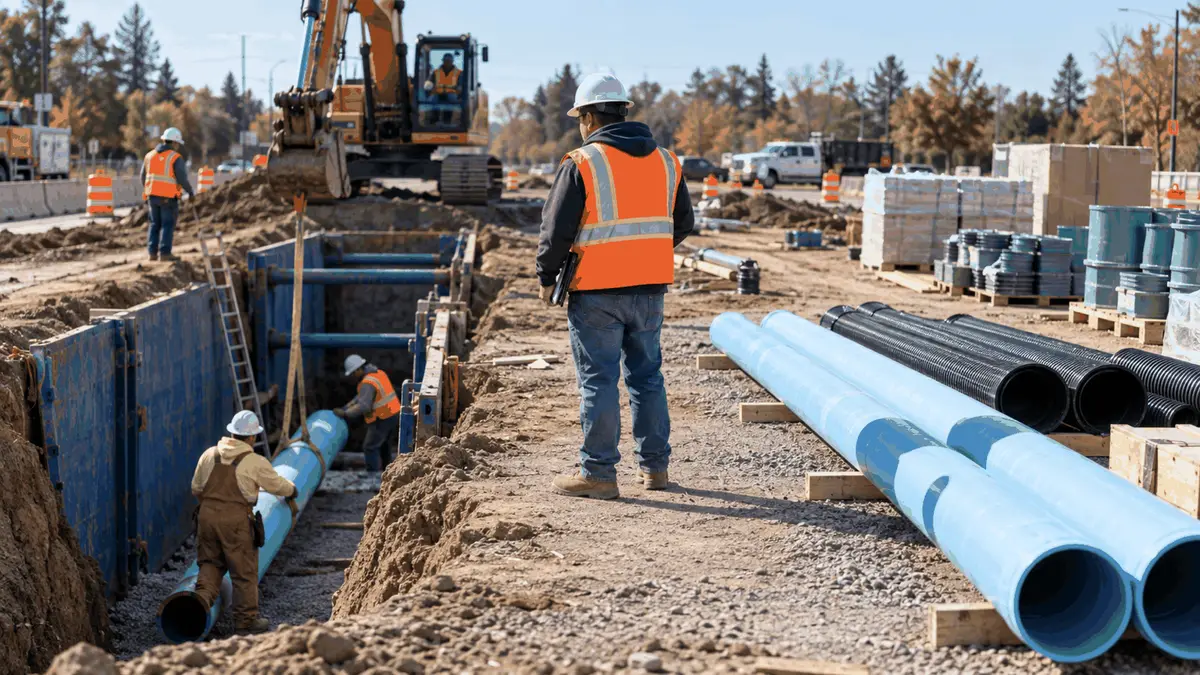
Trench shields are often treated as equipment that can be moved whenever the pipe crew reaches the next work area. That mindset is risky because the shield is only one part of a protective system. Its size, rating, installation, position, clearance, and relationship to the trench walls all matter. When a shield is dragged, lifted, repositioned, or exchanged for another model, the conditions that supported the previous entry may no longer exist.
The change can affect more than the shield itself. A relocation may expose fresh soil, disturb a trench wall, move a ladder, change the distance from an open end, alter the work zone around a utility, or put workers near unsupported material while the machine is operating. Rain, vibration, traffic, groundwater, and nearby loads can add another layer of uncertainty. A good work plan therefore treats every relocation as a decision point, not as routine housekeeping.
This is especially important on utility work where the excavation advances in short sections. Production pressure can encourage a crew to move protection quickly, but the safe question is whether the new location has been inspected and whether the selected system is appropriate for the new depth, width, soil, and loads. The answer should be visible in the crew briefing and in the inspection record.
Employers should also consider what workers understand about the move. An entrant who saw a shield installed correctly in the prior position may assume the same conditions exist after relocation. Training should make clear that workers must wait for the competent person or supervisor to release the new work area, even when the equipment appears unchanged.
Employer and Supervisor Knowledge
The employer should identify who has authority to stop the move, inspect the new position, and correct a problem before entry. OSHA's excavation guidance describes the competent person as someone able to identify existing and predictable hazards and authorized to take prompt corrective measures. That authority matters during relocation because the person evaluating the change must be able to delay production, require a different protective system, or remove workers from the excavation.
Before the move, the supervisor should compare the planned location with the excavation plan, utility information, and equipment limits. Useful questions include whether the depth has changed, whether the trench bottom is stable, whether the shield will be fully within its rated configuration, and whether the ends of the trench create an unprotected exposure. If the shield will be raised or lowered with lifting equipment, the crew should know the exclusion zone and the signal person arrangement.
The inspection should look at the soil and the walls before the machine enters the work area. Fresh cracks, sloughing, bulging, tension fissures, water, or material falling from the wall are reasons to stop and reassess. A visual check should include the area above the excavation because a safe-looking wall can be affected by a spoil pile, parked equipment, stored pipe, traffic vibration, or a nearby structure.
The shield itself needs an equipment check. The supervisor should verify that the frame, spreaders, pins, welds, connecting hardware, and identification markings are in usable condition. The crew should know which components are permitted by the manufacturer and which field modifications are prohibited. A shield that was adequate for one depth or width may not be adequate after the excavation changes.
Access and egress must be reviewed again. A ladder may have moved with the shield, become too far from the work area, or be blocked by pipe and spoil. Workers should have a stable route that does not require climbing on the shield or stepping across unsupported soil. The route should remain usable during the task, not only at the beginning of the shift.
Training Support for the Work
Training should connect the technical rules to the sequence the crew performs. A useful briefing starts with the planned move, identifies the hazards that could change, and assigns each worker a clear pause point. The operator needs to know where people may stand. The signal person needs a communication method. The competent person needs authority to inspect and release. Entrants need to know when they may approach, where they may work, and what conditions require immediate exit.
Role-based instruction is more useful than a generic reminder to be careful. Operators should understand swing radius, suspended loads, blind spots, and how equipment movement can affect trench edges. Ground workers should understand pinch points, falling material, and why they must stay out of the excavation while the shield is being repositioned. Supervisors should practice the inspection questions they will ask before the next entry.
Training can also use a simple change trigger. If the shield moves, the depth changes, the soil changes, water appears, a utility is exposed, a load approaches the edge, or weather affects the excavation, the crew pauses for a new evaluation. The trigger helps workers recognize that an inspection is needed even when the change seems small.
Employers should document enough to show what was reviewed. A useful record can include the date and location, the person inspecting, the shield identification, approximate depth and width, soil observations, access and egress, nearby loads, atmospheric concerns when relevant, corrective actions, and the release time. The record should not become a substitute for field judgment, but it can help the employer identify repeated problems and coach supervisors.
The training should also address communication with other crews. A pipe crew may share the excavation with a locator, concrete worker, utility owner, or traffic-control team. Each group needs to understand the boundaries of the protective system and the rule that no one enters during a move. Multi-employer coordination is part of controlling the work area, especially when another employer brings equipment or materials close to the edge.
A Practical Relocation Review
Start by stopping entry and clearing the trench. Confirm that all workers are accounted for, that tools and materials are removed from the move path, and that the operator has a clear plan. Establish a perimeter so no one walks into the swing area or stands beneath a suspended component. Review the communication signal before equipment moves.
After the shield is placed, inspect the new location from the surface and from the protected area only when entry is permitted. Check the walls, bottom, ends, shield condition, clearances, and the relationship between the shield and the soil. Verify that the system is installed according to the manufacturer's instructions or the employer's engineered plan. Do not assume that a shield is protective simply because it is present.
Next, review the work task. Pipe, tools, and workers should fit within the protected zone without forcing people outside the shield. If the crew must work beyond the shield, the plan should identify how that exposure is controlled. Check that the ladder or ramp is stable, that access is close enough for the crew, and that the route remains open while production continues.
Finally, brief the crew on the new conditions. Explain what changed, what the competent person found, and what signs require a pause. The briefing should be short enough to use often and specific enough that workers can repeat the plan. If the work cannot be performed within the protection, stop and change the method before entry.
The review should continue during the shift. A shield may remain in place while the crew adds bedding, moves pipe, changes the trench bottom, or brings a loader beside the opening. Those actions can alter clearances and loads without moving the shield again. Supervisors should set a time or event for reinspection and should ask workers to report cracks, water, movement, vibration, or any condition that differs from the briefing.
Records are also useful when a project has several similar excavations. A supervisor can compare relocation notes and identify whether one access arrangement, shield size, or staging practice is repeatedly creating delays or exposures. That information can improve the next work plan, equipment selection, and training discussion. The record should remain factual and should not imply that paperwork alone makes the excavation safe.
The employer should make the relocation standard easy to use in the field. A pocket checklist or digital form can prompt the same questions without replacing judgment: Is the excavation depth different? Is the soil disturbed? Are the walls, ends, and bottom stable? Is the shield rated for the new configuration? Is access available? Are people and equipment separated during the move? What changed since the last inspection? Consistency makes coaching easier and helps a supervisor show why entry was delayed or released.
Key Takeaway
Relocating a trench shield is a new excavation decision. Employers and supervisors should control the move, inspect the changed conditions, verify the protective system and access, and communicate the release conditions before workers return. Training supports that process by giving operators, entrants, and competent persons a shared set of triggers and responsibilities. A consistent relocation review helps turn changing excavation conditions into a controlled pause instead of an assumption.
Sources
Occupational Safety and Health Administration, Trenching and Excavation Safety https://www.osha.gov/etools/construction/trenching
Occupational Safety and Health Administration, 29 CFR 1926 Subpart P https://www.osha.gov/laws-regs/regulations/standardnumber/1926/1926SubpartP
Occupational Safety and Health Administration, Compliance Directive for the Excavation Standard https://www.osha.gov/sites/default/files/enforcement/directives/CPL_02-00-165.pdf