Employers planning excavation near overhead lines must coordinate clearance, equipment movement, utility information, and crew training before digging begins.
Overhead electrical conductors are easy to notice and easy to underestimate. A crew may be focused on trench depth, soil, traffic, and underground utilities while a boom, mast, dump body, ladder, or load moves upward into a line's clearance zone. The risk is not limited to direct contact. Electricity can arc across a gap, equipment can become energized, and a person on the ground can be exposed while trying to help an operator. A workable excavation plan therefore treats overhead exposure as part of the excavation hazard assessment, not as a separate concern left to the equipment operator.
The employer's planning question is practical: what will move, where will it move, who will control it, and what conditions require work to stop? A competent person, supervisor, utility coordinator, and equipment operators may each hold different pieces of the answer. Training helps them turn those pieces into a shared plan that fits the actual site, the actual machinery, and the actual sequence of work.
Why This Matters on Excavation Jobsites
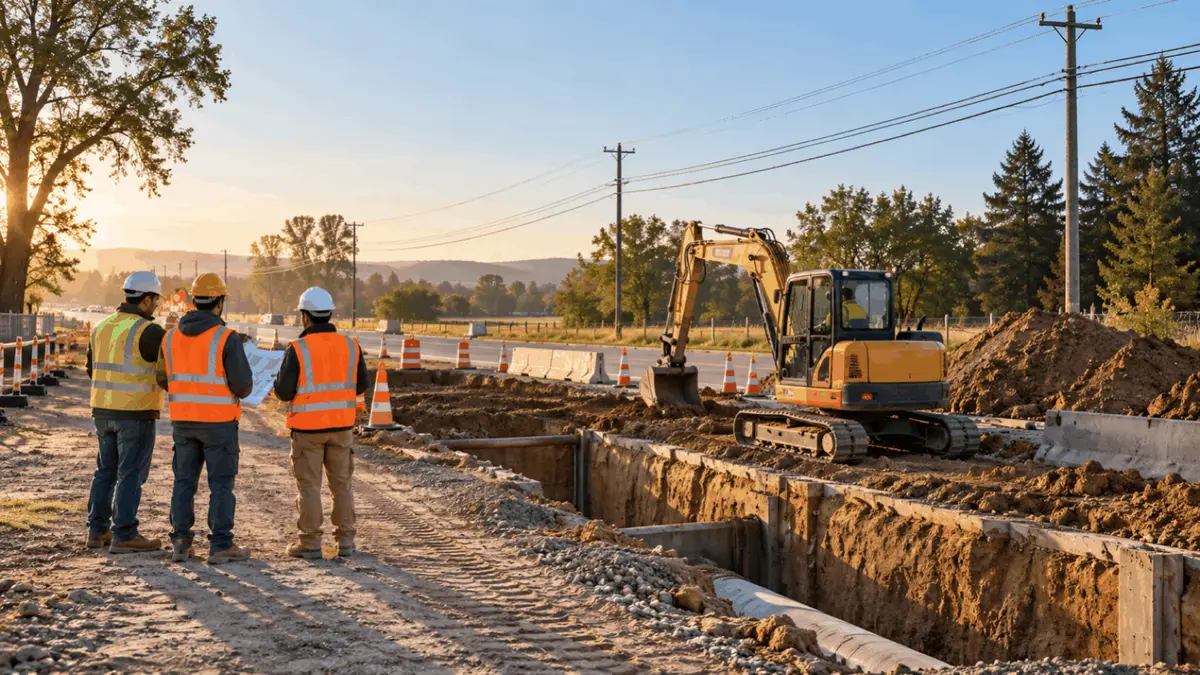
Excavation work changes the geometry of a site. Spoil piles, trench shields, pumps, cranes, loaders, trucks, and temporary access routes can place people and equipment in locations that were not considered during estimating. A route that looks clear at ground level may put a raised bucket or dump bed close to an overhead line. A trench shield may require a larger machine swing. A utility repair may force a crew to stage materials on the opposite side of the excavation. Each change can affect clearance and supervision.
The consequences are severe, but the planning lesson is more useful than a warning. A site can lose production when equipment must be moved, a delivery is refused, or a crew discovers that a planned access route is unusable. A near miss can trigger an investigation, retraining, schedule disruption, and difficult conversations with the owner or utility. A contact can injure workers, damage equipment, interrupt service, and create a complicated emergency. Clear planning before mobilization gives supervisors more options than improvisation after a line becomes a concern.
Overhead line planning also connects to the duties that already define a safe excavation program. The competent person must evaluate changing conditions, inspect the work area, and recognize hazards that could affect workers. The supervisor must communicate limits to the crew and coordinate with other employers. Operators must understand the machine envelope, spotter signals, and stop-work authority. Ground workers must know that touching equipment or a person may be unsafe if an electrical event occurs. These are role-based responsibilities, not facts that one general toolbox talk can cover completely.
The excavation itself can make the exposure harder to judge. The edge may be protected by barriers, but a worker may still need to reach under a line to connect a pump or guide a pipe. Rain can change footing and visibility. Wind can move a suspended load or conductor. Darkness can reduce the ability to see a boom tip or a temporary marker. A traffic shift can bring a truck into a different approach path. A plan that is safe at the beginning of the shift may need to be reviewed after weather, layout, equipment, or utility conditions change.
What Employers and Supervisors Should Know
Before work begins, the employer should identify overhead lines, determine who owns or controls them, and establish the information needed to work safely near them. The plan should account for the largest equipment and highest load, not just the machine configuration used during the first task. If the project involves an electrical utility, the employer should coordinate with the utility and follow the applicable clearance and control requirements. OSHA construction rules, utility procedures, and local requirements may interact, so project leaders should confirm the details rather than rely on a remembered distance.
A useful pre-work review asks the following questions:
- Which lines, poles, anchors, and service drops are within or near the equipment travel area?
- What is the maximum working height of each boom, arm, bucket, dump body, load, and attachment?
- Where will trucks turn, back, queue, load, unload, and park during excavation work?
- Who will install and maintain barriers, warning lines, height markers, or physical controls?
- Which tasks require a dedicated spotter, and what signal means stop immediately?
- What will happen if a line sags, a pole shifts, weather changes, or the route becomes blocked?
- How will the employer communicate the plan to subcontractors, delivery drivers, and short-term workers?
The answers should be visible in the field. A note in a bid file will not guide a driver who arrives after the morning meeting. A marked site plan, a pre-task briefing, physical limits, and a supervisor who watches the work can make the plan operational. The markings should be placed where operators can see them without creating a new trip, struck-by, or traffic hazard. They should not be treated as permission to work closer than the project has authorized.
Equipment selection matters as much as worker behavior. A smaller excavator may reduce reach, but it may also need to work longer or require more repositioning. A low-clearance attachment may reduce the maximum height for one task but not for loading or maintenance. A dump truck with a raised body can create a different hazard than an excavator. Employers should use manufacturer information and the actual work sequence to understand the complete envelope of the machine. The competent person and operator should review any change in attachment, material, or travel route.
Spotters need a defined role. A spotter should not be assigned casually to a worker who is also expected to carry pipe, guide traffic, watch the trench, and answer radio calls. The person giving signals must have a clear view of the equipment and the hazard, a reliable communication method, and authority to stop the operation. The operator and spotter should agree on signals before movement begins. If communication is lost, visibility is blocked, or the spotter is pulled into another task, the machine should stop until control is restored.
The emergency plan should cover an energized machine or vehicle. Workers need to know not to rush toward the operator, touch the equipment, or create a second path to ground. The site should define how to keep people away, summon emergency help, notify the utility, and communicate with the operator without approaching. The correct action can depend on the circumstances, equipment, and utility guidance. Training should emphasize following the established emergency procedure and the instructions of qualified responders, while avoiding improvised rescue attempts.
Employers should document the planning decision in a form that can be updated. Useful records may include the site sketch, utility contact, pre-task briefing, equipment list, spotter assignment, weather review, and corrective actions. Documentation does not replace field control. It does help the supervisor see whether the plan was actually communicated and gives the next shift a starting point instead of forcing them to recreate decisions from memory.
How Training Supports a Safer Excavation Program
OSHA-aligned excavation training gives workers a common vocabulary for protective systems, inspections, access, changing conditions, and employer responsibilities. The overhead-line topic fits naturally into that larger program because equipment movement and utility exposure can affect the excavation perimeter, the work sequence, and the decision to allow entry. A general worker needs to recognize the boundary and report a change. An operator needs to understand the machine envelope and stop signals. A supervisor needs to coordinate the plan. A competent person needs to integrate the exposure into inspections and changing-condition decisions.
Training should be assigned by duty. Excavation crews may need instruction on overhead and underground utilities, equipment exclusion zones, spotter communication, and emergency actions. Foremen and supervisors may need a deeper review of pre-task planning, multi-employer coordination, documentation, and stop-work decisions. Designated Competent Persons need training that supports their broader evaluation and inspection responsibilities under the employer's excavation safety program. Employers should also provide site-specific orientation because a course cannot know the utility layout, weather, equipment, or local procedures for a particular project.
A practical training plan can use short field discussions after formal instruction. Ask the crew to identify the highest point of the machine, demonstrate the agreed signal, walk the travel route, and explain where people will stand during loading. Then change one condition in the exercise: a delivery truck arrives, a line is discovered outside the original sketch, or rain reduces visibility. The goal is not to test memorization. It is to see whether the crew can recognize that the plan must be paused and revised.
Employers can reinforce learning through observations and reviews. Supervisors can check whether barriers remain in place, whether the spotter is actually dedicated, and whether operators stop when visibility or communication is lost. Competent Persons can include overhead exposure in daily inspection conversations when site geometry changes. Management can review near misses without turning the response into blame. These actions help training become part of the excavation safety program rather than a certificate filed away after onboarding.
Key Takeaway
Excavation near overhead lines is a planning problem involving equipment, utilities, workers, traffic, weather, and changing site conditions. Employers should identify the exposure, coordinate controls, assign clear roles, brief the crew, and stop when the plan no longer matches the field. The right people need the right depth of instruction, including workers who recognize hazards, supervisors who control the work, and Competent Persons who evaluate excavation conditions. OSHA-aligned Excavation, Trenching & Shoring Safety Training and Competent Person for Excavation, Trenching & Shoring Training can support that role-based approach, while site-specific controls and employer follow-through remain essential.