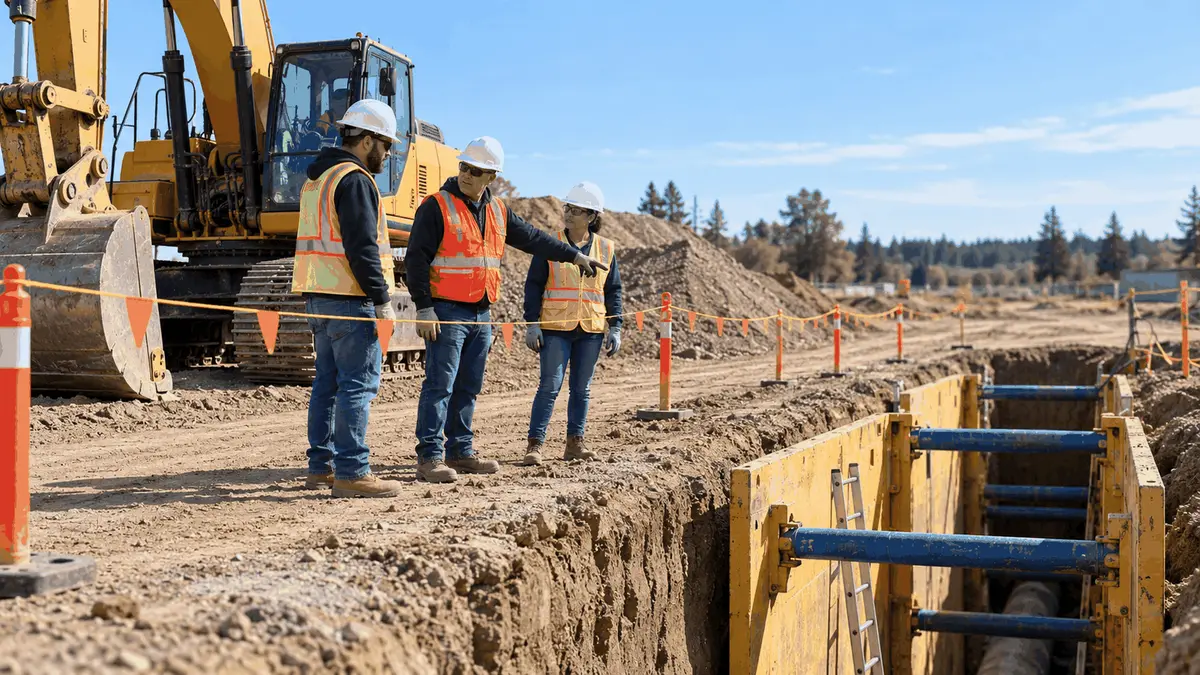
Mobile equipment changes excavation conditions quickly, so supervisors need a plan for separation, communication, edge control, and reinspection before entry.
Excavators, loaders, dump trucks, compactors, and delivery vehicles create more than a struck-by concern. Their weight and movement can add surcharge loads, transmit vibration, block access, obscure a worker from an operator, or disturb soil at the edge. A crew may have a sound protective system and still create an unsafe entry condition by parking equipment too close, swinging a boom over an opening, or allowing traffic to use an unplanned route.
This is why a Competent Person's inspection must connect the excavation to the entire work zone. The question is not simply whether a trench shield is installed. The question is whether the soil, protective system, access, equipment, utilities, weather, and work sequence still support safe entry for the next task.
Why This Matters on Excavation Jobsites
OSHA's excavation requirements address hazardous atmospheres, falling loads, spoil and materials near edges, access and egress, water accumulation, inspections, and protective systems. Mobile equipment can affect several of these controls at once. A truck backing toward a trench can place a load near the edge. A vibrating compactor can change soil behavior. An excavator working from a bench can restrict the ladder route. A delivery vehicle can force pedestrians toward the excavation perimeter.
The risk also changes by phase. Equipment used for digging may be gone when a crew installs pipe, but a loader may arrive for bedding, a crane may set a structure, or a vacuum truck may expose a utility. Every change can require a new look at the edge, the support system, and the path people use to enter and exit. A morning inspection is not a permanent approval for every later activity.
An effective plan gives workers a visible answer to four questions: Where may equipment travel, where may it park, who controls movement, and what happens when the plan cannot be followed? Without those answers, an operator may rely on mirrors, a spotter may lack authority to stop work, and a worker may step into a blind area while attention is focused on production.
The consequences are operational as well as safety-related. A near miss can stop a crew, require a reinspection, delay utility work, trigger a customer conversation, and expose weaknesses in the employer's excavation program. A practical separation plan helps crews protect people while keeping the sequence predictable.
What Employers and Supervisors Should Know
The Competent Person should review equipment interaction before the shift and whenever conditions change. The review should be specific to the excavation rather than a generic statement that machines will stay clear. Mark the edge, identify travel lanes, establish pedestrian routes, and decide which locations are acceptable for staging materials. If the site changes, update the briefing and inspect again.
Important controls include:
- Keep spoil, materials, and equipment back from the excavation edge as required by the applicable standard, and evaluate whether unusual loads or site conditions require more distance or additional protection.
- Use barricades, cones, physical stops, or an equivalent control that operators can recognize in poor visibility. Tape alone may not prevent a vehicle from rolling into a hazard area.
- Assign a spotter when the operator cannot see the travel path, edge, workers, or overhead and underground constraints. Give the spotter one clear signal system and authority to stop movement.
- Separate workers on foot from operating equipment with a planned route, waiting area, and no-entry zone around swing radii and backing paths.
- Keep ladders, ramps, and other access points clear of parked machines, hoses, spoil, and delivery activity.
- Control suspended loads and materials that could fall or roll into the excavation. Workers should not be beneath loads or where a load can enter the opening.
- Recheck the excavation after heavy rain, freezing and thawing, vibration, a utility exposure, a change in equipment position, or any event that could affect the soil or protective system.
Supervisors should also verify that the equipment plan matches the protective system. A trench shield may protect workers inside the shield, but it does not automatically address a machine operating at the edge or a load striking the shield. A shoring system may be designed for expected loads, but a new traffic pattern can exceed the assumptions used by the designer or manufacturer. When the planned use differs from the system's instructions, stop and obtain competent technical direction before entry.
Communication deserves its own check. Radios need a channel, charged batteries, and a backup signal. Hand signals need to be reviewed with operators and spotters. The person controlling a movement should be identified by role, not just by a vest color that workers may not recognize. If multiple contractors operate equipment in the same area, their signals and exclusion zones need to be coordinated before work begins.
The inspection record should capture conditions, not merely a signature. Useful notes include the excavation location, soil observations, protective system, equipment positions, traffic controls, access points, water or weather conditions, and corrective actions. A photograph can support the record, but it does not replace the Competent Person's evaluation or the crew's understanding of the controls.
How Training Supports a Safer Excavation Program
OSHA-aligned excavation training helps employers give different roles the information they need to act consistently. A crew member needs to recognize edge hazards, falling loads, equipment blind spots, and the authority to stop and report an unsafe condition. An operator needs to understand how machine placement, swing radius, vibration, and backing activity affect people and soil. A supervisor needs to coordinate the work sequence and confirm that controls are in place before entry.
Competent Person training adds a deeper focus on inspections, soil classification, protective systems, access and egress, water, changing conditions, and employer responsibilities. It helps the designated person ask whether mobile equipment changes the excavation assessment instead of treating the inspection as a routine form. It also supports better conversations with competent technical specialists, manufacturers, and project managers when a condition falls outside the original plan.
Training should be followed by site-specific practice. Walk the actual excavation, point out the edge, demonstrate the stop signal, identify the safe route, and rehearse what happens when a vehicle must enter the exclusion zone. Review how a worker reports an unexpected crack, a displaced barricade, a new utility, or equipment that cannot maintain the planned separation. The goal is not to make online learning stand in for field controls. The goal is to give the field briefing a common vocabulary and a clear connection to the employer's program.
Employers can reinforce the lesson with short pretask discussions. Ask what equipment will move today, where people will stand, who controls backing, what conditions require reinspection, and how the crew will leave the excavation if the route is blocked. Rotate examples so the conversation covers utility work, road work, structures, and confined work areas rather than one familiar trench.
The plan should account for people who are not part of the excavation crew. A delivery driver may not know the edge limits, a surveyor may need to cross a travel lane, and a utility owner may arrive to observe exposed facilities. Assign a person to orient visitors, keep them outside the exclusion zone, and prevent a well-intended request from interrupting the operator's line of sight. Good controls remain understandable when the site is busy.
Supervisors should compare the planned equipment position with the actual position during the shift. A machine that starts on firm ground may be moved closer to gain reach. A truck queue may lengthen after a delay. A temporary ramp may redirect tires toward the opening. Small changes can increase loading or remove a worker's escape route. A quick stop, look, and update is often enough to catch the change before entry.
Records should show who completed training, which role the training supported, and what site-specific orientation was delivered. A certificate of completion can support the employer's records, but it does not by itself prove that a worker is qualified for every duty or that a particular excavation is safe. The employer still must assign responsibilities, provide equipment and controls, and verify that the Competent Person can perform the required duties.
Supervision is strongest when the crew knows the reason for each control. Explain that separation protects both the worker and the operator, that a spotter is not a substitute for a safe layout, and that a barricade can fail if traffic is allowed to move it. Then ask workers to identify one condition that would make them leave the excavation and notify the Competent Person. That feedback often reveals a blocked ladder, a weak signal, or a route that was never explained.
Key Takeaway
Mobile equipment is part of the excavation hazard assessment, not a separate production issue. Before entry, supervisors should control the edge, traffic, swing radius, blind areas, access routes, signals, and loads, then recheck the plan whenever conditions change. Crew-level excavation safety training and Competent Person training can help turn those expectations into repeatable actions, while the employer remains responsible for applying them to the actual jobsite.