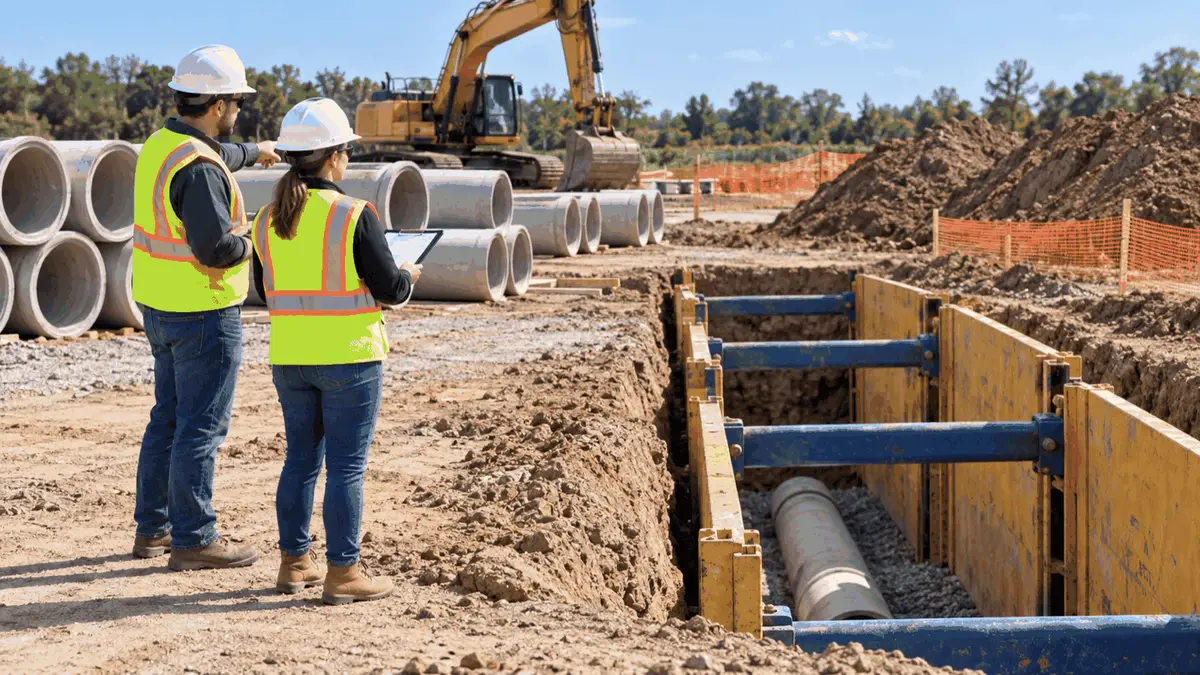
Supervisors can reduce excavation risk by controlling pipe, pallets, spoil, and equipment loads before workers enter a trench or open excavation.
Pipe and material staging is often treated as a productivity decision, but it also changes the conditions around an excavation. A bundle placed near the edge can add surcharge load, obstruct access, fall into the opening, or force workers to stand in an awkward location while handling it. The same concern applies to pallets, trench boxes, fittings, bedding material, hoses, generators, and removed pavement. A safe plan connects the delivery sequence to the protective system, the competent person's inspection, and the crew's entry decision.
The practical question is not simply where materials fit on a crowded site. It is whether the employer has evaluated the excavation, surrounding loads, equipment travel, access and egress, utilities, water, traffic, and changing soil conditions as one work area. Training helps supervisors recognize when staging changes the job enough to require a new inspection, a different control, or a pause.
Why This Matters on Excavation Jobsites
Loads near an excavation edge can affect the stability of the face even when nobody is working directly beneath the load. A pipe rack, truck, crane outrigger, loader, or stack of trench materials transfers weight through the ground. The effect depends on distance, soil, depth, moisture, vibration, geometry, and the protective system. A competent person should evaluate the condition instead of relying on a universal visual distance.
Staging also affects struck-by exposure. A round pipe can roll toward the opening. A fitting can slide from a pallet when a worker pulls another item. A forklift can approach from a blind side. A delivery driver may not know where the exclusion zone begins. When people improvise around these conditions, they may step onto an unsupported edge, enter a trench to retrieve a tool, or work beneath a suspended load.
Access and egress are part of the staging plan. Ladders, ramps, and stairways must remain available, stable, and close enough for the planned work. A stack that narrows a travel path can cause workers to climb over materials or walk beside moving equipment. Mud, hoses, and loose bedding can make a route slippery. A supervisor should ask whether the planned path remains usable after the next delivery, not only whether it is clear at the beginning of the shift.
Material placement can hide important inspection evidence. A stack may cover tension cracks, spoil movement, water seepage, or a change in the edge. Pipe can make it difficult to see whether a trench shield is properly positioned. A delivery can disturb the edge after the morning inspection. The competent person needs a clear view and a reason to reinspect whenever staging, traffic, weather, vibration, or protective-system conditions change.
The risk is also operational. Poor staging creates repeated handling, longer exposure time, more equipment crossings, and rushed decisions near the trench. A crew that cannot reach the next piece safely may choose a shortcut. Good staging supports productivity because it reduces rehandling while preserving the controls that make entry acceptable.
What Employers and Supervisors Should Know
Employers should identify the materials needed for each phase before the excavation opens. That list should include permanent pipe and structures, temporary shoring or shielding components, ladders, pumps, generators, bedding, warning systems, barriers, and emergency equipment. The plan should show where each item will be received, inspected, staged, moved, and removed.
The competent person should consider at least these questions:
- What loads will be placed near the excavation, and how far will they be from the edge?
- Does the protective-system design account for nearby loads, traffic, or vibration?
- Can pipe, tools, or pallets roll, slide, or fall into the opening?
- Is there a marked exclusion zone for workers, visitors, trucks, and delivery personnel?
- Can workers reach every entry point without climbing over materials?
- Will the next delivery block a ladder, ramp, walkway, spoil route, or emergency path?
- Are lifting points, tag lines, and handling responsibilities understood?
- Is a spotter needed when a truck, forklift, or excavator works near the edge?
- What changes after rain, freezing, thawing, dewatering, or nearby vibration?
- What must be rechecked before the crew enters after staging is moved?
The answer should be specific to the excavation. OSHA 29 CFR 1926 Subpart P establishes requirements for open excavations, protective systems, access, water control, and inspection. It does not turn a generic site sketch into a complete plan for every soil and loading condition. Employers should use the standard, competent-person judgment, and an engineered design when conditions call for one.
Delivery control deserves a short briefing. The driver should know the approach route, stop point, edge exclusion zone, communication method, and unloading sequence. A spotter should have authority to stop movement when the driver loses sight of the edge or when people enter the path. Hand signals should be agreed before the load moves. A radio is useful only when the people using it know the words that mean stop, hold, back, and clear.
Pipe handling needs its own controls. Chocks, racks, dunnage, or other suitable restraints should keep round materials from rolling. The crew should not stand in the line of travel or place hands between pieces as a stack is adjusted. A worker should not climb onto an unstable bundle to attach a sling. When a pipe must cross or pass over an excavation, the employer should use a planned method that addresses support, falling objects, clearance, and worker positioning.
Temporary materials can become permanent hazards when the task changes. A pump hose may cross an access route. A generator may add vibration or exhaust concerns. A trench shield component may be set beside the opening where it can fall in. A pile of fittings may force a worker closer to the edge. Supervisors should include temporary items in each inspection rather than treating them as harmless because they are not part of the finished installation.
How Training Supports a Safer Excavation Program
OSHA-aligned excavation training helps workers understand why staging decisions matter. Awareness training can teach the whole crew to recognize surcharge loads, rolling materials, blocked egress, falling-object exposure, and changing conditions. Competent Person training can build the inspection and decision skills needed to evaluate soil, protective systems, water, adjacent loads, and work-area changes.
Training should be role based. Operators need to understand exclusion zones and communication. Delivery personnel need to know where to stop and when to wait. Laborers need to recognize a blocked route or unstable stack. Foremen need to connect the work sequence to the inspection. The designated Competent Person needs enough knowledge and authority to identify hazards and take corrective action.
Supervisors should also plan for the moment when material leaves the laydown area. A pipe may be lifted by an excavator, moved with a sideboom, or pulled by hand into a trench. Each method changes the workers' positions and the forces near the edge. The crew should know who directs the lift, who controls the exclusion zone, where the load will land, and what happens if the piece does not fit the planned location. A delivery plan that ends at the stack is incomplete if the highest exposure occurs during installation.
When staging is tight, the safest answer may be to change the sequence rather than squeeze more material into the same space. Employers can schedule smaller deliveries, use a separate laydown area, stabilize a travel route, or finish one section before opening another. These decisions should be communicated during the pre-task briefing. They are also useful examples for training because they show workers that production planning and excavation safety are connected.
A useful exercise is to walk the planned material route before the first delivery. Mark the edge, entry points, equipment lanes, laydown areas, and emergency path. Ask the crew what changes after a pipe bundle arrives. Then repeat the exercise after the protective system is installed. This turns a general safety message into a job-specific decision process.
Employers should also document what training was assigned, who completed it, what the briefing covered, and what corrective action followed an inspection. A certificate of completion does not replace field supervision or a competent-person inspection. It does help show that the employer gave workers a consistent foundation for recognizing and reporting hazards.
Refresher training is appropriate when the crew changes, the excavation becomes deeper, the work moves into a roadway, a different material-handling method is used, or an incident or near miss reveals a gap. The goal is not to create paperwork for its own sake. The goal is to make the next decision predictable when the job no longer looks like the morning plan.
Key Takeaway
Pipe and material staging should be planned as part of excavation safety, not added after the trench is open. The employer, supervisor, and Competent Person should control loads, rolling hazards, delivery routes, access, egress, equipment movement, and reinspection triggers before workers enter.
The right training supports that process by giving crews a shared vocabulary and giving designated Competent Persons a stronger basis for inspection decisions. Employers should train the roles that make and act on those decisions, then connect the training to the actual excavation plan. That combination helps protect workers and supports employer compliance without suggesting that training alone guarantees a safe or compliant job.