
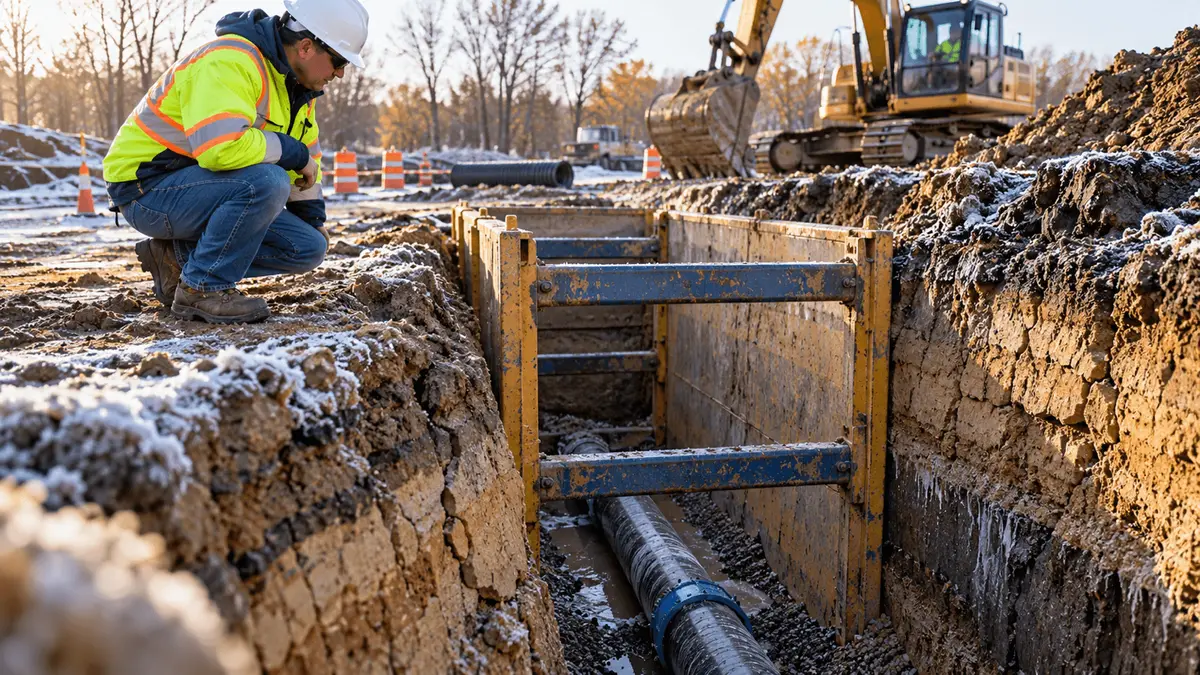
Freeze-thaw cycles can change excavation soil, drainage, and protective-system conditions between shifts, so every re-entry decision deserves a fresh review.
Cold weather can make an excavation look stable while moisture is frozen, then weaken the same face as temperatures rise and ice melts. A competent person who inspected the cut yesterday may find different cracks, sloughing, seepage, surcharge effects, or support loading today. The issue is not simply whether snow or frost is present. It is whether changing temperature and moisture have altered a condition that affects safe entry.
Employers should treat a freeze-thaw transition as a reason to renew the field picture, not as a seasonal footnote. The inspection must connect current soil behavior, water movement, protective-system condition, access, adjacent loads, and the planned work. A useful process gives the competent person time and authority to stop entry, obtain engineering input, change protection, or remove hazards before workers descend.
Why Freeze-Thaw Changes Matter in Excavation Work
Water in soil expands when it freezes and moves as it thaws. That movement can open fissures, loosen previously firm material, change surface drainage, and release blocks that were temporarily held by ice. Repeated cycling can be more important than one cold night because each cycle can widen defects and carry water into new paths. The visible surface may dry while deeper material remains wet and weak.
The timing of the inspection matters. A trench checked before sunrise may still contain frozen faces and firm travel surfaces. By midday, direct sun or warmer air can soften one side while the shaded side remains frozen. Meltwater may begin running toward the cut after workers have already entered. When conditions are changing through the shift, a single early observation may not represent the hazards workers face later.
Frozen spoil and compacted ground near the edge can also create a false sense of security. As thaw progresses, spoil can lose cohesion, equipment routes can rut, and edge material can become saturated. Those changes may increase surcharge loading or send water, stones, and soil toward the excavation. Ice on ladders, ramps, walkways, or trench-shield surfaces adds a separate access and slip hazard.
OSHA's excavation rules require daily inspections by a competent person before work starts and as needed throughout the shift. An inspection is also required after rainstorms or other hazard-increasing occurrences. A freeze-thaw transition can be handled within that same practical framework: inspect when the event could have increased risk, and remove exposed employees until necessary precautions are in place.
What Employers and Supervisors Should Know
The employer remains responsible for providing a workplace that meets the excavation requirements. Naming a competent person does not transfer every planning and resource decision to one field employee. Management must make sure the designated person has the knowledge to identify existing and predictable hazards, the authority to correct them promptly, and access to the protective-system information, equipment, and support needed for the job.
Cold-weather planning should identify who watches forecasts, who checks the site during shutdown periods, and who decides when a new inspection is required. It should also account for weekends, night shifts, temporary warming, dewatering, snow removal, and sudden temperature swings. A crew arriving after two days away should not assume that barricades, pumps, spoil piles, and protective systems remain in the same condition.
Supervisors should coordinate excavation work with equipment operators and other contractors. Snow plowing, material deliveries, crane setup, traffic, and thawing equipment can add loads or vibration near the edge. A subcontractor may redirect meltwater without realizing that it drains toward the cut. The competent person's inspection should therefore include changes outside the excavation that can affect conditions inside it.
The protective system needs its own review. Timber, hydraulic shoring, aluminum systems, trench shields, and engineered systems respond differently to soil movement and water. Ice may hide damage, pins, connections, hydraulic leakage, or gaps. Soil can move around a shield or support system as it thaws. The competent person should compare the actual configuration with the manufacturer's tabulated data, approved design, or applicable protective-system requirements rather than relying on appearance alone.
Documentation can support consistent decisions without turning the inspection into paperwork for its own sake. A short record might identify the time, temperature trend, precipitation or melt conditions, affected locations, observed soil and water conditions, protective-system status, corrective actions, and the person authorizing entry. Photos taken from safe positions can help show change over time, but they do not replace an in-person inspection.
A Practical Freeze-Thaw Reinspection Sequence
Begin above and around the excavation. Look for ponding snowmelt, blocked drainage, ice dams, new runoff paths, soft ground, vehicle ruts, or water discharging from nearby operations. Check whether diversion ditches, berms, pumps, hoses, and discharge points still move water away without causing erosion or undermining. Verify that snow piles do not direct meltwater toward the excavation.
Next, examine the edges and faces from a safe location. Look for new tension cracks, separation from pavement or structures, bulging, sloughing, falling material, exposed ice lenses, wet seams, and color or texture changes. Compare sunny and shaded faces because they may thaw at different rates. Listen for small falls or water movement, but never approach an unstable edge merely to improve the view.
Review soil classification assumptions when conditions warrant it. A prior classification does not excuse the competent person from recognizing changed conditions. Water, fissures, vibration, and previously disturbed material can affect the analysis and the protection selected. If the observed behavior conflicts with the original assumptions, pause entry and reevaluate the protective approach. Obtain a registered professional engineer's input when the design or site condition requires it.
Inspect the protective system before workers enter. Confirm that members, spreaders, struts, rails, pins, panels, and connections are in place and show no damage or displacement. Check for voids, soil loss, loads, or frozen material that could interfere with the system. For trench shields, confirm placement, depth, manufacturer limitations, and safe access. Workers must not be exposed between a shield and an excavation face during entry or exit.
Check access and egress. Remove ice and mud from ladders, steps, ramps, and walking surfaces using a method that does not create a new hazard. Confirm that ladders extend as required, remain secured, and are located so workers do not need to cross unstable ground. Inspect crossings, guardrails, barricades, and lighting where low sun, snow, or darkness can reduce visibility.
Then review nearby operations. Note excavators, loaders, trucks, stored pipe, spoil, snow piles, traffic, and structures. Softening ground can change how a load is transferred to the edge. Keep equipment, materials, and spoil at safe locations, and use warning systems where operators do not have a clear view of the edge. Do not assume that frozen ground will continue supporting the same load after thaw.
Finally, define the trigger for another inspection. A substantial temperature rise, direct sun on a frozen face, visible meltwater, pump failure, falling material, new cracking, vibration, or protective-system movement can justify stopping work and checking again. Workers should know how to report changes and should never be discouraged from leaving when a condition appears unsafe.
Training Support for Competent Persons and Crews
Competent-person training should connect regulatory duties to real field observations. Learners need practice distinguishing a cosmetic frost surface from signs of changing soil behavior, identifying water pathways, recognizing protective-system concerns, and choosing when additional expertise is needed. Scenario discussions are useful because freeze-thaw hazards rarely present as one obvious defect.
Supervisor training should cover planning and coordination. The supervisor may control schedules, equipment locations, subcontractors, and production pressure that affect whether the competent person can act. Training should reinforce that a paused entry is a control decision, not a delay to work around. Supervisors should know how to obtain pumps, alternate protection, traffic changes, or engineering review promptly.
Crew instruction should be role specific. Workers should recognize fresh cracks, loose material, water changes, ice on access routes, and protective-system movement. They should know where to exit, whom to notify, and that re-entry waits for the competent person's decision. Equipment operators should understand edge limits, spotter signals, and how their travel can add vibration or surcharge.
Online excavation safety training can support baseline knowledge about Subpart P, soil classification, protective systems, access, water accumulation, and competent-person responsibilities. It should be paired with employer procedures, site-specific instruction, and hands-on review of the systems actually used. Completion of a course does not itself designate someone as competent or replace the employer's evaluation of knowledge and authority.
Refresher discussions can use the day's conditions. A short briefing might compare an early-morning photo with the current face, trace a meltwater route, review the reason for a support change, or identify the next reinspection trigger. This makes training part of the control process instead of a separate annual event.
Common Errors During Cold-Weather Excavation
One error is treating frozen soil as a permanent protective feature. Frozen material can thaw quickly and unevenly, and OSHA's protective-system requirements still apply. Another is documenting air temperature but ignoring solar exposure, subsurface moisture, discharge water, and the time the face has been thawing.
A second error is focusing only on the trench wall. The inspection must also consider spoil, equipment, structures, access, surface water, and the protective system. A stable-looking face does not make a soft edge, flooded bottom, displaced shore, or icy ladder acceptable.
A third error is continuing work while corrective measures are being arranged. If the competent person finds evidence of a possible cave-in, protective-system failure, hazardous atmosphere, or another hazardous condition, exposed employees must be removed until precautions are taken. Monitoring a defect from inside the hazard is not a substitute for control.
A fourth error is assuming yesterday's record proves today's condition. Records help establish continuity, but the decision to enter must reflect what exists now. If a crew change, weather event, pump issue, or thaw has altered the site, the inspection process must catch it before exposure resumes.
Key Takeaway
Freeze-thaw work requires disciplined reinspection because the excavation can change faster than the schedule. Employers should give a qualified competent person the authority, information, and resources to review soil, water, protection, access, and nearby loads before entry and whenever conditions change.
The best cold-weather plan is not based on a calendar alone. It links forecasts and observations to clear stop-work triggers, corrective actions, and communication with every affected role. When the field evidence no longer supports the original plan, the safe decision is to pause, reassess, and adjust protection before workers return.
Sources
OSHA, 29 CFR 1926.651 Specific Excavation Requirements: https://www.osha.gov/laws-regs/regulations/standardnumber/1926/1926.651
OSHA, 29 CFR 1926 Subpart P Excavations: https://www.osha.gov/laws-regs/regulations/standardnumber/1926/1926SubpartP