
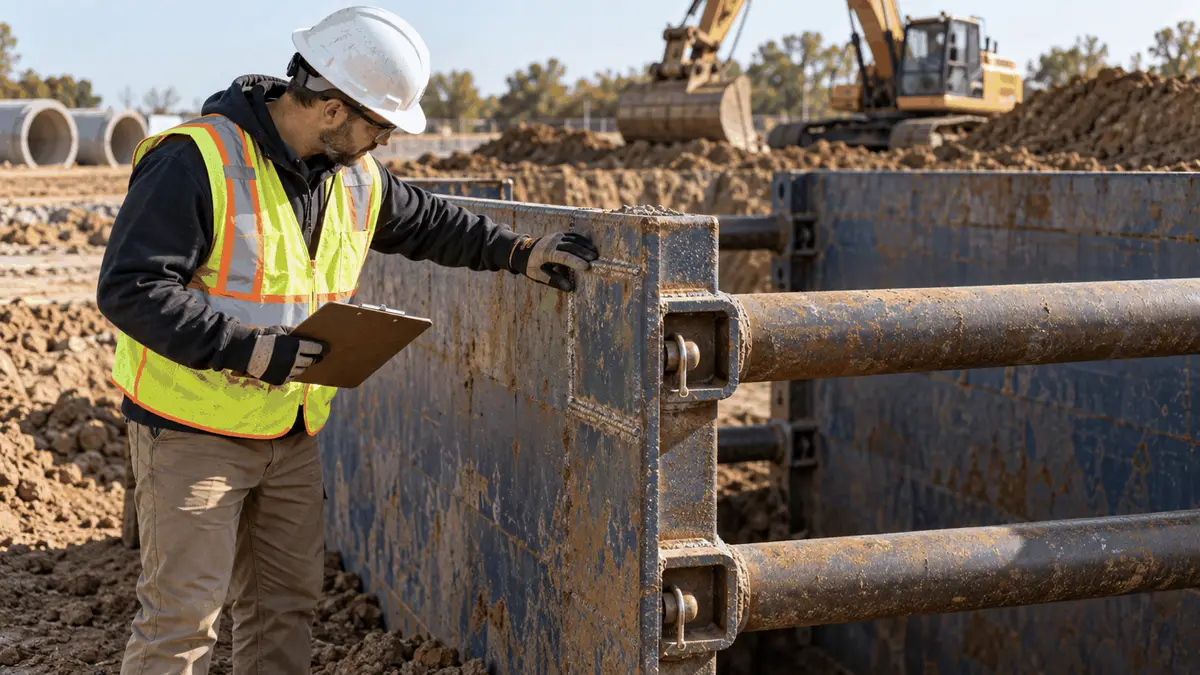
A trench shield can arrive looking serviceable while transport damage, missing hardware, or distorted connections quietly changes how the system may perform.
Moving a shield between yards and projects is ordinary work, but the trip can subject a protective system to impacts, poor lifting, unsecured components, and loading it was not designed to carry. Mud and fresh paint can also hide defects. A quick glance from the cab does not establish that the shield remains suitable for use. Before workers rely on it, the employer needs a deliberate receiving and pre-use process led by a person who understands the equipment, the excavation plan, and the limits in the applicable tabulated data.
OSHA's excavation requirements place important inspection and corrective-action responsibilities on the competent person. The standard also addresses damaged materials and equipment used for protective systems. The practical lesson is direct: if damage affects structural integrity or the system's ability to perform as designed, the shield should not be placed into service until the appropriate repair and approval steps are complete. This is not a cosmetic judgment and it should not be reduced to whether the box still looks square from a distance.
Why Protective-System Damage Matters
A trench shield is intended to protect employees within the shielded area if a cave-in occurs. Its performance depends on the complete assembly, including panels, structural members, spreaders, sockets, pins, keepers, welds, lifting points, and the configuration allowed by the manufacturer or other applicable design information. Damage to one connection can change how loads transfer through the system even when the rest of the box appears normal.
Transport creates several predictable opportunities for damage. A spreader can strike the trailer deck. A chain can be connected to a point that was not intended for lifting. A panel can be hit by loading equipment. Pins and keepers can be lost in the yard. Components from different systems can be mixed because they appear to fit. Tie-down pressure can be applied across an unsupported member. None of these conditions proves that a shield is unusable, but each is a reason to stop, identify the equipment, and inspect it against reliable criteria before assembly or placement.
The consequences extend beyond the shield itself. A damaged connector may delay a lift while the trench is open. A bent spreader may tempt a crew to force components together. A missing pin may be replaced with a bolt that has not been evaluated for the application. A shield that cannot be configured as planned may leave workers entering before an alternative protective system is ready. The receiving inspection therefore belongs in production planning, not only in a safety checklist.
OSHA identifies a competent person as someone capable of recognizing existing and predictable hazards and authorized to take prompt corrective measures. That authority matters here. The person inspecting a questionable shield must be able to stop unloading, tag a component out of service, obtain the correct information, and keep employees out of an inadequately protected excavation without waiting for schedule pressure to settle the question.
What Employers and Supervisors Should Know
The employer should know exactly which shield is being delivered. A usable equipment record may include the manufacturer, model, serial or asset number, panel size, spreader type, connector details, weight, approved configurations, soil and depth limitations, and the revision of the tabulated data kept at the jobsite. Rental paperwork or a yard nickname is not a substitute for matching the actual components to the information used in the protective-system plan.
Supervisors should separate three decisions that crews sometimes blend together. The first is whether the individual components appear free of defects that could affect use. The second is whether the complete assembly matches the applicable configuration. The third is whether that configured system is suitable for the actual trench, soil, depth, surcharge loads, water conditions, adjacent structures, and work sequence. A good result on one decision does not automatically answer the other two.
The inspection should begin before the shield is lifted from the trailer when visibility and access allow. The competent person can look for obvious deformation, cracked or separated welds, torn metal, damaged lifting points, missing identification, loose parts, and improvised repairs. Photographing all sides before unloading can establish the equipment's condition at receipt and provide a useful reference if additional damage is noticed later.
After safe unloading, components should be cleaned enough to expose the areas that matter. Heavy soil around a socket or weld can conceal a crack. The inspection should compare like sides and repeated features because asymmetry may reveal bending or displacement. Connection holes should be examined for elongation, tears, or distortion. Pins and keepers should be the specified parts, not merely objects that pass through the holes. Spreader ends, sockets, and collars should seat as intended without hammering, heating, cutting, or field modification.
Distinguish damage from an approved repair
A repaired area is not automatically unacceptable, but the employer needs documentation showing that the repair was evaluated and completed under the appropriate authority. An undocumented plate, weld bead, drilled hole, or cut edge should trigger questions rather than confidence. OSHA has explained that protective systems damaged enough to affect structural integrity or design performance cannot be used until repaired and recertified by a registered professional engineer or the system manufacturer. The competent person should not invent a field acceptance standard for structural damage.
The same discipline applies to replacement parts. Similar dimensions do not establish interchangeability. Mixing spreaders, pins, or panels from different models can create a configuration that is not addressed by the tabulated data. If the delivered equipment differs from the plan, the supervisor should pause assembly and contact the supplier, manufacturer, or qualified designer as appropriate.
Connect the receiving check to the excavation inspection
Passing the receiving inspection does not end the competent person's responsibilities. OSHA requires daily inspections of excavations, adjacent areas, and protective systems before work starts and as conditions warrant, including after rainstorms or other hazard-increasing events. Once the shield is installed, the competent person should check for damage caused during assembly, lowering, repositioning, excavation contact, or material handling.
The inspection must also consider how the shield sits in the excavation. Workers should be protected from cave-in hazards while entering, working, and exiting. The shield should be used within its design limitations, and employees should not be placed in areas that the protective system does not cover. If a shield shifts, racks, or receives a significant impact, the crew should leave the affected area while the condition is evaluated.
A Practical Post-Transport Inspection Workflow
Start with identity and documents. Confirm that the equipment on the trailer matches the delivery ticket and the tabulated data available at the site. Record the model and asset identifiers that can be read. If identification is missing or ambiguous, treat that as an unresolved issue because the crew may be unable to confirm configuration limits.
Next, create a controlled unloading zone. Keep workers clear of suspended loads and pinch points, use the designated lifting provisions, and follow the supplier's handling instructions. The goal is to avoid introducing new damage while inspecting damage that may already exist. A rushed lift can erase the distinction between transport damage and unloading damage, but more importantly, it can expose workers to a serious struck-by hazard.
Inspect the main structural areas in a consistent order so that the crew does not skip the less visible side. One workable sequence is panel faces and edges, top and bottom rails, end posts, welds, spreader sockets, spreaders, connection holes, pins and keepers, lifting points, and identification plates. The exact checklist should reflect the equipment's design and manufacturer guidance. Measurements, tolerances, and acceptance criteria should come from a qualified source, not from a generic internet image or a crew member's memory.
Classify findings by action rather than by appearance. A component can be accepted for assembly, held for clarification, or removed from service. The record should identify what was found, where it was located, who made the decision, what information supported the decision, and what happened next. A photo with a ruler or other scale can help the manufacturer or engineer understand the condition, provided the photo does not replace any requested examination.
When a defect is questionable, protect the equipment from accidental use. A tag alone may be ineffective if the part remains in the assembly area and the next shift is not briefed. Separate or secure the component, update the equipment list, tell the supervisor and competent person, and document who is contacting the supplier. If the planned shield cannot be used, revise the protective-system and work plan before anyone enters.
After assembly, conduct a second check. Verify that the intended spreaders, pins, and keepers are installed; connections are fully seated; no new distortion appeared during assembly; and the configuration agrees with the data. Then connect that equipment check to the competent person's excavation inspection. Soil classification, depth, water, surcharge loads, vibration, nearby structures, spoil placement, access, and the work sequence still determine whether the planned protection fits the conditions.
How Training Supports Better Decisions
Training should teach workers what they are expected to notice and what they are not authorized to decide. Equipment operators and riggers need handling instructions, designated lift-point knowledge, and clear stop signals. Laborers need to recognize missing hardware, visible cracking, improvised parts, and changes after repositioning. Supervisors need a process for resolving equipment questions without sending workers into the trench while the issue is open.
Designated competent persons need deeper preparation. They should understand Subpart P responsibilities, protective-system options, soil classification, inspection triggers, tabulated data, manufacturer limitations, and their authority to remove employees from a hazardous area. Training can build the vocabulary and decision framework, but it does not transform a person into a competent person by itself. The employer must designate someone with the knowledge, experience, and authority needed for the work being performed.
Scenario practice is useful because shield damage rarely appears as a tidy textbook example. A class can ask participants what they would do with a bent keeper, an unreadable identification plate, a weld repair without paperwork, a spreader from another rental unit, or damage discovered after the first move. The best answer is often a process: stop, isolate, document, consult the applicable information, obtain qualified direction, and revise the plan before entry.
Training records should be connected to equipment and field records. If repeated findings show that pins are being lost, lifting points are being misused, or damage is discovered only after assembly, the employer has a system problem to correct. Refresher instruction, yard controls, supplier coordination, and revised checklists may all be appropriate. A certificate of completion can document course participation, but it does not replace site-specific instruction or manufacturer-approved procedures.
Key Takeaway
A trench shield should be treated as a protective system, not as ordinary steel freight. After transport, the employer should confirm equipment identity, inspect critical components, verify approved parts and configuration, isolate questionable damage, and connect the equipment decision to the competent person's inspection of the actual excavation.
The controlling question is not whether the shield can be assembled. It is whether reliable information supports using the complete system as designed under current site conditions. When the answer is uncertain, keep workers out, preserve the evidence, and obtain direction from the manufacturer, registered professional engineer, or other appropriate qualified source. A short delay at receiving is far better than asking a crew to depend on a system whose condition has not been resolved.
Sources
OSHA, 29 CFR 1926.650 Subpart P, Excavations | https://www.osha.gov/laws-regs/regulations/standardnumber/1926/1926SubpartP
OSHA, 29 CFR 1926.651, Specific Excavation Requirements | https://www.osha.gov/laws-regs/regulations/standardnumber/1926/1926.651
OSHA, 29 CFR 1926.652, Requirements for Protective Systems | https://www.osha.gov/laws-regs/regulations/standardnumber/1926/1926.652
OSHA, Trenching and Excavation Competent Person eTool | https://www.osha.gov/etools/construction/trenching/competent-person
OSHA, Construction Standards Addressing Excavations Interpretation | https://www.osha.gov/laws-regs/standardinterpretations/1992-03-23