Small changes in a trench wall can signal a larger loss of stability, so crews need a disciplined inspection before anyone goes back below grade.
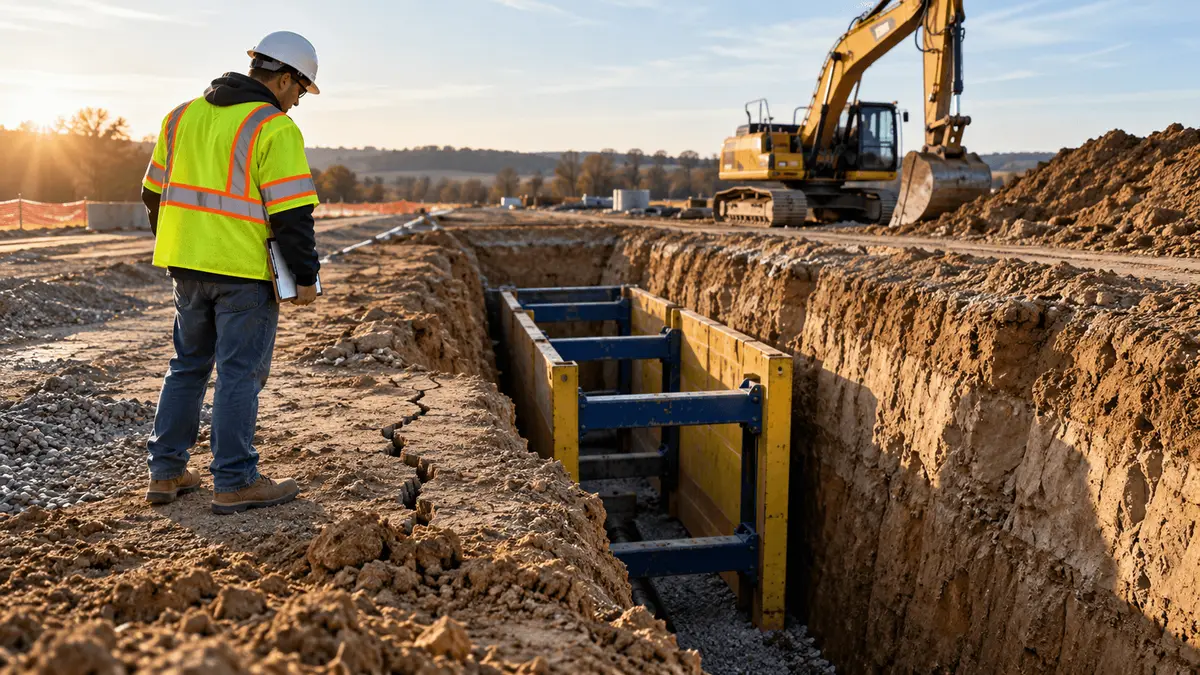
A trench can look unchanged from the access point while its soil is moving in ways that matter. A new fissure near the edge, a small stream of pebbles from the face, a bulge near the toe, or a shallow depression behind the cut may be early evidence of distress. These observations are not cosmetic details. They can show that the forces acting on the excavation have changed and that the protective system, work zone, or entry decision needs another review.
OSHA's excavation rules require daily inspections by a competent person and additional inspections after hazard-increasing events such as rainstorms. The competent person must be able to identify existing and predictable hazards and have authority to take prompt corrective measures. That combination of knowledge and authority is central when a crew sees sidewall movement. The proper response is not to debate the size of a crack from inside the trench. Exposed employees should be removed from the hazardous area until necessary precautions have been taken.
This article focuses on how employers, supervisors, and competent persons can organize a practical sidewall-warning review. It does not replace a site-specific protective-system design, tabulated data, manufacturer instructions, or the judgment of a registered professional engineer when one is required.
Why Sidewall Warning Signs Matter
Soil does not need to fail as one clean block to create a serious hazard. Material may ravel from the face, slump from an upper bench, bulge near the bottom, or move behind a support system. A relatively small release can strike a worker, block an egress route, load a shield, damage utilities, or signal that a larger failure is developing. The visible symptom and the actual failure surface may not be in the same place.
OSHA's Appendix B to Subpart P describes distress using examples such as fissures near the excavation, edge subsidence, face slumping, bottom bulging or heaving, spalling, and ravelling. Those terms give a competent person a shared vocabulary, but the inspection cannot become a word-matching exercise. Conditions must be evaluated together, including soil classification, depth, water, vibration, surcharge loads, nearby structures, protective-system condition, and changes since the last inspection.
Time also matters. A trench may remain open through changing temperatures, equipment cycles, dewatering, traffic, or overnight weather. Soil exposed to air can dry, soften, freeze, thaw, or lose support. Spoil piles and materials can move closer to the edge as production changes. A loader that was parked elsewhere during the morning inspection may begin operating beside the cut after lunch. Each change can alter the stress on the sidewall.
Warning signs matter outside the trench as well as on the face. Tension cracks may develop back from the edge. Pavement may separate or settle. A curb, utility pole, fence post, or temporary barricade may lean. Water may begin disappearing into a crack rather than flowing along the surface. These observations can help the competent person recognize that a larger zone is moving and that workers, equipment, and stored materials need to be kept farther away.
What the Competent Person Should Examine
Begin with a comparison, not a snapshot. The inspection should ask what changed since the last accepted condition. Photos taken from safe, repeatable viewpoints can help, as can a simple sketch showing crack locations, protective-system position, water, spoil, equipment routes, and active work areas. A photograph is supporting evidence, not proof that the trench is safe. The competent person's direct evaluation and authority remain essential.
Look at the excavation face from a safe location above grade. Note fresh fissures, exposed layers, loose fragments, sloughing, undercut areas, and material collecting at the bottom. A clean vertical line that appeared after a piece fell away can be more important than the amount of material already on the floor. Do not send an employee below grade merely to obtain a closer view of a suspected failure.
Examine the surface behind the edge. Walk the accessible perimeter while staying outside any unstable zone. Look for cracks, settlement, soft spots, wheel ruts, drainage changes, and evidence that equipment or stockpiles have added load. The apparent top edge of the excavation is not necessarily the limit of the potential failure mass. Barricades and equipment controls should account for the area that may be affected.
Check the bottom and toe when they can be observed safely. Heaving, bulging, squeezing soil, muddy boils, or unexpected water can indicate instability. Water can remove soil, soften layers, increase pressure, and conceal movement. Pumping can also change conditions if it erodes material or draws soil from behind a support system. Dewatering should follow a planned method with discharge controlled so it does not return to the excavation or destabilize adjacent ground.
Inspect the protective system as part of the same review. For shields, look at position, clearance, damage, deformation, spreader connections, and possible soil loss around or below the system. For shoring, review members, connections, preload or hydraulic condition where applicable, and evidence of soil moving between or behind supports. For slopes and benches, compare actual geometry with the selected design method and soil classification. A system that was adequate for the original excavation may not fit the current depth, width, layers, water, or loading.
Confirm access and egress remain usable. Soil movement can narrow a path, shift a ladder, bury its base, or place the route beside a distressed face. The crew should not have to pass beneath loose material or move outside the protected area to reach an exit. OSHA requires a stairway, ladder, ramp, or other safe means of egress in trench excavations 4 feet or more in depth so employees need no more than 25 feet of lateral travel.
Employer and Supervisor Knowledge
Employers should define who is designated as the competent person for the shift and make that authority visible to the crew. The role cannot be an informal title assigned to someone who lacks training, experience, time, or authority. The designated person needs access to soil information, protective-system documents, manufacturer data, site plans, weather information, and any engineering instructions that control the work.
Supervisors should understand that production decisions can create inspection triggers. Advancing the trench, changing depth, moving a shield, removing shoring, placing pipe, relocating spoil, introducing compaction equipment, starting dewatering, or opening the site to traffic can change conditions. The daily inspection is a minimum rhythm, not a shield against changes that occur later.
The employer should establish a clear stop-work path. Any worker should be able to report falling material, unusual sounds, cracks, vibration, water, or equipment encroachment without entering the hazard or delaying the report. The competent person must be able to remove employees and hold reentry until controls are restored. If the condition exceeds the person's knowledge or the selected protective-system method, the employer should involve the appropriate designer, manufacturer, or registered professional engineer.
Documentation should show what was found, what action was taken, and who authorized reentry. A useful record identifies the location, time, weather, excavation dimensions, soil observations, protective system, water condition, nearby loads, warning signs, corrective measures, and the name of the competent person. Avoid vague entries such as "trench checked" when the decision depended on a specific crack, shield position, pump change, or load relocation.
Crews also need boundaries around informal repairs. Knocking loose soil down from inside the trench, pushing a bulge back with an excavator while employees remain exposed, covering a crack with spoil, or moving a shield through an occupied area can create additional hazards. Corrective work should be planned, performed from protected positions, and coordinated so employees are not exposed while the condition is being changed.
A Practical Reentry Decision
A reentry review should begin only after exposed employees are out of the hazardous area. Control access at the surface so another worker or subcontractor does not enter while the evaluation is underway. Stabilize nearby operations by stopping equipment, redirecting traffic, controlling water, and keeping loads away from the affected zone.
Next, identify the likely contributors. Consider weather, soil layers, unsupported height, overexcavation, water, vibration, surcharge loads, adjacent structures, utilities, and any change to the protective system. More than one contributor may be present. A fissure after rainfall may also be influenced by spoil loading and traffic vibration. Treating only the most visible item can leave the underlying condition unchanged.
Choose corrective measures that match the hazard and the design basis. Actions may include removing loose material from a safe position, scaling back the excavation, revising the slope, installing or adjusting a support or shield system, controlling water, relocating loads, or obtaining an engineered solution. The competent person should verify that the completed work matches the applicable option under Subpart P, tabulated data, manufacturer requirements, or engineering design.
Then perform and document a fresh inspection. Do not rely on the earlier form with a note that the condition was fixed. Confirm the face and surface are stable enough for the selected system, the system is properly installed, egress is clear, water is controlled, loads are managed, and the crew understands the new work limits. Reentry authorization should be explicit.
Continue monitoring after work resumes. Some corrective measures change the excavation again. Pumping can reveal additional seepage, a revised slope can expose another layer, and shield movement can disturb the sidewall. The competent person should set the next observation point based on the condition rather than waiting automatically until the next day.
How Training Supports Better Inspections
Competent-person training should connect regulatory language to field recognition. Participants need to practice identifying fissures, ravelling, slumping, spalling, bulging, heaving, water effects, and surcharge conditions in photographs and realistic site scenarios. They should also explain what they would do, what information they would seek, and why a reentry decision is or is not justified.
Training should cover the limits of the role. A competent person selects and applies permitted protective-system options within the person's qualifications and the available design information. The role does not authorize improvising beyond tabulated data, ignoring a manufacturer's limitations, or replacing engineering judgment where a registered professional engineer is required. Knowing when to escalate is part of competence.
Supervisors and equipment operators need supporting instruction even if they are not designated competent persons. They should recognize that equipment placement, vibration, water handling, spoil, lifting, and trench advancement can trigger reinspection. Workers entering the excavation should know the warning signs to report, the location of safe egress, and the expectation to leave immediately when directed or when a hazardous condition develops.
Brief scenario drills can make the stop-work process usable. Present a situation such as a new crack behind the edge after a delivery truck arrives. Ask the crew who controls access, who contacts the competent person, where equipment moves, what is documented, and who can authorize reentry. The goal is a reliable response, not a memorized list of soil terms.
Key Takeaway
Sidewall warning signs are decision points. A fissure, ravel, slump, bulge, heave, or settlement may be the first visible evidence that the excavation no longer matches the conditions used to select its protective system. Employers should give competent persons the training, information, and authority to stop work, evaluate the entire hazard picture, direct corrective measures, and document a new inspection before reentry.
A safe excavation program treats observation as an active control. Crews report changes early, supervisors pause production without hesitation, and competent persons compare current conditions with the approved design and prior inspection. That discipline turns small clues into timely action before soil movement becomes an emergency.
Sources
- Occupational Safety and Health Administration, 29 CFR 1926.650, Scope, Application, and Definitions
- Occupational Safety and Health Administration, 29 CFR 1926.651, Specific Excavation Requirements
- Occupational Safety and Health Administration, 29 CFR 1926.652, Requirements for Protective Systems
- Occupational Safety and Health Administration, Appendix B to Subpart P, Sloping and Benching