Changing trench conditions can make yesterday's protection decision unreliable, so supervisors need a repeatable stop-work record before crews enter again.
An excavation can look familiar while its risk profile has changed. Rain can soften a sidewall, a new load can add surcharge, a utility conflict can alter the cut, or nearby traffic can introduce vibration. A competent person needs a practical way to recognize the change, pause work, communicate the decision, and document the conditions that must be corrected before entry resumes.
This article is a planning and training discussion for excavation employers, supervisors, competent persons, and crews. It does not replace the applicable OSHA standard, a protective-system design, a manufacturer's instructions, an engineer's direction, or the site-specific judgment required at the excavation.
Why This Issue Matters
The most dangerous moment is often the transition between a condition that was reviewed and a condition that was assumed. A trench may have been inspected at the start of a shift, then exposed to rainfall, dewatering, equipment movement, material delivery, or a change in the excavation geometry. If the crew treats the original inspection as permanent, the work plan can lag behind the hazard.
OSHA's excavation rules require daily inspections by a competent person before work begins and as needed throughout the shift when conditions change. The rule also addresses hazardous atmospheres, falling loads, water accumulation, access and egress, and protection from cave-ins. A stop-work record should connect the observed change to the decision made, not simply say that the trench was checked.
A useful record protects the crew's shared understanding. It can show which area was affected, who was notified, what protection was present, what condition triggered the pause, and what evidence supports reopening. The record is not a substitute for field judgment. It is a way to preserve that judgment so the next supervisor, shift, or subcontractor does not have to reconstruct it from memory.
The decision may be temporary. A pause could last while water is removed, spoil is relocated, a shield is adjusted under an approved method, a utility is exposed safely, an access point is restored, or a competent person completes a new inspection. The important point is that entry does not restart merely because equipment is available or production pressure has increased.
Employer and Supervisor Knowledge
Employers should define who can stop excavation work and how that decision reaches the people who can control the hazard. A crew member who sees sloughing, cracking, exposed utilities, unexpected water, or a damaged ladder should know whom to contact and should not be penalized for raising the concern. Supervisors should make the reporting path visible during the pre-task briefing.
The plan should identify the competent person for each shift and work area. It should also explain how coverage works during breaks, deliveries, lunch, night work, and handoffs. A competent person needs authority to identify existing and predictable hazards and authorization to take prompt corrective measures. Naming a person on a form without giving that person time, access, or authority does not make the inspection process effective.
Supervisors need to understand the difference between an observation and a conclusion. A photograph of a crack is useful evidence, but it does not by itself establish whether the protective system remains adequate. A note that says water is present is useful, but the team still needs to consider its effect on soil, stability, access, and the work method. Records should preserve what was seen and what decision followed without pretending that a checklist can make the judgment for the competent person.
The employer should also account for nearby operations. Vibratory compaction, crane setup, truck traffic, spoil piles, pipe staging, and changes to a roadway can affect an excavation even when those activities occur outside the trench. The inspection conversation should include the surrounding work area, not just the cut face.
Conditions That Should Trigger a Pause
Water is a common trigger. Accumulation, seepage, a failed pump, a blocked discharge route, or a rising water table can change sidewall behavior and make access difficult. A record should identify where water appeared, whether employees were exposed, whether pumping changed the soil, and what review is required before the crew returns. The team should not assume that adding another pump automatically makes entry acceptable.
Surface movement is another trigger. Cracks, tension openings, sloughing, bulging, raveling, settlement, and falling material deserve attention. The record should describe the location and extent of the observation, whether it is growing, and whether people or equipment were moved away. A vague statement such as soil looked bad does not give the next person enough information to make a safe decision.
Loads and vibration can change conditions without touching the edge. Spoil, pipe, pallets, excavators, trucks, or temporary barriers may be placed closer to the excavation. A stop-work note should capture the load, its location, the operation involved, and the plan for removal or control. If the distance from the edge matters, measure it or describe it with a reliable reference rather than relying on a casual estimate.
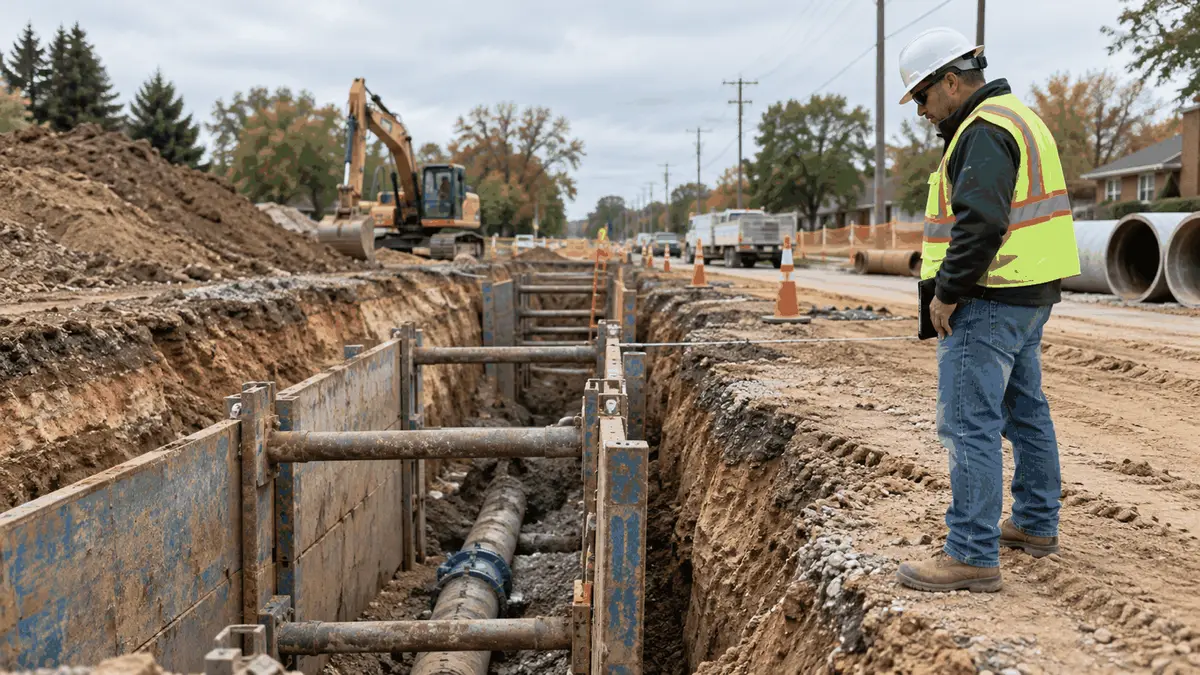
Access and egress deserve their own review. For trench excavations four feet or more in depth, OSHA requires a stairway, ladder, ramp, or other safe means of egress so employees need not travel more than 25 feet laterally. A ladder can become unusable because of mud, shifting, damage, a blocked route, or a change in the work area. The record should identify the affected route and confirm how the crew will reach safety before entry resumes.
Atmospheric concerns can also stop the job. Excavations in areas where hazardous atmospheres may exist should be evaluated and tested as required. Utility work, landfills, stored chemicals, nearby sewers, fuel releases, and enclosed portions of a cut may create a reason for additional controls. The record should identify the test, location, instrument status, result, and person making the decision, while following the site's atmospheric-monitoring procedure.
Training Support for Crews
Training should turn stop-work authority into a practiced behavior. Crews can rehearse short scenarios: rainfall starts during pipe installation; a trench edge cracks beside a haul route; a shield is moved and the work area no longer matches the plan; a ladder is buried by spoils; or a utility is found where the locate drawing predicted something else. The exercise should ask who speaks, who moves people, what is recorded, and what must happen before restart.
Workers should learn the difference between leaving the area and correcting the condition. Moving employees away from the exposure is an immediate protective action, but it does not authorize someone else to enter. The supervisor should control the boundary, prevent casual re-entry, and ensure that equipment operators know the work has paused. Clear language helps: stop, move to the designated safe location, notify the competent person, and wait for release.
Training can include the actual form used at the site. Have the crew identify the excavation location, time, weather, work activity, protective system, access route, and observed change. Then ask them to state the next action without filling the form with unsupported assumptions. Practicing with real forms exposes confusing fields, missing escalation contacts, and duplicate documentation before an event makes those problems visible.
Supervisors also need handoff training. A condition that is unresolved at the end of one shift should be transferred with a clear status, boundary, owner, and next review. The incoming supervisor should be able to find the record, understand why work stopped, and confirm whether the corrective action was completed. A verbal message alone is easy to lose during a busy shift.
What Employers Should Document
At minimum, the record should identify the date, time, project, excavation location, work activity, competent person, crew or contractor, and reason for the pause. Add the weather or event context when relevant. State whether employees were inside, at the edge, or kept out when the condition was observed. Note any equipment or materials that could affect the decision.
Describe the condition in observable terms. Record where cracking, water, soil movement, spoil, traffic, damaged protection, or access obstruction appeared. Include photographs, measurements, sketches, test results, or equipment identifiers when they help another person verify the observation. Avoid language that implies a correction occurred if the record only shows that a request was made.
The next part is the decision. Identify the immediate controls, such as stopping entry, moving the crew, isolating the area, removing a load, controlling water, providing a new access route, or contacting a qualified designer or engineer. Record who owns each action and what review is required. If the protective system must be changed, follow the applicable design, manufacturer's instructions, and competent-person process rather than improvising in the field.
Closeout should be equally specific. The competent person should document the follow-up inspection and the evidence used to release the area, or record that the work remains stopped. If a condition cannot be verified, say so. A complete record can include the time of reinspection, changes made, photographs, atmospheric results when applicable, and the name of the person authorizing the next step.
Common Mistakes to Avoid
One mistake is treating a daily inspection as a one-time permission slip. The inspection must respond to changing conditions. Another is recording only that a supervisor was notified. Notification is important, but the record should also show the protective action and the status of the excavation.
Avoid using the same generic corrective action for every event. Water, a surcharge load, a damaged shield, a utility conflict, and a hazardous atmosphere call for different controls. Avoid allowing production schedules to determine when the reinspection occurs. The work plan may be adjusted, but the hazard review comes first.
Do not let photographs replace context. A picture taken from the wrong angle may hide the edge, access route, or nearby load. Do not assume a trench box makes every condition acceptable; the protective system must be selected, installed, used, and maintained for the conditions present. Do not ask unqualified workers to make a protective-system design decision because the competent person is unavailable.
Another mistake is failing to connect the event to learning. Repeated stop-work triggers may reveal a planning gap, weak weather preparation, poor staging, or incomplete training. Review patterns without blaming the person who reported the condition. The purpose is to improve control before the next shift encounters the same problem.
Key Takeaway
An effective excavation stop-work process makes changing conditions visible, gives crews authority to pause, and preserves the competent person's reasoning. Employers should train the behavior, supervisors should control the boundary, and records should show what changed, what action was taken, and what evidence supports the next decision. That discipline supports safer work without promising that a form or course can eliminate every excavation hazard.
Sources
Occupational Safety and Health Administration, 1926.651 Specific Excavation Requirements https://www.osha.gov/laws-regs/regulations/standardnumber/1926/1926.651
Occupational Safety and Health Administration, 1926 Subpart P Excavations https://www.osha.gov/laws-regs/regulations/standardnumber/1926/1926SubpartP