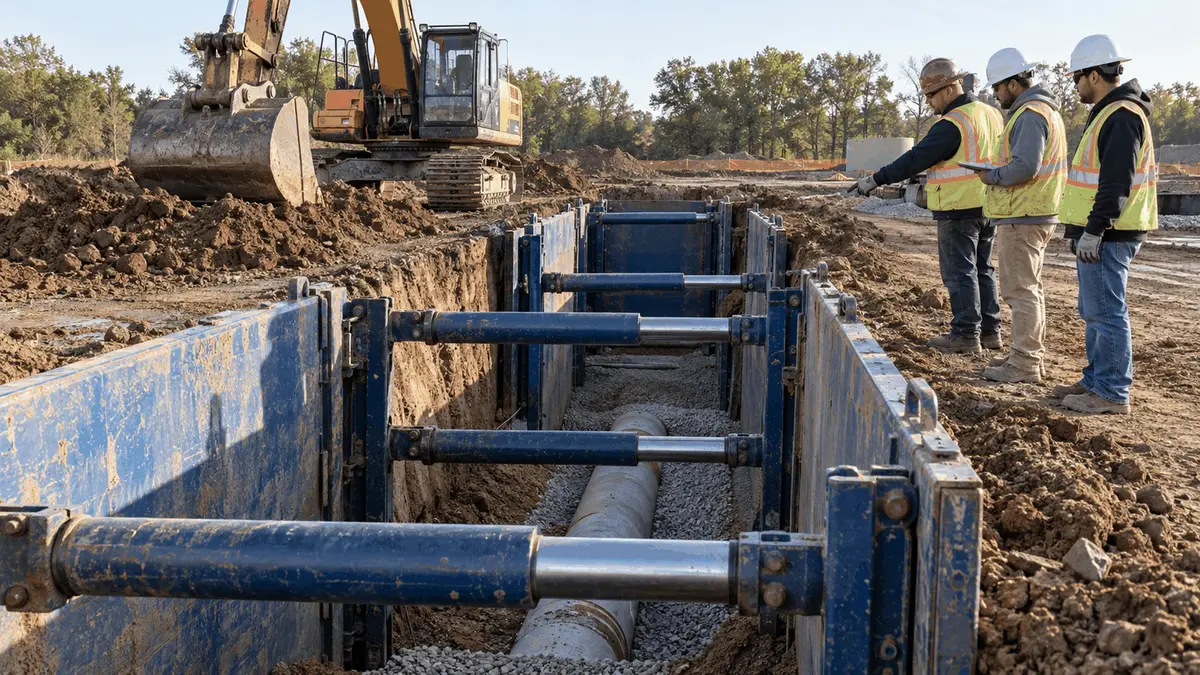
Removing trench shoring changes the support holding soil in place, so supervisors need a controlled sequence before any component is released or disturbed.
The end of trench work can feel routine because the pipe is installed, the repair is complete, or the inspection has passed. Yet removing a support system creates a new phase of excavation exposure. Loads can shift as a member is loosened, soil can move into a newly opened space, and equipment used for backfilling can change edge conditions. The crew needs a plan for this phase before production pressure turns removal into an improvised task.
This article provides a planning and training discussion for excavation employers, supervisors, competent persons, equipment operators, and crews. It does not replace OSHA requirements, a registered professional engineer's design, tabulated data, manufacturer information, or the site-specific judgment required for the actual excavation and support system.
Why This Issue Matters
Shoring is different from shielding. A shoring system supports the sides of an excavation to help prevent movement, while a shield is intended to protect employees within the shield if a cave-in occurs. When shoring components are released, the operation changes the support relationship between the equipment, the soil, nearby structures, underground installations, and any backfill already placed. Treating removal as simple cleanup can overlook that changing load path.
OSHA's excavation protective-system requirements include specific provisions for installing and removing support systems. The rule states that removal begins at and progresses from the bottom of the excavation, that members are released slowly so indications of possible failure or cave-in can be observed, and that backfilling progresses together with removal. It also calls for additional precautions before an individual member is temporarily removed when that member is carrying a load.
Those provisions establish important boundaries, but they are not a complete field method for every system. Hydraulic shoring, timber shoring, sheet systems, braces, wales, uprights, and engineered arrangements can behave differently. Excavation depth, soil, water, vibration, adjacent loads, utilities, and structures can affect the plan. The employer must connect the applicable rule to the design and actual conditions rather than turning a general sequence into a universal procedure.
Removal can also expose people who are not performing the disassembly. An operator may be moving backfill, a truck may be approaching the edge, a laborer may be handling a hose, or another trade may be preparing the next task. If those activities are not coordinated, someone can enter a changing work zone, stand near a component under load, or place a new surcharge beside the excavation.
Employer and Supervisor Knowledge
Employers should decide who controls the removal plan, who serves as the competent person, and who has authority to stop the operation. The competent person must be able to identify existing and predictable excavation hazards and take prompt corrective measures. That authority needs practical support, including time to inspect, access to the system information, a way to communicate with operators, and the ability to keep people out while conditions are evaluated.
Supervisors should confirm exactly what system is installed. A label such as hydraulic shoring is not enough. The team needs the available design, tabulated data, manufacturer information, component identification, spacing, installation history, and any approved changes. If the field arrangement does not match the information, the answer is not to invent a removal sequence. The discrepancy should be resolved with the appropriate qualified resource before work proceeds.
The pre-removal review should compare the current excavation with the conditions assumed when the system was selected. Has the trench become deeper or wider? Has water entered? Has backfill or bedding changed the pressure around the system? Are there signs of movement, damage, distortion, leaking hydraulic components, loose connections, or soil loss? Have traffic, stockpiles, equipment, weather, or nearby work changed the loads at the edge?
Underground installations and adjacent structures deserve separate attention. A pipe, conduit bank, footing, pavement edge, pole, or wall may rely on soil or temporary support that is affected during removal. The support system may also be sharing or transferring a load that is not obvious from the surface. Where the plan involves engineered support or a condition outside the system's normal information, the supervisor should obtain the required design direction rather than asking the crew to judge it during disassembly.
Build the Removal Sequence Before Work Starts
A useful sequence identifies the stages, the responsible person for each stage, the equipment involved, and the condition that must be verified before the next stage begins. It should show how backfill and support removal advance together, how the bottom-up requirement will be followed, and how employees will remain protected throughout the operation. The plan should be specific enough that the operator, ground crew, and competent person share the same mental picture.
Start by defining the work zone. Identify the excavation edge, equipment route, swing radius, component handling area, backfill location, and safe observation point. Keep workers away from suspended loads and from positions where a released component, hose, connection, soil movement, or machine motion could strike or trap them. If a signal person is needed, establish one signal system and make stop authority clear.
Next, identify what carries load at each stage. Before temporarily removing an individual member, OSHA calls for additional precautions to protect employees, such as installing other structural members to carry the loads imposed on the support system. The correct precaution depends on the system and design. A crew should never assume that a brace is unnecessary because it appears loose or because a similar member was removed on another job.
Plan how members will be released slowly and observed. The competent person and crew need agreed stop indicators, which may include unexpected pressure, binding, soil movement, cracking, sloughing, water entry, component deformation, movement of an adjacent feature, or a condition that no longer matches the plan. Observation should occur from a protected position. A worker should not enter an unsupported area to get a closer look.
The sequence should also address interruptions. A delivery, weather change, equipment problem, shift change, or newly exposed utility can leave the system partly removed. Define how the area will be secured, marked, inspected, and handed off if the work cannot be completed as planned. A partially completed sequence should never be treated as a normal entry condition without a fresh review.
Coordinate Backfilling and Support Removal
Backfill is part of the protective sequence, not a separate production task that happens nearby. OSHA requires backfilling to progress together with support-system removal. The supervisor should translate that requirement into planned stages that fit the installed system, the material, the design, and the excavation. The plan should identify when material is placed, when it is distributed or compacted, when a component may be released, and who verifies the stage.
Equipment position matters. An excavator, loader, compactor, or truck can add surcharge and vibration near the edge. It can also block access, limit visibility, damage a component, or move material into the work zone unexpectedly. The operator needs a defined route and stopping point. The competent person should consider how each equipment move affects the excavation, not only whether the bucket can reach the backfill area.
Material placement should avoid creating an unbalanced or unexpected load on the remaining support. The details belong in the applicable design, manufacturer information, and site plan. Crews should not use a generic lift thickness or compaction practice as permission to deviate from those instructions. If the backfill does not flow, settle, or compact as expected, the operation should pause for review before a support member is released.
Water can complicate the sequence. Pumping, seepage, wet backfill, or a change in drainage may erode material, create voids, soften the bottom, or obscure soil movement. Removing visible water does not by itself establish that the excavation or support system is suitable for the next stage. The competent person should evaluate the condition and determine whether additional protective measures or design input are needed.
At each stage, record enough information to support the next decision. Useful details can include the time, excavation location, system section, backfill level, component removed, equipment used, observed condition, and name of the competent person. Photographs can support the record when taken from a safe position, but they should not replace the inspection or the written description of what was verified.
Inspection and Stop-Work Triggers
The excavation should be inspected by the competent person as required before work starts and as conditions change. Removal itself is a changing condition, so the inspection process needs to stay connected to the sequence. A check completed before the first member is released cannot automatically cover every later stage.
Stop-work triggers should be concrete. Unexpected soil movement, cracking, raveling, heaving, water, loss of material behind or below a system, movement of an adjacent structure or utility, damaged components, abnormal hydraulic behavior, or a load that was not included in the plan all deserve immediate attention. So does any difference between the field arrangement and the available design or manufacturer information.
Communication is part of the control. When a stop is called, the operator should know how to place equipment in a safe condition, the ground crew should move to the designated location, and the supervisor should secure the boundary. The competent person then evaluates the change and determines the next step. Restart should be based on corrected conditions and an appropriate review, not on elapsed time or schedule pressure.
A near miss or unusual condition should be preserved as a learning record. Note what stage was underway, what changed, how the team responded, and whether the plan, briefing, component inspection, or equipment layout should change on future work. The goal is not to discourage reporting. It is to prevent the same surprise from reaching another crew.
Training Support for Crews
Training helps each role understand why the removal sequence cannot be improvised. Crew-level Excavation, Trenching and Shoring Safety Training can build recognition of cave-in exposure, changing conditions, falling or suspended loads, equipment hazards, access limits, water, and stop-work expectations. Site-specific instruction must then connect those concepts to the support system and removal plan actually in use.
Competent Person for Excavation, Trenching and Shoring Training supports the person expected to inspect the excavation, recognize hazards, understand protective-system concepts, and take prompt corrective action. A course does not select a system or write the employer's field plan. The employer still needs to designate a capable person, provide authority and resources, and verify that the person can apply the knowledge to the site.
Operators need role-specific practice. They should understand where equipment may travel, how loads and vibration can affect the edge, who gives movement signals, where people must remain, and what condition requires an immediate stop. Ground workers need to understand exclusion zones, component handling, pinch points, suspended-load rules, and why entering to free a stuck member can create a new exposure.
A tabletop exercise can expose gaps before removal begins. Ask the group to walk through the planned stages and then introduce one change: water appears, a brace binds, the excavator must move, a utility is uncovered, or the next shift takes over. The team should identify who stops the work, where people move, what gets inspected, who provides technical direction, and how the revised decision is communicated.
Common Mistakes to Avoid
One mistake is waiting until the end of the job to think about removal. The installed system, component access, backfill method, and equipment layout may leave few safe options if removal was not considered during planning. Another mistake is relying on memory instead of keeping the applicable design and system information available to the people making decisions.
Avoid removing a member because it appears unloaded. Loads can be transferred through the system or soil in ways that are not visible. Do not begin at the top for convenience when the applicable OSHA sequence requires removal to begin at and progress from the bottom. Do not separate backfilling from removal or advance one operation without confirming how it affects the other.
Do not allow workers inside an area that has lost its planned protection. Do not place anyone under a suspended component or within the path of equipment used to pull, lift, or handle members. Avoid improvised attachment points, unplanned pulling methods, and changes to components that are not supported by the design or manufacturer information.
Finally, do not treat a familiar system as proof that today's excavation is familiar. Soil, depth, water, adjacent structures, utilities, component condition, and site loads can change the decision. A disciplined pause is appropriate whenever the field condition no longer matches the plan.
Key Takeaway
Trench shoring removal is a planned excavation operation, not an afterthought. Employers should connect the bottom-up removal requirement, slow release of members, coordinated backfilling, system information, competent-person inspections, equipment control, and clear stop-work triggers into one site-specific sequence. Role-based training can help crews understand the sequence, but the employer remains responsible for the protective system, supervision, and conditions at the jobsite.
Sources
Occupational Safety and Health Administration, 1926.652 Requirements for Protective Systems https://www.osha.gov/laws-regs/regulations/standardnumber/1926/1926.652
Occupational Safety and Health Administration, 1926 Subpart P Excavations https://www.osha.gov/laws-regs/regulations/standardnumber/1926/1926SubpartP
National Institute for Occupational Safety and Health, Trenching and Excavation Safety https://www.cdc.gov/niosh/trenching/about/