
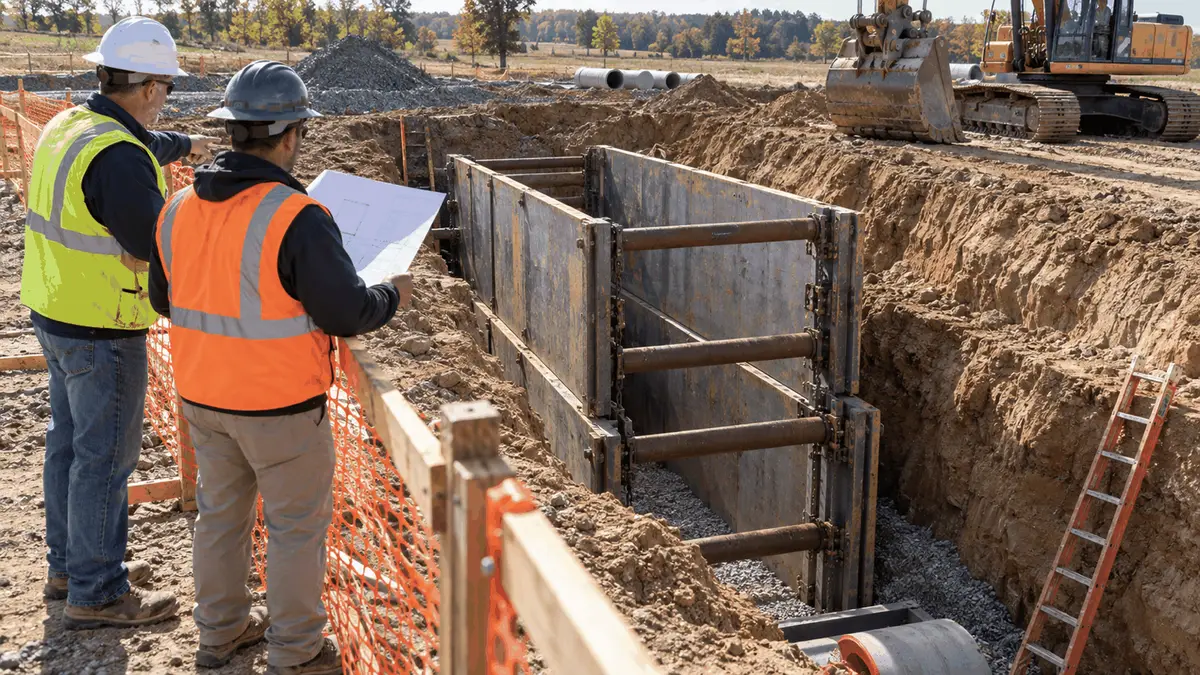
Stacking trench shields can extend protection in deeper excavations, but only when the configuration follows compatible, job-specific tabulated data. A stack that looks stable from grade can still create serious exposure if the shields were not designed to be combined, the spreaders do not match, the depth rating is exceeded, or workers leave the protected area. Employers should treat a stacked shield plan as a protective-system decision that requires documentation, inspection, and clear authority before anyone enters the trench.
Why Stacked Shield Configuration Matters
A trench shield protects employees by providing a protected space during a cave-in. It is not intended to prevent the soil from moving, and it does not make conditions outside the shield safe. When two shields are stacked, the configuration introduces additional questions about compatibility, connection points, structural loading, installation sequence, clearance, and access. Those questions cannot be answered by appearance alone. The employer and competent person need the applicable manufacturer's tabulated data or another permitted design basis for the exact equipment and planned use.
The stakes increase as excavation depth increases. Soil pressure, surcharge loads, vibration, water, adjacent structures, and previously disturbed ground can all affect the excavation and the demands placed on a protective system. The shield rating, maximum depth, soil assumptions, spreader arrangement, and stacking instructions must align with actual site conditions. If the plan changes after digging begins, the protective-system review must change with it.
OSHA's Subpart P framework requires employees in excavations to be protected from cave-ins unless a specific exception applies. Manufactured protective systems must be designed and used in accordance with the manufacturer's recommendations, limitations, and specifications. Deviations require written approval from the manufacturer or a registered professional engineer. The practical lesson is simple: a crew cannot improvise a stacked assembly because two boxes happen to fit inside the trench.
Stacking can also change how employees enter, exit, and remain within the shield. A ladder must be positioned so workers can use it without climbing on spreaders or exposing themselves outside the protected area. Materials, pipes, and equipment may narrow the usable space. The top shield may affect visibility between the operator and spotter. A good configuration review therefore addresses the whole work system, not only whether the steel panels are upright.
What Employers and Supervisors Need to Know
The employer should establish who is authorized to approve the shield configuration and who will stop work when field conditions differ from the plan. The competent person must be able to identify existing and predictable hazards and have authority to take prompt corrective measures. That authority matters when a delivery contains a different shield model, a spreader is substituted, the trench becomes deeper than planned, or a connection component is missing.
The equipment identity should be verified before assembly. Record the manufacturer, model, serial number or other equipment identifier, panel height, spreader type, and any designated stacking hardware. Compare those details with the tabulated data kept at the jobsite. One set of data may cover multiple identical shields, but the crew still needs a reliable way to confirm that each component belongs to the configuration described in that data.
Compatibility is not a visual judgment. Shields from different manufacturers should not be stacked merely because their dimensions appear similar. Shields that were not designed for stacking should not be stacked. Connection points, pins, keepers, spreader sockets, panel strength, and allowable loads are part of an engineered system. A mix-and-match assembly can create forces or failure modes that the available data does not address.
Supervisors should also understand what the depth rating means. The applicable data may tie allowable depth to soil type, equivalent fluid pressure, panel size, spreader length, or a specific stacked configuration. A rating for one shield used alone does not automatically apply to two shields stacked together. Likewise, a deeper rating in one soil condition cannot be carried into a different condition without support from the design information.
Soil classification remains part of the decision. The competent person should review the soil and other conditions using the methods required by the employer's program and Subpart P. Previously disturbed soil, fissures, vibration, water, layered deposits, and nearby loads can change the analysis. If the tabulated data relies on a soil assumption that the site cannot support, entry must wait for a suitable protective-system decision.
The relationship between the shield and the trench matters as much as the steel itself. Voids between shield panels and trench walls can allow movement that displaces the box. Sloping toward the shield can introduce material into the protected area unless the configuration provides the required extension or another suitable control. Excavating below the bottom of a shield is allowed only within the conditions established by the standard and the system design, including limits on depth and signs of soil loss from behind or below the system.
A Pre-Entry Configuration Review
Begin with the work scope. Confirm the planned trench depth, length, width, pipe or structure dimensions, equipment access, worker tasks, and anticipated changes during the shift. A stacked configuration that works for pipe placement may become inadequate when a large fitting, pump, or compaction tool changes where workers must stand. The review should identify the protected work zone for each task.
Next, match the physical equipment to the design documents. Verify the shield models, panel heights, spreaders, stacking connectors, pins, and other hardware. Check for damage, unauthorized repairs, distorted sockets, bent spreaders, cracked welds, missing identification, or components that do not seat correctly. Equipment damaged enough to affect structural integrity or performance should not be used until it is repaired and recertified as required.
Review the assembly sequence before equipment is suspended over the excavation. The plan should establish where shields will be connected, how employees will be kept clear of suspended loads, how tag lines or other controls will be used, and who will communicate with the equipment operator. No employee should be beneath loads handled by lifting or digging equipment. Assembly shortcuts that place workers between panels or under a suspended shield defeat the purpose of the protective system.
Confirm the final position and the path of work. Workers need to remain within the area protected by the shield. If the trench is longer than the box, the crew should know how the box will be advanced and when workers must exit. If the operation uses more than one shield end to end, transitions between protected areas need deliberate planning. A worker should never step into an unprotected gap to guide pipe, clear soil, retrieve a tool, or reposition a ladder.
Access and egress deserve a separate check. For trenches four feet or deeper, a stairway, ladder, ramp, or other safe means of egress must be located so employees do not travel more than 25 feet laterally. The access method should extend and be secured as required, avoid conflict with spreaders, and land within the protected area. Crews should not treat a spreader as a step or climb the shield wall.
Review adjacent loads and changing conditions. Spoil, materials, lifting equipment, traffic, and cranes can add surcharge or vibration near the excavation. Rain, seepage, pumping, utility leaks, and changing groundwater can affect soil behavior. The competent person should inspect the excavation, adjacent areas, and protective system before work, as needed throughout the shift, and after rainstorms or other hazard-increasing events. A completed morning checklist does not authorize entry after conditions change.
Finally, make the approval visible to the crew. A brief configuration record can identify the equipment, the design data reviewed, the depth and soil basis, the person authorizing entry, and any restrictions such as maximum depth, required shield projection, or prohibited component substitutions. This record supports communication, but it does not replace the competent person's inspection or the manufacturer's instructions.
How Training Supports Better Decisions
Training should help supervisors and competent persons read tabulated data as an operating document. They should be able to find the model identification, allowable depth, soil or pressure assumptions, spreader requirements, stacking limitations, repair restrictions, and notes governing special configurations. If a data sheet is present but no one can connect it to the equipment in the trench, the document is not supporting the field decision.
Crew training should explain the difference between shielding and shoring. Shielding protects workers within the box during a cave-in, while shoring supports the excavation walls. That distinction helps workers understand why soil movement outside a shield is still important, why they must stay inside the protected zone, and why a shield does not automatically protect a utility, adjacent structure, or worker standing beyond its end.
Equipment operators and spotters need role-specific practice. They should understand the planned lift points, communication signals, pinch zones, clearance from the trench edge, and stop-work signals. The operator should know that a worker's request to reposition a shield does not override the configuration plan. Spotters should be positioned where they can see the equipment and the edge without entering the line of fire.
Scenario-based training is especially useful. Present the crew with changes such as a different shield delivered to the site, a missing connector, unexpected water, a deeper invert, or a damaged spreader. Ask who stops work, what document is checked, and who can approve a revision. This approach builds decision habits instead of encouraging employees to memorize a generic setup.
Employers should also train workers to recognize when they are leaving the protected area. A worker may focus on a pipe joint or hand tool and gradually move beyond the shield end. Marking the protected work zone, discussing it during the briefing, and maintaining active supervision can reduce that drift. Workers should know they can call a stop when access, visibility, or task positioning pushes them outside the plan.
Refresher training should follow more than a calendar. It may be appropriate after a near miss, damaged equipment, a revised manufacturer's instruction, a new shield model, an observed shortcut, or a change in assigned duties. Supervisors can use completed configuration reviews and inspection findings to identify the specific knowledge gaps that need attention.
Training supports compliance and jobsite judgment, but it does not turn a course certificate into engineering approval. Employers remain responsible for selecting and using an adequate protective system, providing a competent person, following the applicable design information, and correcting hazards before employees enter.
Key Takeaway
A stacked trench shield configuration should be treated as a documented protective-system plan, not a field improvisation. Verify that the shields and components are designed to work together, match the exact equipment to the applicable tabulated data, confirm that site conditions fit the design basis, and keep workers inside the protected area.
The most useful pre-entry question is not whether the stack looks strong. It is whether the employer can show that the configuration, depth, soil assumptions, hardware, access, and work position all match a permitted design and today's conditions. When that answer is incomplete, the safe next step is to stop and obtain the missing information or qualified review before entry.
Sources
OSHA, Trenching and Excavation Newsletter: https://www.osha.gov/trenching-excavation/newsletter
OSHA, Technical Manual Section V Chapter 2 Excavations: https://www.osha.gov/otm/section-5-construction-operations/chapter-2
OSHA, 29 CFR 1926.652 Requirements for Protective Systems: https://www.osha.gov/laws-regs/regulations/standardnumber/1926/1926.652
OSHA, Construction Standards Addressing Excavations Interpretation: https://www.osha.gov/laws-regs/standardinterpretations/1992-03-23