
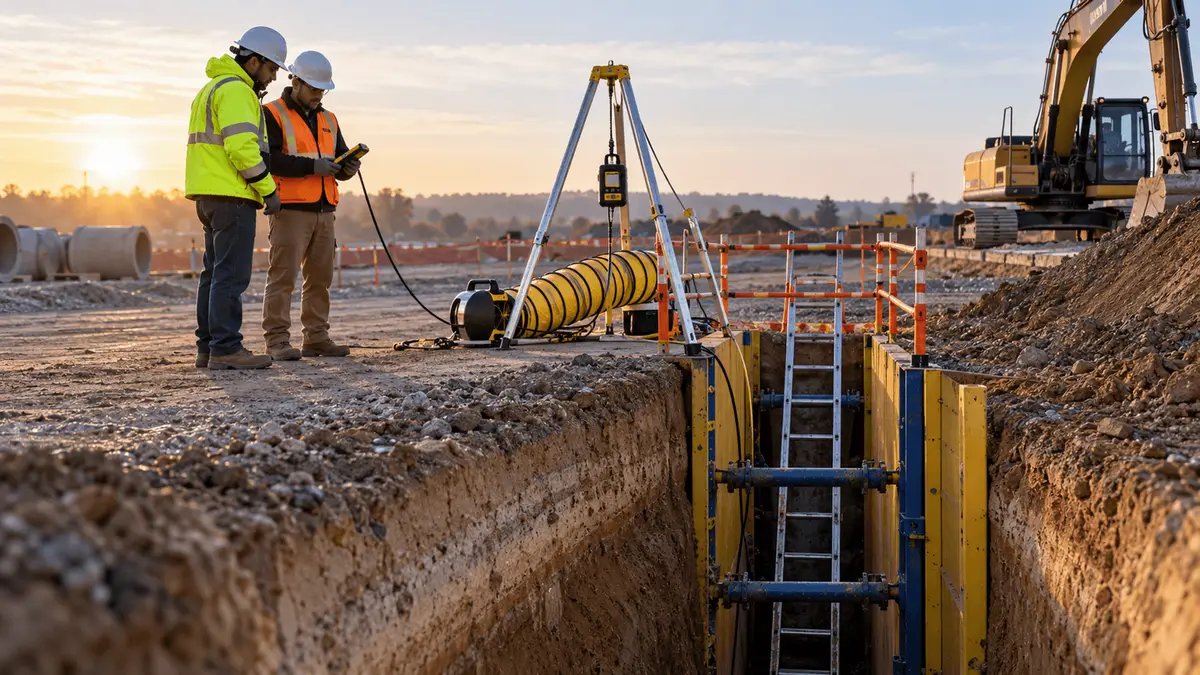
An excavation can look stable at the surface while low oxygen, toxic vapor, or flammable gas creates an invisible hazard below the edge for workers.
Crews often associate excavation safety with soil, protective systems, access, and equipment movement. Those hazards deserve constant attention, but they do not replace atmospheric planning. A trench near a sewer, landfill, fuel line, contaminated area, chemical process, or recently filled ground can collect or release gases that are not obvious by sight or smell. Engines, coatings, welding, cleaning products, and other work activities can also change the air after entry begins.
This issue belongs inside the excavation plan, not in a generic note copied from a confined-space form. OSHA's excavation requirements address testing before employees enter excavations deeper than four feet when oxygen deficiency or a hazardous atmosphere exists or could reasonably be expected. They also address precautions, ventilation, repeated testing when controls are used, and emergency rescue equipment where hazardous atmospheric conditions exist or may reasonably be expected to develop.
The employer remains responsible for the program, equipment, training, and safe work practices. The competent person brings those requirements into the field by identifying existing and predictable hazards, recognizing changes, and having authority to take prompt corrective action. Good planning connects those responsibilities before anyone crosses the edge.
Why Atmospheric Hazards in Excavations Matter
Excavations can create low areas where heavier-than-air vapors settle and ventilation is limited. Utility trenches may communicate with vaults, pipes, sewers, or leaking services. Soil disturbance can expose buried contamination. Work near landfills, storage areas, refineries, wastewater systems, or former industrial property may present conditions that require evaluation even when the excavation is open to the sky.
Oxygen deficiency is only one concern. A hazardous atmosphere may be flammable, toxic, irritating, corrosive, oxygen enriched, or otherwise harmful. A single reading taken from the edge does not necessarily represent the air at the bottom, around a pipe, inside a shield, or near the active work. Stratification, wind, temperature, trench geometry, and the source of a release can create different conditions at different locations.
The task can be the source. Gasoline or diesel engines near the cut may introduce exhaust. Welding, cutting, coating, solvent use, pipe cleaning, curing products, or the opening of a utility can change conditions during the shift. Even a control measure can change the picture. Ventilation may redirect contaminants, create an ignition concern if equipment is not suitable, or provide acceptable conditions only while it continues to operate.
Atmospheric planning also affects rescue. A worker who collapses in a trench may appear reachable, but an unplanned entry can expose a second worker to the same atmosphere. Rescue arrangements need to match the expected hazard, trench configuration, access point, protective system, and equipment on site. Calling emergency services is not a substitute for evaluating what the excavation requires before work begins.
What Employers and Supervisors Should Know
Start by identifying when an atmospheric hazard could reasonably be expected. The answer should come from site history, utility information, nearby operations, soil or environmental reports, safety data sheets, prior monitoring, and the work method. A checklist that asks only whether a trench is deeper than four feet can miss an obvious source at a shallower location, while depth alone does not prove that a hazardous atmosphere is present.
The work plan should name who evaluates the need for testing, who performs the test, which instrument is used, and what readings or conditions stop entry. It should also explain where sampling occurs and how the crew handles different elevations or locations. Instrument selection must match the substances or conditions of concern. A standard multi-gas meter does not detect every possible contaminant, and a displayed number is useful only when the sensor, range, limitations, and alarm settings are understood.
Instrument readiness is part of the plan. Crews need a defined process for calibration, bump testing, battery condition, sensor status, tubing, pumps, filters, and recordkeeping. The manufacturer's instructions matter. A monitor that has not been checked, has an expired sensor, or is used with an incompatible sampling line can create false confidence even when the screen appears normal.
Pre-entry testing should represent the places employees will occupy. Where remote sampling is used, the probe should be positioned without exposing the tester. Sampling needs enough time for air to travel through tubing and reach the sensors. The sequence should account for oxygen, flammable atmospheres, and potential toxic contaminants, while the site-specific procedure addresses any substances that require dedicated instruments or laboratory support.
Acceptable conditions must be defined before entry, not negotiated at the edge after an alarm. OSHA's excavation rule identifies less than 19.5 percent oxygen as an oxygen-deficient atmosphere and requires precautions to prevent exposure to oxygen deficiency and other hazardous atmospheres. It also requires precautions to prevent exposure to flammable gas above 20 percent of its lower flammable limit. Employers should evaluate any additional occupational exposure limits, product hazards, site rules, and emergency thresholds relevant to the work.
Ventilation is a control, not evidence by itself that conditions are safe. The employer should plan the air source, blower location, duct routing, discharge location, equipment suitability, and effect of nearby exhaust or releases. Fresh air must not be drawn from a contaminated area. Ducting should not block access, damage the protective system, create a trip hazard, or interfere with material handling. If the atmosphere depends on mechanical ventilation, the crew needs to know what happens when the blower stops.
Repeated or continuous testing should match the possibility of change. OSHA requires testing as often as necessary when controls are used to reduce contaminants to acceptable levels. The plan should consider work activities, nearby processes, wind shifts, fuel-powered equipment, changing depth, newly exposed utilities, and pauses in ventilation. A safe pre-entry reading is a point in time, not a promise for the entire shift.
Supervisors should integrate atmospheric controls with the rest of Subpart P. Testing equipment and ventilation cannot compensate for an inadequate protective system, water accumulation, unstable access, falling loads, or missing inspections. Likewise, a trench shield does not address toxic vapor. The daily inspection should treat these controls as one coordinated system.
A Practical Field Planning Sequence
Before excavation starts, review the location and proposed depth against utility records, environmental information, property history, and nearby operations. Ask whether sewers, pipelines, tanks, landfills, chemicals, decomposing material, or previous spills could affect the work. Document the basis for the conclusion, including when no atmospheric source is identified.
Before employees enter, inspect the excavation and protective system, then complete any required atmospheric testing from a protected position. Record the date, time, sampling locations, instrument identification, readiness check, readings, and person performing the test. The record should be easy for the competent person and supervisor to interpret, not a row of unexplained numbers.
If a reading is outside the employer's acceptable conditions, keep workers out and follow the site response plan. That may require stopping nearby equipment, identifying the source, revising the work method, adding ventilation, consulting an industrial hygienist or other qualified resource, or addressing an emergency. Do not use a worker's senses to confirm that the condition has cleared.
If ventilation or another control is applied, verify that it works before entry and determine the needed testing frequency. Place the monitor where it can detect a change relevant to workers. Establish who watches the readings, who receives alarms, and who has authority to order exit. Make sure the plan covers breaks, shift changes, relocation of a shield, deeper digging, and movement to a new section of trench.
Coordinate rescue before the hazard is present. OSHA's excavation rule calls for emergency rescue equipment to be readily available where hazardous atmospheric conditions exist or may reasonably be expected. The employer should determine what equipment and trained assistance fit the excavation. Equipment should be accessible, compatible with the task, and attended when required. Crews should understand that impulsive entry into a suspect atmosphere can multiply the emergency.
Close the loop after work. Review alarms, unusual readings, ventilation problems, symptoms, work changes, and stop-work decisions. Update the hazard assessment when new information appears. A short field debrief can improve the next shift's sampling locations and controls, while a vague note that conditions were fine does not preserve useful knowledge.
How Training Supports the Plan
Excavation awareness training can help crew members recognize that atmospheric hazards belong alongside cave-ins, utilities, water, and mobile equipment. Workers should know not to enter when required testing is incomplete, not to silence or ignore an alarm, and not to reposition ventilation or monitoring equipment without authorization. They also need a clear route for reporting odors, symptoms, spills, exhaust, or changing conditions.
Competent person training should connect regulatory duties with field judgment. The competent person needs enough knowledge to identify existing and predictable hazards, understand when atmospheric expertise or additional equipment is needed, evaluate the complete excavation, and remove employees from danger until corrective action is taken. Training does not transfer the employer's duty or make one person an expert in every contaminant.
Supervisors and atmospheric testers need equipment-specific instruction and hands-on practice. They should be able to complete required readiness checks, obtain a representative sample, understand response time, interpret alarms, recognize sensor limitations, document results, and apply the site's decision rules. Manufacturer instructions and site procedures should be available where the testing occurs.
Scenario practice is especially useful. A crew can walk through a monitor alarm after a utility is opened, a blower failure during work, exhaust drifting toward the trench, or a worker reporting dizziness. The exercise should test communication, evacuation, accountability, stop-work authority, and the rule against unplanned rescue entry. The goal is a repeatable response under pressure.
Refresher training should follow the employer's program and observed needs. Triggers can include a change in equipment, task, hazard, site conditions, procedure, or employee performance. Training records should show the course, date, participant, instructor or provider, and any site-specific or practical component. A completion record supports documentation, but competent field performance still has to be verified.
Common Planning Gaps
One mistake is assuming open air guarantees safe air. A trench can collect vapor or connect to a source below grade. Another is using depth as the only trigger. The four-foot provision is important, but the competent person and employer should respond to recognizable hazards at any depth and evaluate the full situation.
A second mistake is treating one multi-gas meter as universal. The instrument may not detect the chemical suspected at the site, and cross-sensitivity can complicate interpretation. Select sensors and methods based on the hazard assessment, and seek qualified assistance when the contaminant is uncertain.
A third mistake is recording only pass or fail. Useful records identify where, when, how, and with which instrument the air was tested. They also show what changed after ventilation, whether testing continued, and who made the entry decision. Records should support action, not merely prove that a box was checked.
A fourth mistake is separating atmosphere planning from production changes. Digging deeper, exposing a line, applying a coating, moving an engine, or changing wind direction can make an earlier decision obsolete. The competent person needs timely information from operators, utility crews, subcontractors, and supervisors.
A fifth mistake is treating ventilation as a cure for every condition. Ventilation may be appropriate, but it needs a clean air source, suitable equipment, effective placement, and verification. Some situations require respiratory protection, process isolation, specialized monitoring, or a different work method. Those decisions require the employer to apply the appropriate standards and qualified expertise.
Key Takeaway
Atmospheric safety in excavations starts with a site-specific reasoned decision: could a hazardous atmosphere exist or develop, and what will the crew do about it? Employers should define the assessment, instruments, acceptable conditions, controls, testing frequency, rescue resources, and records before entry. Supervisors should coordinate those measures with protective systems and the daily inspection. Competent persons should have the knowledge, authority, and support to stop work when information is missing or conditions change.
Training supports that system by giving workers and leaders a common way to recognize sources, use equipment, interpret alarms, communicate changes, and exit without delay. It does not replace a site assessment or qualified technical help. When planning is specific and the decision points are clear, an invisible hazard is less likely to be dismissed as someone else's problem.
Sources
Occupational Safety and Health Administration, 29 CFR 1926.650 Scope, Application, and Definitions: https://www.osha.gov/laws-regs/regulations/standardnumber/1926/1926.650
Occupational Safety and Health Administration, 29 CFR 1926.651 Specific Excavation Requirements: https://www.osha.gov/laws-regs/regulations/standardnumber/1926/1926.651
Occupational Safety and Health Administration, Trenching and Excavation Construction Resources: https://www.osha.gov/trenching-excavation/construction