Trench shields protect workers only within their designed zone, so crews must understand what happens at each open end before anyone enters or exits.
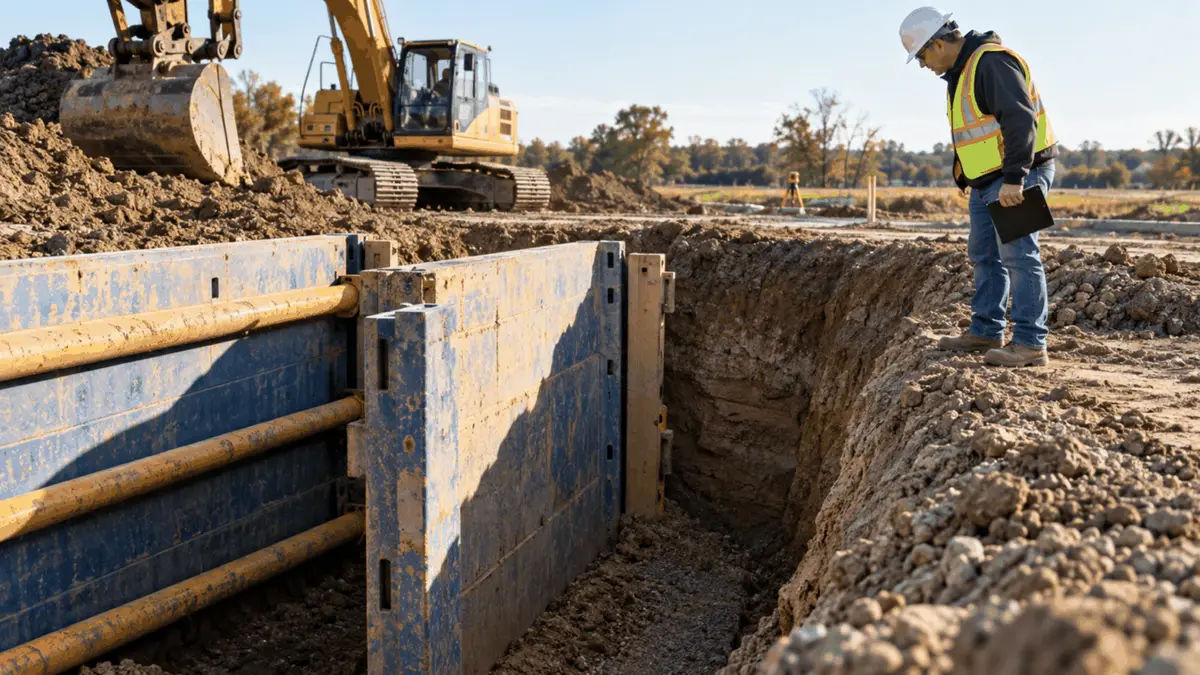
A trench box can be correctly rated, positioned, and maintained while a serious exposure remains just beyond its end. The transition from shielded space to open trench is easy to treat as a minor detail, especially when pipe alignment, ladder access, utility connections, or excavation progress draws attention elsewhere. Yet soil can move from the side, face, or end of the excavation, and a worker crossing that transition may leave the area the shield was designed to protect.
End protection is not a one-size-fits-all accessory or a field improvisation. The competent person must evaluate the excavation, soil, depth, shield configuration, nearby loads, work sequence, and manufacturer or engineering information. Employers must then provide a protective approach that fits the conditions and keep workers out of exposed areas. This article offers planning questions for that decision, not a substitute for site-specific design or professional engineering when required.
Why Trench Shield Ends Matter
Shield systems are designed to protect employees from cave-ins within the shielded area. OSHA's excavation standard also states that employees must be protected from cave-in hazards when entering or exiting areas protected by shields. Those two ideas meet at the end of the box. A ladder located beside the shield, a pipe joint assembled beyond it, or a worker stepping around a spreader can create exposure even though the shield itself is present.
The soil face at the end of a shield may look stable and still require protection. Cracks, sloughing, loose material, water, vibration, previously disturbed soil, intersecting utilities, and surcharge loads can change the end condition. The competent person should consider the whole protective system rather than assume that the shield walls address every direction from which soil may move.
Work sequence also changes the risk. A box may advance while the excavation face moves, pipe may extend beyond the shield, or bedding work may require access near the end. Each step can shift the relationship among the worker, shield, ladder, soil face, and equipment. A configuration that was acceptable during one activity may not remain acceptable after the excavator advances or materials are placed.
An end exposure is especially easy to miss during short tasks. Someone may intend to connect a sling, check grade, retrieve a tool, guide a pipe, or inspect a utility for only a minute. Duration does not remove the cave-in hazard. A clear boundary and a planned method help prevent a quick task from becoming unprotected entry.
What Employers and Supervisors Should Know
Employers are responsible for selecting and providing an adequate protective system unless a specific exception in the standard applies. Supervisors should understand which design option supports the system, where the written data is kept, and which limitations affect use. If the shield is used according to manufacturer tabulated data, the crew should have the applicable specifications, recommendations, and limitations at the jobsite during construction of the protective system.
The shield is only one part of the excavation plan. Sloping or benching outside the shield, an engineered end treatment, a properly designed support system, or a work method that keeps employees entirely within protected space may be relevant depending on the site. The correct choice depends on conditions and design information. Crews should never build makeshift end panels, add attachments, stack components, or change spreader arrangements without confirming that the configuration is allowed by the governing data or specifically approved in writing.
Supervisors should define the protected work zone in practical terms. Workers need to know where their feet, torso, and assigned task may be located, not merely that a box is in the trench. A pre-entry briefing can identify the permitted route, ladder location, material landing point, excavator swing limits, and no-entry area beyond each end.
Access and egress deserve a separate check. A ladder placed outside the shield can require a worker to pass through an exposed section. A ladder leaning through an end opening can interfere with pipe placement or movement of the shield. The route should fit the shield, meet applicable access requirements, remain clear, and keep employees protected during the entire transition between the surface and work area.
Equipment operators also need the boundary. Bucket movement, pipe placement, and spoil handling can create loads or disturb the end face. The operator should know when workers are permitted in the trench, where the box ends, which signals stop movement, and who confirms that employees are clear before the shield or equipment moves.
A Competent Person's End-of-Box Review
Begin with the current excavation geometry. Record depth, width, shield location, the distance from each shield end to the excavation face or next protected area, and the location of ladders, utilities, pipe, bedding, and workers. A sketch or marked daily plan can make a changing configuration easier to discuss than a generic checklist.
Review the soil and face condition at both ends. Look for tension cracks, loose blocks, raveling, undercutting, water seepage, saturated material, bulging, and material falling from upper edges. Consider whether the end crosses previously excavated ground, a utility trench, a backfilled area, or layers with different behavior. Soil classification is part of the evaluation, but visible change can require action even when the classification record has not changed.
Check surface conditions. Spoil piles, parked equipment, traffic, stored pipe, cranes, and structures can add surcharge or vibration. Rain, dewatering, leaking utilities, and runoff can alter the end face or the material below the shield. Barricades and traffic controls should keep people and equipment from creating hazards at the edge while preserving the competent person's access for inspection.
Confirm the shield position and the design limits. Compare depth, soil conditions, surcharge, shield rating, spreader arrangement, stacking configuration if any, and permitted excavation below the shield with the applicable written data. OSHA permits excavation below a shield only within stated limits and only when the shield is designed for the full depth and there are no indications of soil loss from behind or below it. The presence of a shield does not authorize a crew to exceed those conditions.
Examine how employees enter, exit, and perform each task. Trace the actual movement of a worker carrying tools, guiding materials, or passing another person. If any part of the task takes the worker beyond protection, revise the configuration or method before entry. Do not rely on verbal instructions to stay close to the box when the task itself requires reaching or stepping outside it.
Finally, set reinspection triggers. A competent person must inspect excavations, adjacent areas, and protective systems daily before work, as needed during the shift, and after rainstorms or other hazard-increasing occurrences. For end conditions, useful triggers include advancing the face, moving the shield, changing ladder placement, exposing a utility, starting dewatering, adding nearby equipment, observing soil movement, and resuming work after a delay.
Coordinating the Work Sequence
Planning should begin before the box is lowered. The excavation and installation sequence should show where employees will stand while the shield is placed, how workers will access the protected area, how pipe or structures will enter, and how the shield will advance. Employees are not permitted inside shields while shields are being installed, removed, or moved vertically, so the sequence must keep them clear during those operations.
Pipe work often creates pressure to move beyond the shield. The pipe may project toward the excavation face while joints, laser checks, bedding adjustments, or connections occur near the end. Supervisors should decide whether the box will move, the excavation will be extended, another protective method will be installed, or the task will be performed from a protected position. That decision belongs in the plan rather than being made by an entrant under production pressure.
When two shields or protected areas meet, the gap between them should be evaluated. Workers should not assume that proximity creates continuous protection. Differences in width, height, alignment, soil contact, and movement can leave a transition exposed. Any combined configuration should follow its design information and preserve safe access.
Communication should be simple enough to work in noise and changing visibility. One designated person should coordinate the competent person's release, employee entry, equipment movement, and stop-work signals. The crew should know that a change at either end cancels the earlier assumption until the competent person evaluates it.
Documentation can stay concise. A daily record may identify the shield, governing data, location, end conditions, access route, observed changes, corrective actions, and the competent person's decision. Photos can support the record when taken from a safe location, but they do not replace direct inspection or design information.
How Training Supports Better Decisions
Training should help competent persons and supervisors recognize the limit of shield protection, interpret tabulated data, evaluate changing conditions, and stop entry when a configuration no longer fits. Classroom knowledge is useful, but employers should connect it to the actual shields, soil conditions, equipment, and tasks their crews encounter.
A practical exercise can use a trench drawing with a box, ladder, pipe, excavator, spoil pile, and changing face. Ask participants to mark the protected zone, identify every moment a worker could leave it, select inspection triggers, and explain what information they need before choosing an end treatment. Changing one fact at a time, such as adding water or moving the ladder, shows why the review is dynamic.
Workers who are not designated competent persons still need clear instruction. They should understand the no-entry boundary, access route, signals, and conditions that require them to leave or stay out. They should also know whom to notify about cracks, falling soil, water, shield movement, damaged components, or a task that cannot be completed from within the protected area.
Online excavation safety or competent-person training can support this foundation, but it does not replace employer designation, site-specific evaluation, practical instruction, or the authority to correct hazards. Employers remain responsible for selecting qualified people and providing the resources needed to act on their findings.
Key Takeaway
A trench shield does not create an invisible extension of protection beyond its ends. The competent person must evaluate where the protected zone begins and ends, how workers reach it, and how the configuration changes as excavation and installation proceed. Employers and supervisors should connect design data, soil and surface conditions, access, equipment movement, and task sequence before authorizing entry.
The most useful question is not simply whether a trench box is present. It is whether every employee can enter, work, and exit without passing into an area exposed to a cave-in. When the answer is uncertain, keep workers out, review the governing information, and revise the system or method before work resumes.
Sources
OSHA, 29 CFR 1926.650 Scope, Application, and Definitions | https://www.osha.gov/laws-regs/regulations/standardnumber/1926/1926.650
OSHA, 29 CFR 1926.651 Specific Excavation Requirements | https://www.osha.gov/laws-regs/regulations/standardnumber/1926/1926.651
OSHA, 29 CFR 1926.652 Requirements for Protective Systems | https://www.osha.gov/laws-regs/regulations/standardnumber/1926/1926.652
OSHA, 29 CFR 1926 Subpart P Excavations | https://www.osha.gov/laws-regs/regulations/standardnumber/1926/1926SubpartP