
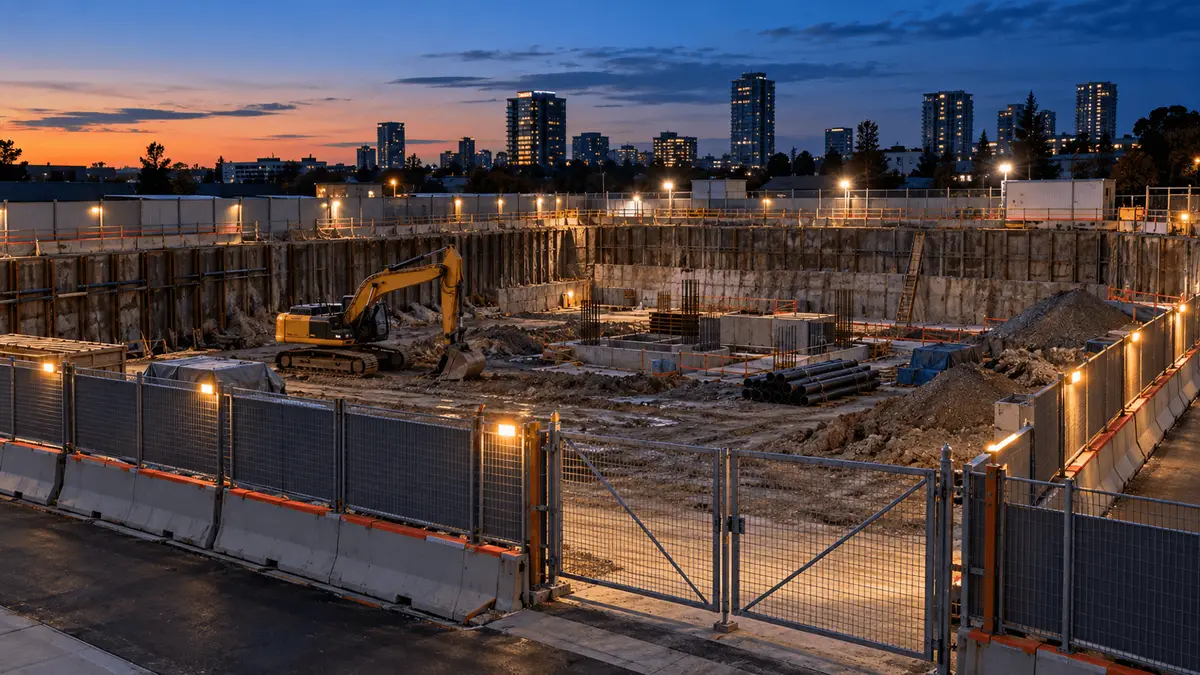
Unattended excavations can expose workers and the public to falls, unstable edges, equipment hazards, and access risks long after a crew leaves.
Closing a shift does not close the hazard. An open cut beside a sidewalk, roadway, facility, utility corridor, or future building pad may remain accessible to other trades, delivery drivers, inspectors, residents, children, or the public. Darkness, rain, wind, traffic, and unauthorized access can change the setting while the excavation crew is away. A strong shutdown routine treats the unattended period as a planned phase of excavation work, not as empty time between productive shifts.
The employer should base that routine on the actual site, applicable requirements, and the competent person's findings. OSHA's excavation standard includes specific provisions for fall protection at remotely located excavations and for barricades or covers at wells, pits, shafts, and similar excavations. Other conditions may require additional controls. This article offers planning and training guidance, not a substitute for the employer's site-specific evaluation or professional design.
Why Unattended Excavations Matter
The people exposed after hours may not understand excavation hazards. A worker from another contractor may see a shortcut across the site. A driver may follow yesterday's route toward an edge that was advanced during the day. A pedestrian may not recognize a dark opening behind lightweight warning tape. An operator arriving early may move a barrier without knowing why it was placed. The control system must communicate and physically manage the hazard even when the excavation crew is absent.
Site conditions also keep changing. Surface water can collect or flow toward the cut. Soil can dry, crack, freeze, thaw, or slough. Wind can move light barricades and signage. Traffic vibration can affect the edge. Stored pipe, spoil, tools, pumps, ladders, hoses, and fuel containers can shift or create new access paths. A shutdown inspection should identify which changes are reasonably foreseeable and which controls must remain effective until the next competent-person inspection.
An unattended excavation can also complicate emergency response. A passerby who falls, equipment that rolls, or water that accumulates may be discovered by someone who does not know the site address, hazard limits, or emergency contacts. Clear site identification, controlled access, and a reliable reporting path help prevent a bad condition from becoming a confused response.
The goal is not to assume that one barricade works everywhere. Warning tape may communicate a boundary but provide little physical resistance. A rigid barrier may control pedestrians but be inadequate for vehicle exposure. A cover can be useful for some openings only when it is selected, secured, and capable of carrying anticipated loads. Lighting can improve visibility but does not replace edge control. The site plan should match the exposure.
What Employers and Supervisors Should Know
The employer remains responsible for planning the work and protecting employees. A competent person must be capable of identifying existing and predictable excavation hazards and must have authority to take prompt corrective measures. That role is especially important before the crew leaves and again before workers return, because the competent person connects the day's excavation geometry and soil conditions to the controls that remain in place.
OSHA 29 CFR 1926.651(l) addresses walkways over excavations and fall protection at certain excavation locations. It states that adequate barrier protection must be provided at all remotely located excavations, wells, pits, shafts, and similar excavations, and that wells, pits, shafts, and similar excavations must be barricaded or covered. Temporary wells, pits, shafts, and similar excavations must be backfilled when exploration or similar operations are completed. Employers should read the full standard and determine how it applies to the site rather than turning one phrase into a universal layout.
Supervisors should distinguish the excavation edge from the larger controlled area. The edge hazard may require a barricade, guardrail, cover, setback, or other measure. The controlled area may also need vehicle routing, gates, fencing, lighting, warning devices, and coordination with property owners or other employers. A barrier at the edge will not prevent a truck from entering the wrong gate, and a locked perimeter will not protect employees who are authorized to enter the site but unaware of the cut.
Responsibility for after-hours controls should be explicit. The shutdown plan should identify who installs or verifies barriers, who controls keys or gates, who receives alarm or security calls, who responds after storms, and who can authorize changes. When multiple employers share a site, the controlling employer, excavation employer, property owner, security provider, and arriving trades need a practical communication method. Contract language alone is not enough if the night guard or morning delivery driver has no usable instructions.
Supervisors should also understand that an excavation cannot simply be assumed safe because no one is scheduled to enter it overnight. Employees may still work near the edge, inspect pumps, secure materials, or operate equipment nearby. Controls must address those tasks and must not create new hazards such as blocked emergency routes, unstable fence bases, trip hazards, inaccessible fire connections, or barriers that force pedestrians into traffic.
Build a Shutdown Inspection Around the Site
Begin with the final geometry of the shift. Record or mark the excavation limits, depth changes, ramps, trenches, pits, shafts, spoil locations, protective systems, utilities, and any portion advanced since the morning inspection. A current sketch or site photo can help the next shift understand what changed, but it should supplement rather than replace direct inspection.
Walk the perimeter from the viewpoint of an unfamiliar person. Check each approach from parking areas, buildings, streets, sidewalks, adjacent lots, haul routes, and internal travel paths. Look for gaps behind stored material, between fence panels, beside equipment, or where terrain hides the opening. Consider how the site appears in low light and whether signs can be seen before someone reaches the hazard.
Verify that barriers and covers match expected exposure. Check connections, bases, anchorage, gates, visibility devices, and continuity. Confirm that a vehicle cannot easily displace a pedestrian-only control where vehicle contact is foreseeable. Do not place barrier supports so close to an unstable edge that their weight or installation affects the excavation. Where covers are used, verify their suitability, identification, securement, and load capacity under the applicable requirements.
Check equipment and materials. Park mobile equipment on stable ground with attachments lowered and movement controlled according to the employer's procedures. Keep spoil, pipe, pallets, and tools away from the edge or restrain them so they cannot fall or increase surcharge loading. Secure ladders, pumps, hoses, extension cords, and fuel containers without leaving an inviting access route into the cut. Protect utilities and temporary services that remain exposed.
Review water and weather. Confirm surface drainage, diversion measures, pump arrangements, discharge routing, power supply, alarms, and the response plan for forecast precipitation or freezing conditions. A pump can fail, clog, lose power, or discharge where it erodes the edge. If a system requires checking while the crew is away, the person assigned to that task needs safe access and clear limits on what can be done without a new inspection.
Finally, document the handoff. Note the time, inspector, conditions, control locations, open issues, weather concerns, contacts, and conditions that require an after-hours response. Photographs should be oriented and labeled so they are useful. Avoid a generic entry such as site secured. A record should let the next responsible person understand what was checked and what remains sensitive.
Training Supports a Reliable Shutdown Routine
Training should give each role a usable part of the plan. Crew members need to know which materials and tools must be removed or secured, where barriers belong, and why a shortcut through the controlled area is unacceptable. Operators need shutdown parking locations and routes that do not add edge loads. Supervisors need to evaluate access from outside the excavation operation, not only from the crew's normal work zone.
The competent person needs deeper preparation. That person should be able to connect soil, geometry, protective systems, adjacent loads, water, weather, and observed changes to the shutdown decision. Training should reinforce the authority to delay departure until controls are corrected and to prevent reentry when overnight conditions create a hazard.
Security personnel and other employers need focused orientation, not a full excavation course unless their duties require it. They should know the controlled boundary, prohibited actions, reporting contacts, and emergency process. They should not enter the excavation, move protective systems, reset pumps, or change barriers unless authorized, trained, and covered by the employer's procedure.
Practical exercises improve consistency. Give the team a site sketch showing a sidewalk, delivery gate, open trench, pump, spoil pile, and forecast rain. Ask them to select the boundary, barrier types, equipment parking, drainage checks, handoff details, and morning restart sequence. Then change one fact, such as a fence panel blocking a fire route or a delivery scheduled before the crew arrives. The discussion reveals whether the plan works beyond ideal conditions.
Training records should describe the content and roles covered, not merely list attendance. Employers should also observe shutdowns periodically. If barriers are repeatedly misplaced, logs use vague language, or other trades keep entering the zone, the program needs correction, clearer coordination, or a different control arrangement.
Common Shutdown Gaps
One common gap is relying on visual warning alone where a physical barrier is needed. Cones and tape can be useful communication devices, but they can be moved, overlooked, or defeated by wind and traffic. The control should match the foreseeable person or vehicle exposure and the applicable standard.
Another gap is protecting only the most visible side. Excavations are often approached from service alleys, adjacent lots, building doors, or equipment routes. A complete perimeter review should include every practical approach and the possibility that site conditions or deliveries will create a new one.
Teams also fail when they leave yesterday's plan in place after today's excavation advances. Moving the cut can change the boundary, drainage, lighting, haul route, access point, and distance to occupied areas. The shutdown plan should be updated at the end of each shift and after material changes.
Do not treat the morning inspection as permission to ignore the overnight plan. The controls protect people during the unattended period, while the next competent-person inspection determines whether employees can safely resume work. Both steps are necessary and serve different purposes.
Avoid leaving response instructions with someone who lacks authority or training. A security guard may be able to report a fallen barrier or pump alarm, but correcting the excavation condition may require the competent person, supervisor, electrician, equipment operator, or emergency service. The call tree should reflect those limits.
Key Takeaway
An excavation shutdown is part of the job, not the absence of work. Employers should secure the perimeter, control approaches, stabilize equipment and materials, address water and weather, coordinate with other parties, and document the handoff. The controls must match the real exposure and remain effective until the next inspection.
Before the next shift ends, have the competent person and supervisor walk the site as if they were an unfamiliar visitor arriving after dark. Identify every route toward the excavation, verify the physical controls, and test the reporting process. Correct gaps before the crew leaves, then require a fresh inspection before work resumes.
Sources
Occupational Safety and Health Administration, 29 CFR 1926.651 Specific Excavation Requirements | https://www.osha.gov/laws-regs/regulations/standardnumber/1926/1926.651
Occupational Safety and Health Administration, Trenching and Excavation Safety | https://www.osha.gov/sites/default/files/publications/osha2226.pdf
Electronic Code of Federal Regulations, 29 CFR Part 1926 Subpart P Excavations | https://www.ecfr.gov/current/title-29/subtitle-B/chapter-XVII/part-1926/subpart-P