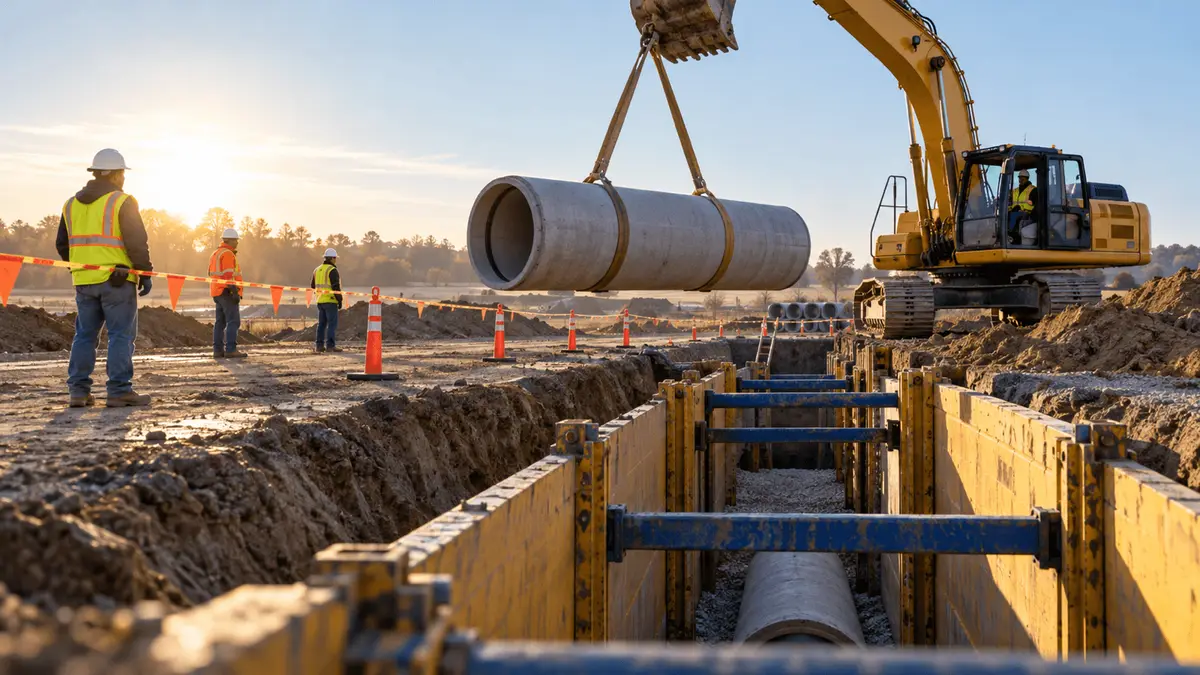
Suspended pipe, trench spoil, and materials handled near an excavation can expose workers in seconds unless the lift zone is planned before work begins.
Excavation crews routinely work around buckets, pipe, trench shields, bedding stone, road plates, spoil, and trucks being loaded or unloaded. Each task may look ordinary to an experienced crew, yet the combination of an open cut, restricted movement, lifting equipment, and changing production creates a severe struck-by hazard. A worker inside a trench may have limited room to move. A worker at grade may step into a swing path while watching the excavation. A load that shifts, spills, or swings can reach people who believed they were outside the operation.
OSHA's excavation standard addresses this risk directly. Section 1926.651(e) prohibits employees from being underneath loads handled by lifting or digging equipment and requires employees to stand away from vehicles being loaded or unloaded to avoid falling or spilled material. Those requirements are not satisfied by telling workers to be careful. Employers need a field system that separates people from suspended and falling loads before a bucket moves, a truck dumps, or pipe is lowered.
This article focuses on the coordination around the excavation, not on selecting rigging for a particular lift. Rigging, crane operations, material handling, and equipment operation may involve additional standards, manufacturer instructions, and qualified personnel. The excavation competent person, supervisor, operator, signal person, and crew still need to understand how those activities affect entry conditions and when workers must leave or remain outside the exposure zone.
Why Falling-Load Control Matters on Excavation Jobsites
An excavation changes how a jobsite can absorb error. Workers below grade may be protected from a cave-in by a shield or support system, but that system does not make it safe to work under an excavator bucket, suspended pipe, or material being dumped. A trench box protects against soil movement within its design limits. It is not a roof, a falling-object barrier, or permission to place employees below an active load.
The hazard extends beyond a load hanging from slings. Excavated soil can spill from a bucket. Bedding stone can pour past the intended placement point. Material can slide from a dump body. Pipe can rotate as it is lifted, especially when the center of gravity, rigging arrangement, wind, tag-line control, or operator visibility changes. Trench plates, shield components, pumps, and tools can also become falling or swinging hazards during handling.
The loading or unloading area deserves the same attention. OSHA requires workers to stand away from vehicles being loaded or unloaded so they are not struck by spillage or falling material. The standard permits an operator to remain in a protected cab when the vehicle is equipped as required, but that limited provision should not be treated as permission for ground workers to remain alongside the vehicle. A driver outside the cab, spotter, laborer, inspector, or supervisor can still be exposed.
Production sequencing often creates the conflict. A pipe crew wants the next joint close to the work. An excavator is removing spoil while a loader approaches. A truck is backing into position as employees prepare bedding. A trench shield must be moved while the crew wants to stay nearby. When these actions overlap, workers can drift under a load or into a swing path without anyone deliberately deciding that the exposure is acceptable.
Visibility can make the problem worse. The equipment operator may lose sight of a worker behind a spoil pile, near the trench wall, or below the edge. Sun glare, rain, dust, noise, and equipment geometry can reduce communication. A spotter or signal person can help, but only when that role is clearly assigned, the signals are understood, and the operator stops if communication is lost. More people giving signals does not create more control.
An exclusion zone gives the crew a shared boundary. Its shape should account for the load path, equipment swing radius, possible material spill, vehicle movement, trench access, and places where a worker could be pinned. The boundary may need barricades, cones, a dedicated observer, or a work pause, depending on the job. It should not be drawn so tightly around the equipment that a swinging load can cross it.
Conditions can change during the shift. The trench advances, the excavator relocates, trucks approach from a different direction, a new pipe size changes the lift, or stockpiles reduce visibility. Rain can make travel surfaces slippery and affect equipment positioning. A control that worked for the morning setup may be inadequate after the work area moves. The competent person's ongoing inspection should recognize those changes and require correction before entry continues.
What Employers and Supervisors Should Know
Employers should begin by separating the work into phases. Excavation, spoil handling, material delivery, pipe placement, shield movement, backfill, and compaction may happen in a short area, but they should not all expose workers at the same time. A pre-task plan can state which workers must be out of the trench or outside the zone during each phase, who authorizes the transition, and how the crew confirms that everyone is clear.
The load path should be planned before the lift starts. Supervisors should identify where the load begins, how it will travel, where it will be placed, and what could happen if it rotates, drops, or sheds material. Workers should not have to pass beneath the load to reach a ladder or complete another task. The planned path should also avoid unnecessary travel over protective systems, utilities, occupied work areas, and equipment cabs.
Access and egress remain important. A ladder may satisfy the lateral travel requirement and still be poorly located for a lifting operation. If pipe is lowered between workers and the ladder, or the excavator swing blocks the route, employees may not have a usable exit when the task changes. Supervisors should evaluate access for the active phase of work, not only for the empty trench observed at the start of the shift.
The competent person should include falling-load exposure in excavation inspections. Useful observations include whether workers are under lifting or digging equipment, whether employees stand clear of loading and unloading, whether loose material can fall into the excavation, whether equipment has a clear approach, whether the operator can see the edge, and whether a warning system is needed when mobile equipment approaches an edge that is not clearly visible.
OSHA's excavation rules also require protection from loose rock or soil and address keeping excavated or other material and equipment at least two feet from the edge or using retaining devices that prevent material from falling or rolling into the excavation. That control supports falling-material prevention, but it does not replace the prohibition on employees under handled loads. A two-foot setback is not a safe radius for an active lift.
Equipment selection and setup need deliberate review. The machine must be suitable for the task and used within manufacturer limits. Travel surfaces and setup areas should support the equipment. The operator should know where the excavation edge, protective system, underground installations, overhead hazards, and workers are located. If a crane, hoist, or specialized lifting device is used, the employer should apply the standards and qualifications that govern that operation in addition to Subpart P.
Communication should be simple enough to work under noise and pressure. The crew should know who directs the movement, what signals will be used, and that anyone can give an emergency stop signal. The designated signal person should remain visible to the operator or use a reliable agreed communication method. If the operator loses the signal, loses sight of the area, or is uncertain that workers are clear, movement should stop.
Supervisors should control pedestrian routes. Inspectors, delivery drivers, subcontractors, and visitors may not recognize the lift zone. A person walking to speak with the foreman can enter the hazard while the core crew is following the plan. Barricades and a clear meeting point help keep unassigned people away. Site orientation should explain that the trench edge and equipment swing area are controlled work zones.
Vehicle loading and unloading needs its own procedure. Identify where drivers wait, whether they remain in a protected cab, where ground workers stand, how tailgates and dump bodies are controlled, and who confirms that the area is clear. Consider the direction of material flow and where spillage could land. Workers should not stand between a vehicle and the trench, between vehicles, or beside a body that is being loaded or raised.
Documentation can be concise and still useful. A daily inspection or pre-task record might note the equipment used, material handled, exclusion-zone boundary, signal method, access location, worker-clear confirmation, and changes made during the shift. The goal is not to create paperwork around every bucket movement. The goal is to make the control repeatable and show how the crew addressed a predictable hazard.
Near misses should trigger review. A swinging pipe, unexpected bucket spill, worker entering the zone, missed signal, unstable truck position, or load passing over the trench should not be dismissed because nobody was hurt. The employer should identify why the plan failed, correct the immediate condition, and decide whether equipment, layout, staffing, sequencing, or training must change before work resumes.
How Training Supports Safer Load Control
Excavation, Trenching and Shoring Safety Training can help crew members recognize that cave-ins are not the only serious excavation hazard. Workers need to understand falling loads, mobile equipment, spoil placement, access, inspections, water, utilities, and protective systems as connected parts of one jobsite. That foundation helps a laborer understand why a quick step beneath a suspended pipe is unacceptable even when the lift appears stable.
Competent Person for Excavation, Trenching and Shoring Training supports the designated person's deeper responsibilities. The course can reinforce hazard recognition, inspection triggers, protective-system concepts, soil conditions, equipment exposure, and corrective authority. The employer must still designate a person who meets the standard's knowledge and authority criteria and provide site-specific information, equipment instruction, and practical evaluation.
Operator and signal-person instruction should connect directly to the excavation plan. An operator may be skilled at equipment control yet unfamiliar with the crew's entry sequence or exclusion boundary. A signal person may know standard signals but not understand when the competent person has prohibited entry. A short field briefing should join those roles: where the load may travel, where people must stand, when the trench must be empty, and what stops the operation.
Scenario practice is valuable. Supervisors can walk through a pipe delivery, a bucket of bedding, a shield relocation, and a dump-truck unloading cycle before production begins. Ask where each worker stands, who gives the signal, how access remains open, and what happens if the load shifts or communication fails. A dry run often reveals conflicts that are difficult to see on a written plan.
Training should also address stop-work expectations. Workers may hesitate to stop an operator or delay a delivery because they assume only a supervisor can intervene. The employer can make the rule explicit: anyone who sees a person enter the load zone, loses communication, or observes an uncontrolled condition should call stop. The competent person and supervisor can then decide what must change before work continues.
Course completion is only one part of readiness. Employers should verify that workers can apply the rule to their equipment, trench layout, language needs, hand signals, and work sequence. Refresher instruction may be appropriate after a near miss, a procedure change, new equipment, a different lifting task, or evidence that employees do not understand the exclusion zone. Training records should reflect the role and content, not just a generic safety label.
Key Takeaway
The central rule is straightforward: no employee should be underneath a load handled by lifting or digging equipment, and employees must stand away from vehicles being loaded or unloaded. The reliable way to apply that rule is to plan the sequence, mark or communicate the exclusion zone, keep access clear, assign one signaling method, verify workers are clear, and stop when the setup changes.
Employers should treat falling-load control as part of the excavation system rather than a separate equipment issue. The competent person's inspection, the supervisor's sequencing, the operator's visibility, the signal person's communication, and the crew's stop-work response all have to support the same boundary. When that boundary is understood before movement begins, the job can progress without asking workers to rely on timing, assumptions, or luck.
Sources
Occupational Safety and Health Administration, 29 CFR 1926.651 Specific Excavation Requirements: https://www.osha.gov/laws-regs/regulations/standardnumber/1926/1926.651
Occupational Safety and Health Administration, Compliance Directive for the Excavation Standard, 29 CFR 1926 Subpart P: https://www.osha.gov/sites/default/files/enforcement/directives/CPL_02-00-165.pdf
Occupational Safety and Health Administration, Trenching and Excavation Safety: https://www.osha.gov/trenching-excavation