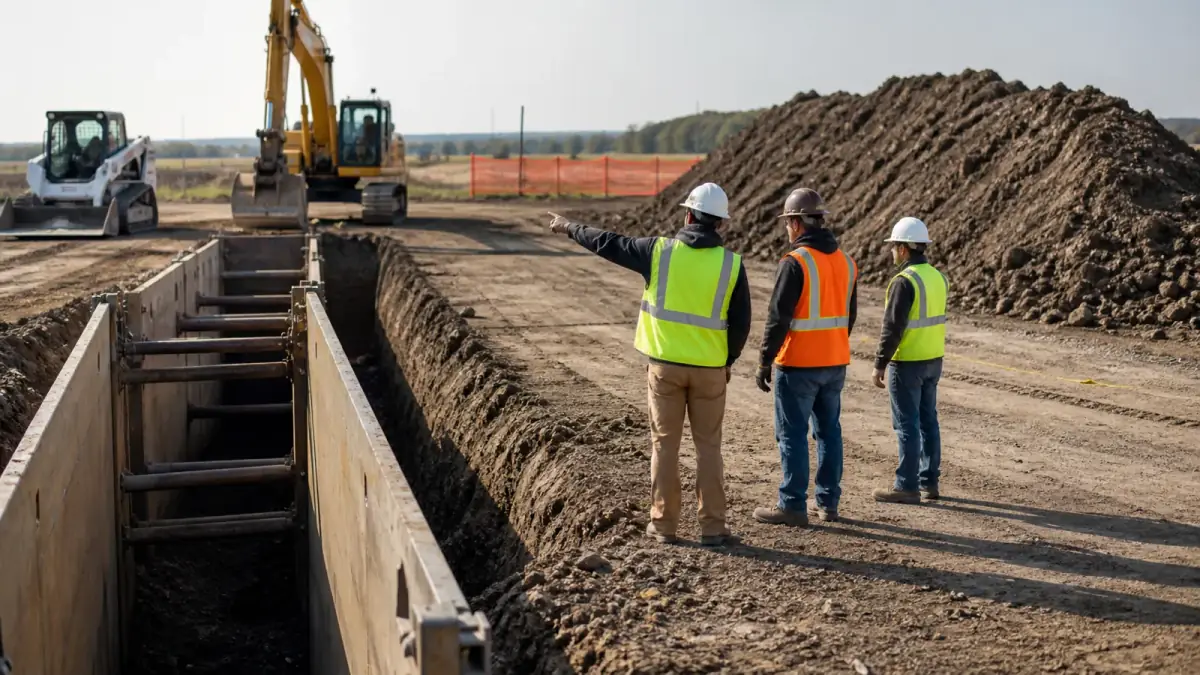
Spoil pile placement can look like a housekeeping detail until the excavation is open, production pressure is high, and the crew needs somewhere to put material fast. On many jobsites, the first bucket of excavated soil lands wherever the operator has room. As the trench gets longer, that pile grows, the edge gets heavier, access routes narrow, and the conditions around the excavation change. For employers and supervisors, the compliance question is not simply whether the trench has a protective system. It is whether the entire excavation setup is being controlled so that workers are protected from cave-ins, falling or rolling material, equipment loads, and changing site conditions.
OSHA Subpart P requires employers to protect workers in excavations from hazards associated with cave-ins and other excavation-related exposures. Spoil piles are part of that risk picture because excavated soil placed too close to the edge can add surcharge pressure to trench walls, drop loose material back into the excavation, block safe access, interfere with inspections, and make it harder for the Competent Person to evaluate the trench. A trench box, shoring system, slope, or bench does not excuse poor spoil placement. Protective systems are selected and used within real jobsite conditions, and surcharge loads near the edge are one of the conditions that can affect trench stability.
The practical decision for supervisors is this: before workers enter, has the spoil been placed, contained, or removed in a way that supports the protective system and keeps the crew safe? That question should be answered during planning, during setup, and during the daily inspection. It should also be revisited when the trench advances, equipment changes position, soil type changes, water appears, vibration increases, or the crew shifts from excavation to pipe installation, utility work, repair, or backfill.
Spoil pile control is especially important because it is visible, preventable, and often correctable without redesigning the entire job. Moving material farther from the edge, using trucks to haul spoil away, controlling the pile height, keeping equipment routes separated, and maintaining access paths can reduce risk. But those decisions only happen consistently when supervisors and crews understand why spoil placement matters and when a designated Competent Person has the authority and training to stop entry until the setup is acceptable.
Why This Matters on Excavation Jobsites
Excavation hazards are rarely caused by one isolated mistake. They usually build through a chain of field decisions. A trench is opened a little deeper than expected. The soil is more granular than the drawings suggested. The spoil pile creeps closer because the right-of-way is narrow. A loader starts traveling beside the trench. Rain from the night before softens the edge. A crew member climbs around the pile instead of using the planned access point. Each item may seem manageable by itself, but together they can create a trench environment that no longer matches the assumptions used when the work began.
Spoil piles matter because excavated material is heavy. Even when it looks loose and harmless, the additional weight near the edge can increase pressure on the trench wall. That pressure can be more significant in previously disturbed soil, wet soil, layered soil, fill material, or soil affected by vibration from traffic and equipment. If a trench wall starts to crack, slough, or bulge, workers may have very little warning before material moves. The goal is to prevent the condition from developing, not to rely on workers noticing a failure in time.
Loose material at the edge also creates a falling-object hazard. Clods, rocks, asphalt chunks, concrete fragments, tools, bedding material, and pipe fittings can roll or slide into the excavation. A worker inside a trench may have limited room to react, and the protective system may not prevent smaller materials from falling from above. Keeping spoil and equipment set back from the edge helps reduce this exposure and keeps the top of the trench easier to inspect.
Access and egress can also be affected. Ladders, ramps, and other means of access must remain usable, visible, and positioned for the work being performed. A spoil pile that blocks the top of a ladder, narrows the walking path, or forces workers to climb over loose material creates avoidable risk. Crews under time pressure may improvise routes, especially when carrying tools or materials. Good spoil placement preserves clean access points and gives supervisors a better chance of keeping movement around the trench predictable.
Productivity is part of the issue as well. Poor spoil control can slow pipe laying, utility repair, bedding placement, inspection, and backfill. Material placed in the wrong location may have to be moved twice. Equipment may need to work closer to the trench than planned. Inspectors may have less room to view conditions. Trucks may be forced into awkward positions. A job that starts with poor spoil placement often becomes harder to manage as the trench advances. That creates pressure to accept shortcuts, and shortcuts around excavations can have severe consequences.
For municipal public works crews, utility contractors, pipeline crews, and general contractors, spoil placement also affects public and third-party exposure. Excavations near roads, sidewalks, alleys, plants, schools, and occupied facilities often have limited space. Spoil piles can obscure traffic control devices, push pedestrians toward the work zone, interfere with temporary fencing, or block emergency access. Supervisors need to consider not only the trench wall but the entire work zone around it.
The Competent Person plays a central role because spoil placement is part of the inspection conversation. Before entry, the Competent Person should be able to evaluate whether spoil, equipment, material storage, traffic, water, vibration, and changing weather have affected the excavation. If the edge conditions are questionable, workers should not enter until the hazard is corrected or the protective system and work plan are reevaluated. That authority only works when the employer has clearly supported it and trained the right people for the responsibility.
What Employers and Supervisors Should Know
Spoil pile control should be treated as a planned excavation safety item, not an afterthought. The best time to decide where excavated material will go is before the first bucket comes out of the ground. Planning should account for trench depth, expected soil type, right-of-way width, equipment movement, truck access, underground utilities, public traffic, temporary fencing, weather, and the protective system selected for worker entry.
Supervisors should understand that the common expectation is to keep spoil and other materials at least two feet back from the excavation edge unless another protective measure is used to prevent material from falling or rolling into the excavation. That two-foot distance is a baseline control, not a guarantee that every condition is safe. Deeper excavations, unstable soil, wet conditions, vibration, heavy equipment, or large spoil volumes may require more conservative handling, removal from the site, engineered controls, or a revised work plan.
Several field questions help determine whether spoil placement is being controlled:
- Is excavated material kept back from the edge throughout the shift, not just during the morning setup?
- Are rocks, pavement chunks, pipe, tools, plates, trench box components, and other materials also kept from rolling or falling into the excavation?
- Is equipment travel separated from the trench edge and spoil pile where possible?
- Can the Competent Person clearly inspect the trench lip, wall conditions, protective system, water accumulation, and access points?
- Are ladders, ramps, walkways, and emergency routes free of spoil and loose material?
- Has the plan changed because the trench advanced, soil changed, rain occurred, vibration increased, or the work shifted to installation or repair?
- Does the crew know who has authority to stop entry if spoil placement or edge conditions become unsafe?
Employers should also recognize the difference between crew-level awareness and Competent Person responsibility. Every worker near excavation work should understand the basic hazards of spoil piles, surcharge loads, falling material, access routes, and staying out of unsafe trenches. That awareness helps crew members recognize when something looks wrong and report concerns early. But the Competent Person needs a deeper level of training because that role involves inspecting excavations, identifying hazards, evaluating soil and protective systems within the limits of the role, and taking prompt corrective action.
For operations managers and safety coordinators, spoil pile placement is a useful audit point because it reveals whether excavation safety expectations are actually being applied in the field. A written program may say the right things, but a site visit can show whether operators, laborers, foremen, and subcontractors understand the rules. If spoil piles are repeatedly too close to trench edges, the issue may not be one careless operator. It may be a planning problem, a sequencing problem, a training gap, or a sign that supervisors are not being given enough time or authority to correct conditions.
General contractors should include spoil placement expectations in pre-task planning and subcontractor coordination. Utility and excavation subcontractors may be working in tight areas with competing space demands from deliveries, traffic control, other trades, and temporary storage. The prime contractor or controlling employer should make sure the work area supports safe excavation practices instead of forcing crews into choices that undermine trench safety.
Documentation can help, but it should be practical. Daily excavation inspection forms, pre-task plans, job hazard analyses, and toolbox talks should include space for spoil placement, surcharge loads, access and egress, water, utilities, traffic, and protective systems. The point is not paperwork for its own sake. The point is to create a repeatable habit: look at the trench, look at the edge, look at the surrounding loads, correct problems before entry, and document the decision.
How Training Supports a Safer Excavation Program
OSHA-aligned excavation, trenching, and shoring safety training helps employers turn spoil pile rules into field behavior. Workers need to understand why material near the edge is not just messy, but potentially dangerous. Operators need to understand how bucket swing, stockpile location, haul routes, and equipment staging can affect workers in and around the trench. Foremen need to know what to watch as the trench advances. Safety managers need a shared vocabulary for coaching, auditing, and documenting corrective action.
Training also helps employers separate basic awareness from Competent Person duties. A crew member may need to know that spoil should be kept back, access points must stay clear, and workers should not enter an excavation that has not been inspected. A Competent Person needs to understand how spoil placement fits into a broader inspection that includes soil conditions, protective systems, water, adjacent structures, underground installations, vibration, weather, and evidence of possible failure. Competent Person training does not make someone OSHA certified or guarantee compliance by itself, but it supports the knowledge and decision-making expected of the role.
For supervisors, training should connect the rule to common production scenarios. A crew may begin with proper spoil placement, then lose control as the trench lengthens. A narrow municipal repair may require trucking spoil away instead of stockpiling it beside the trench. A pipeline crew may need designated spoil zones and equipment routes. A utility crew may need to protect locate marks and access to valves, vaults, or service connections. A site near a roadway may need additional coordination so spoil does not interfere with traffic control or create public exposure.
Good training also reinforces the importance of stopping work before conditions become normal. If crews get used to seeing spoil piled near trench edges, they may stop treating it as a warning sign. If supervisors walk past blocked ladders or overloaded edges without correcting them, the standard on that jobsite changes. Training gives employers a way to reset expectations and make excavation safety a normal part of planning, setup, inspection, and supervision.
An effective excavation safety program should give crews practical rules they can apply, but it should also prepare them to recognize when the simple rule is not enough. Two feet of separation may be a starting point, yet a Competent Person may decide more distance or a different control is needed because of soil type, depth, water, equipment loads, or the size of the spoil pile. That judgment depends on training, experience, employer support, and clear authority.
Employers who invest in excavation and Competent Person training are better positioned to build consistent practices across crews and projects. Training supports better pre-task planning, more meaningful daily inspections, stronger communication between operators and trench crews, and better documentation when conditions change. It also helps supervisors explain decisions to project managers, clients, inspectors, and workers when production needs to pause so a trench can be made safer.
Key Takeaway
Spoil pile placement is one of the clearest signs of whether an excavation is being actively managed or simply dug and worked around. Material placed too close to the edge can add load to trench walls, create falling-object hazards, block access, and make inspections harder. Employers, supervisors, and Competent Persons should treat spoil control as part of the protective system conversation, not as cleanup after the real work is done.
Before workers enter a trench, the jobsite should show that someone has thought through where the material goes, how equipment will move, how access will stay open, and how changing conditions will be handled. OSHA-aligned Excavation, Trenching & Shoring Safety Training and Competent Person for Excavation, Trenching & Shoring Training can help employers give crews and supervisors the knowledge they need to make those decisions consistently. The right people need to be trained before the edge conditions become questionable, not after the crew is already exposed.