Rain does not have to be dramatic to change the safety picture in an excavation. A short storm, steady overnight rain, melting snow, runoff from a nearby paved area, or water from a broken line can all change the condition of soil, trench walls, access points, spoil piles, and protective systems. For employers and supervisors, the real compliance question is not simply whether the trench was acceptable yesterday. The question is whether conditions are still acceptable before workers enter today.
That distinction matters because excavation and trenching hazards can change quickly. A trench that appeared stable during the morning layout can become a different work area after rainfall adds weight, softens soil, creates seepage, or undercuts the bottom of a wall. Water can hide sloughing at the toe of a trench, make ladders unstable, create slip hazards at the edge, and change the way a trench box, shoring system, or sloped wall performs. It can also distract crews who are trying to recover schedule after a weather delay.
OSHA Subpart P places a strong emphasis on inspection by a Competent Person. For employers, this is not a paperwork exercise or a title handed to the most senior employee on site. The Competent Person must be able to identify existing and predictable hazards and must have authority to take prompt corrective action. After rain or any other hazard-increasing occurrence, that responsibility becomes especially important. Re-entry decisions should be made from the condition of the excavation as it exists now, not from the plan, the morning meeting, or yesterday's checklist.
This is where many excavation programs become vulnerable. A contractor may have a trench box on site, a general safety policy, and experienced operators, but still lack a consistent process for weather-related reinspection. A municipal utility crew may understand its repair work but may not stop long enough after rainfall to reassess access and egress. A general contractor may assume the excavation subcontractor is handling trench safety without confirming whether the designated Competent Person has evaluated changed conditions. In each case, the risk is not only technical. It is a supervision, documentation, and training issue.
The practical question for employers is direct: when rain changes the trench, who has the knowledge and authority to decide whether workers can safely enter, what must be checked, and what corrective steps must happen first?
Why This Matters on Excavation Jobsites
Excavation hazards are unforgiving because the warning signs can be subtle and the consequences can be severe. Wet soil does not always announce itself with a visible collapse. It may first show up as tension cracks near the edge, small slides on a wall face, bulging at the bottom, water collecting around a shield, or soft ground where crews need to stand and climb. If supervisors and crews treat those signs as ordinary nuisance conditions, they can miss the point at which the excavation is no longer suitable for entry.
Rain affects soil behavior in several ways. It can add weight to trench walls, reduce cohesion in some soils, create seepage paths, and increase the chance of sloughing or raveling. Previously compacted fill can loosen. Layered soils can behave differently when water moves through one layer faster than another. Granular soils may run or wash out around utilities and bedding material. Clay soils may appear firm at the surface while becoming slick, heavy, and unstable along the cut. These differences are why soil classification and ongoing observation are so important.
Water also changes the usefulness of the jobsite setup. A spoil pile that was properly placed may start shedding material toward the trench when the surface becomes muddy. Equipment vibration may have a greater effect near saturated edges. Barricades and cones may shift. Workers may create new footpaths that bring them too close to the excavation because the original path is muddy. If a ladder sits in standing water or is no longer secured, access and egress planning has degraded. These are common jobsite realities, not rare edge cases.
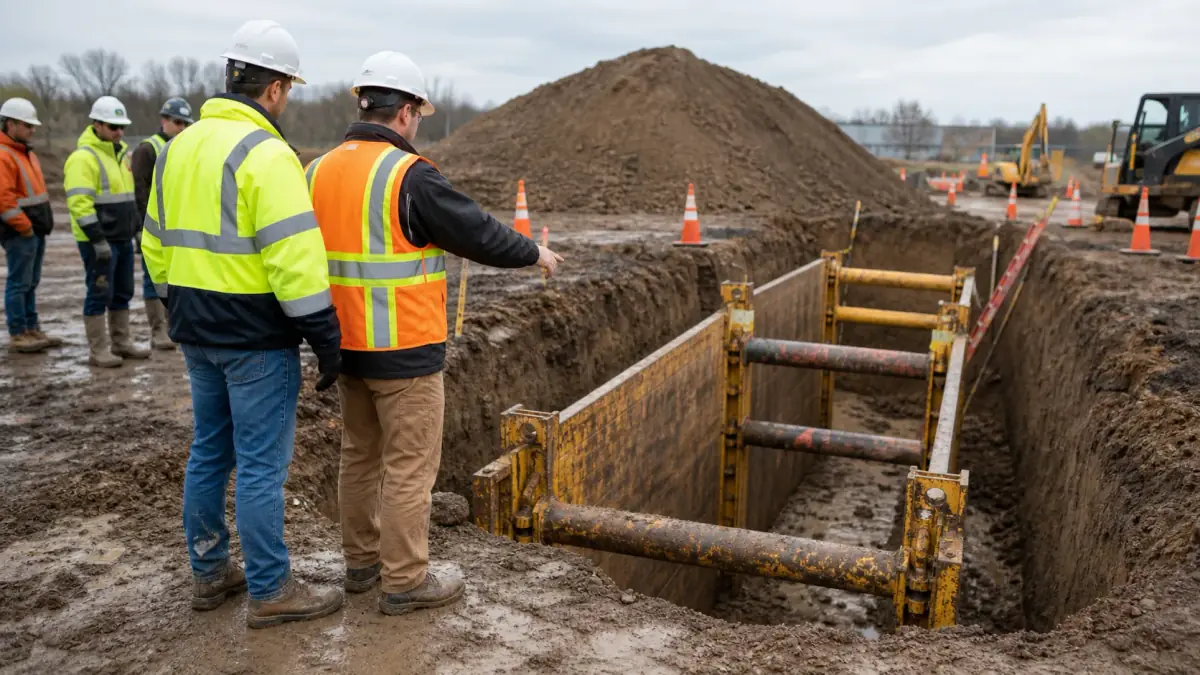
Protective systems deserve special attention after rain. A trench shield, shoring system, sloped excavation, or benched wall must be evaluated against actual site conditions. Water in the trench can affect stability, footing, and work access. Mud or debris can build up around a trench box. Soil can cave behind a shield or load against panels. Shoring components may need inspection for movement, damage, proper bearing, or changed soil contact. Slopes and benches may need to be checked for erosion, cracking, and material sliding into the work area.
The productivity pressure after weather delays can make this risk worse. Crews may be eager to get pipe installed, repair service restored, or a road reopened. Supervisors may feel the schedule slipping. Public works crews may face pressure from residents or traffic control windows. Underground contractors may have other trades waiting. In that moment, the inspection decision is a control point. A deliberate re-entry review can prevent a rushed return to a trench that no longer matches the assumptions used to plan the work.
There is also a liability and documentation issue. If an incident or near miss occurs after weather changed conditions, the employer may need to show how the excavation was inspected, who performed the inspection, what hazards were found, and what corrective actions were taken. A generic statement that the crew "looked it over" is weak compared with a clear process led by a trained Competent Person. Documentation should support real hazard recognition, not replace it. The record is useful because the inspection happened, the decision was informed, and the corrective action was understood by the crew.
For contractors and municipalities, a weather-triggered inspection process can also reduce stop-work decisions. When supervisors know what must be checked and crews understand why entry may be delayed, decisions become less personal and more consistent. The conversation moves from "we need to get back in the trench" to "these conditions must be corrected before entry." That shift supports safety, compliance, and jobsite discipline.
What Employers and Supervisors Should Know
Employers should treat rain as a trigger for renewed excavation review, especially when workers will enter a trench, work near the edge, install or adjust utilities, or rely on a protective system. The depth of the excavation, soil type, nearby loads, water conditions, vibration, and the type of protective system all affect what the Competent Person must evaluate. A shallow excavation can still create hazards, and a familiar jobsite can still change after weather.
The first point is role clarity. Crew members should know who the Competent Person is for the excavation work. Supervisors should know whether that person has the training, experience, and authority to stop entry, require a protective system adjustment, order water removal, move spoil, change access, or pause work until conditions are corrected. A name on a daily report is not enough if the person cannot act.
After rain, the Competent Person should evaluate the excavation before workers enter. Depending on the job, the inspection may include:
- Looking for standing water, seepage, water paths, and signs that water has softened or undercut trench walls.
- Checking trench walls for cracks, sloughing, bulging, raveling, sliding material, or changes at the toe of the cut.
- Reviewing the protective system for movement, damage, improper placement, soil loading, or conditions outside the assumptions used for selection.
- Confirming ladders, ramps, or other access points are stable, properly located, and usable without workers stepping into unstable mud or water.
- Verifying spoil piles, equipment, materials, and traffic are controlled and kept away from trench edges as required by the site plan and conditions.
- Reassessing adjacent structures, pavement, utilities, poles, and other sources of surcharge or collapse exposure.
- Checking whether pumps, drainage controls, traffic control, and communication methods are adequate for the changed condition.
Supervisors should also understand that water removal is not automatically the solution. Pumping may be necessary, but removing visible water does not always restore stable conditions. Soil can remain saturated. The trench bottom can become soft. Erosion can leave voids. Protective systems may need to be reset or reevaluated. If a crew pumps water and immediately returns to work without looking at the whole excavation, it may miss the hazards that rain left behind.
Training should separate crew-level responsibilities from Competent Person responsibilities. Crew-level excavation safety training helps workers recognize warning signs, understand entry restrictions, respect protective systems, maintain access and egress, and report changing conditions. Workers should know that rain, vibration, water seepage, new cracks, shifting spoil, and damaged access points are not minor inconveniences. They are reasons to stop and notify supervision.
Competent Person training must go deeper. The designated person needs a working understanding of OSHA Subpart P expectations, soil classification, protective system options, inspection triggers, hazard recognition, and corrective authority. That training should prepare the person to evaluate conditions, explain decisions, and document findings in a way that supports the employer's excavation safety program. It should also make clear that the Competent Person is not merely observing work. The role includes acting when conditions are unsafe or no longer match the plan.
Employers should build rain response into their normal excavation process. A practical program can include:
- A daily excavation inspection routine that includes weather and changing conditions.
- A defined reinspection trigger after rain, water intrusion, vibration, blasting, freeze-thaw effects, or other hazard-increasing events.
- A method for recording who inspected the excavation, when it was inspected, what was observed, and what corrections were made.
- Crew communication before re-entry so workers understand any changes to access, protective systems, spoil placement, or prohibited areas.
- Supervisor expectations for pausing work when the Competent Person has not yet evaluated changed conditions.
The goal is not to create unnecessary paperwork. The goal is to make the safe decision the normal decision. When rain is treated as a predictable planning condition, crews are less likely to improvise. Employers can plan for pumps, stable access, protective system review, spoil control, and schedule impacts before the first storm interrupts the work.
How Training Supports a Safer Excavation Program
OSHA-aligned excavation, trenching, and shoring training helps employers turn requirements into field decisions. It gives crews and supervisors a shared language for hazards that may otherwise be minimized. When a worker can describe seepage, tension cracks, sloughing, surcharge loads, access problems, and protective system concerns, that worker can participate more effectively in keeping the excavation under control.
For crew members, training supports practical recognition. They do not need to become engineers to understand that entering a trench after rain requires caution and supervision. They should understand why the ladder location matters, why spoil placement matters, why water changes the condition of soil, and why a trench box does not eliminate every hazard. They should also know that reporting a changed condition is part of the job, not an interruption of the job.
For foremen and supervisors, training supports planning and communication. A supervisor who understands excavation hazards is better prepared to schedule work around weather, coordinate with the Competent Person, and communicate with owners, general contractors, inspectors, and crews. That supervisor is also better equipped to avoid mixed messages, such as telling workers to "be careful" while still allowing entry before inspection. Clear training helps supervisors align production decisions with safety responsibilities.
For designated Competent Persons, training is essential because the role carries specific expectations. The person must be capable of identifying existing and predictable hazards and must be empowered to correct them. That requires more than general construction experience. It requires focused knowledge of excavation standards, soil behavior, protective systems, inspection criteria, and jobsite authority. Competent Person training can help the designated employee understand when to stop entry, when to get additional technical input, and how to document the decision.
Training also improves consistency across multiple crews and locations. This is especially valuable for contractors that move between residential, commercial, utility, municipal, and road work sites. Each project may involve different soils, utilities, traffic exposure, depths, equipment, and public pressures. A consistent training foundation helps the employer set expectations that travel with the crew. Rain response should not depend on which supervisor happens to be on the job that day.
It is important to be accurate about what training does and does not do. Training alone does not guarantee compliance, does not remove the employer's responsibility to evaluate each excavation, and does not make a person automatically OSHA certified. What OSHA-aligned training can do is support informed decisions, better hazard recognition, stronger supervision, clearer documentation, and safer jobsite habits. It helps employers put the right people in the right roles and gives those people a better basis for action.
When employers invest in excavation safety training and Competent Person for Excavation, Trenching, and Shoring training, they are not simply checking a box. They are building the decision-making capacity needed when conditions change. Rain is one of the most common examples because it is predictable, frequent, and easy to underestimate. A trained crew understands that the inspection after rain is not a delay. It is part of the work.
Key Takeaway
A trench that was acceptable before rain may not be acceptable after rain. Employers should have a clear process for reinspection, correction, documentation, and crew communication before workers re-enter. The Competent Person must have the knowledge and authority to evaluate changed conditions, and the crew should be trained to recognize and report warning signs. OSHA-aligned excavation safety training and Competent Person training help employers make those decisions with more consistency, stronger jobsite discipline, and a safer excavation program.