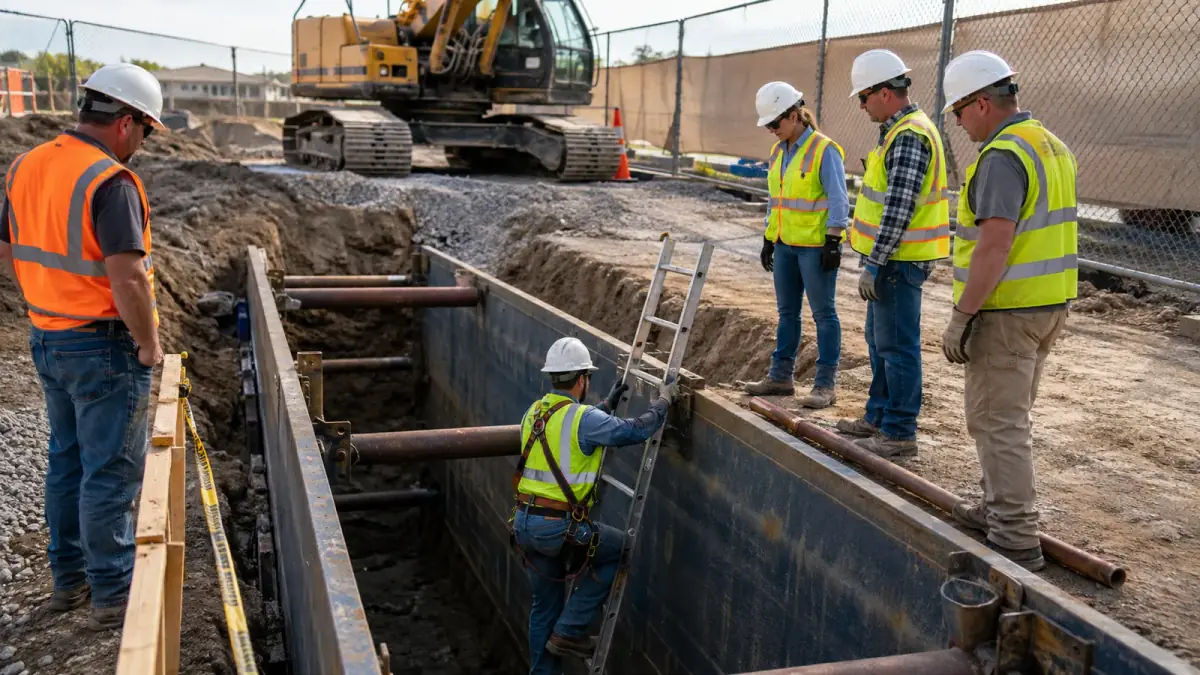
Access and egress can look like a simple jobsite detail until a crew is already working in the trench, production is moving, and someone realizes the nearest ladder is behind pipe, equipment, spoil, mud, or a worker carrying tools. On excavation jobsites, the compliance question is not only whether a ladder, ramp, stairway, or other safe means of exit exists somewhere nearby. The more important question is whether workers can actually enter and leave the excavation safely under the conditions that exist right now.
That question matters because trench emergencies leave very little time for improvisation. A worker may need to exit quickly because soil is sloughing, water is entering the cut, a utility has been exposed, equipment is moving too close to the edge, fumes are suspected, or the Competent Person has ordered workers out. Even when there is no emergency, poor access creates everyday hazards. Workers climb on shoring components, step over pipe, walk through soft spoil, lean ladders against unstable surfaces, or travel farther than planned because the original exit point no longer fits the work sequence.
OSHA Subpart P addresses access and egress because safe entry and exit are part of controlling excavation hazards. Employers must provide a safe way for employees to get in and out of trench excavations when required, and the condition, location, and usability of that access should be part of the jobsite inspection. A ladder that is buried in mud, blocked by material, placed where workers cannot reach it, or positioned in a way that creates a fall hazard does not solve the problem. The access point has to work for the crew, the trench depth, the protective system, the work being performed, and the changing layout of the excavation.
For supervisors, this creates a practical responsibility before workers enter. Someone must look at the excavation and ask whether the planned route in and out still makes sense. Has the trench advanced? Did pipe, bedding, or equipment change the travel path? Is the ladder secured and extending properly? Is the ramp designed, built, and maintained for the load and use? Are workers expected to carry tools or materials while climbing? Can a worker leave without crossing under suspended loads, stepping through water, or passing too close to moving equipment?
The issue is not solved by telling workers to be careful. Access and egress planning requires visible controls, trained supervision, and a Competent Person who understands how entry and exit conditions connect to the larger excavation safety program. Employers who treat ladders and ramps as an afterthought can create compliance exposure and real jobsite risk, even when they have invested in trench boxes, shoring, sloping, or other protective systems.
Why This Matters on Excavation Jobsites
Access and egress planning matters because excavation work rarely stays static. A trench may begin as a short, clean opening, but the work can quickly stretch across a street, yard, parking lot, utility corridor, or municipal right of way. Spoil piles shift as material comes out. Pipe, bedding stone, pumps, trench shields, traffic control devices, saw-cut pavement, and barricades compete for space. What looked reasonable during the morning setup may become difficult once the crew starts lowering materials, connecting utilities, backfilling one section, and opening the next.
The most obvious concern is emergency exit. If workers have to travel too far to reach a ladder or climb over obstructions to leave the trench, the crew loses time when time matters most. A small wall movement, a water intrusion, or a sudden equipment hazard can become more serious when exit routes are unclear. Supervisors should assume that if an exit route is awkward during normal work, it will be worse under stress.
Access and egress also affect fall hazards. Workers entering and leaving a trench often move from ground level to an uneven lower surface. The top edge may be soft, wet, rutted, or crowded. The bottom may contain pipe, tools, bedding, water, mud, or uneven soil. If ladders are not stable, if ramps are too steep or slippery, or if crews climb on trench shields or shoring components instead of using a planned route, the excavation has gained another hazard that can injure workers and disrupt the job.
Poor access can interfere with protective systems. A trench shield is designed for a purpose, but workers still need to get into and out of the protected area without creating new exposures. If the ladder is outside the protected zone, workers may be tempted to travel through unprotected portions of the trench. If the access point forces workers to step over spreaders, braces, pipe, or uneven bedding, the employer may have controlled one hazard while allowing another to develop. Safe access should support the protective system, not compete with it.
Changing soil and weather conditions make this even more important. Rain, seepage, thawing, vibration, and heavy traffic can change the condition of the top edge and the trench floor. A ladder that was stable in dry conditions can become unreliable when mud forms at the base. A ramp can deteriorate after repeated equipment use. Water can collect near the access point and hide holes, soft spots, or debris. The Competent Person should treat those changes as reasons to reevaluate entry and exit, not as routine inconveniences.
Access and egress decisions also influence productivity. Crews move more efficiently when the route into the trench is clear, stable, and close enough to the work. When access is poor, workers waste time waiting, climbing around obstacles, moving materials by hand, or adjusting to a layout that should have been corrected earlier. Productivity problems can then create pressure to rush, skip inspections, or keep working after conditions have changed. Good planning reduces that pressure by building safe movement into the workflow from the beginning.
For general contractors, utility contractors, pipeline crews, municipal public works departments, and excavation subcontractors, the same lesson applies: access and egress should be treated as a controlled part of trench safety. It belongs in pre-task planning, daily inspections, crew briefings, and supervisor follow-up. If the crew cannot safely get out, the excavation is not ready for entry.
What Employers and Supervisors Should Know
Employers and supervisors should start by separating the concept of access from the reality of usable access. A ladder leaning somewhere near the trench may satisfy a quick visual check, but it may not satisfy the actual need of the crew. The question should be whether the access method is appropriate, properly placed, maintained, and available throughout the work.
Important access and egress considerations include:
- Location of ladders, ramps, stairways, or other safe exit methods in relation to where workers are assigned.
- Whether workers can reach the exit without traveling through unprotected or unstable areas.
- Whether the ladder or ramp remains usable as the trench advances.
- Whether access points are blocked by pipe, bedding, spoil, tools, pumps, equipment, barricades, or traffic control devices.
- Whether the top and bottom of the access point are stable, clear, and free of slip or trip hazards.
- Whether the access method works with the trench shield, shoring, sloping, benching, or other protective system in use.
- Whether workers have been trained not to climb on protective system components, pipe, buckets, or other improvised routes.
- Whether changing conditions require the Competent Person to stop work and relocate, repair, or improve access.
The Competent Person plays a central role because access and egress conditions should be evaluated as part of the excavation inspection. This includes inspecting before work starts, as conditions change, after events that may increase hazards, and whenever the work sequence creates a new layout. The Competent Person should have enough knowledge to recognize when access is no longer adequate and enough authority to require correction before workers enter or continue working.
Supervisors should also understand that access and egress planning is not limited to deep utility trenches. Shallow excavations can still create awkward entry, unstable edges, congested movement, and fall hazards. Crews working around catch basins, service laterals, trench boxes, vaults, pipeline tie-ins, and repair excavations may face tight spaces where the location of one ladder or ramp affects the entire work sequence. The smaller the work area, the more important it becomes to plan movement deliberately.
Training should match job responsibilities. Crew members need to recognize unsafe access conditions and understand when they should not enter. Foremen and supervisors need to know how access fits into daily planning and crew control. Designated Competent Persons need deeper training on OSHA Subpart P requirements, hazard recognition, protective systems, inspections, and corrective authority. Employers should not assume that experience alone creates a consistent standard across crews or shifts.
Documentation can support the program, but it should reflect real inspection activity. A checklist that includes access and egress is useful only if the person completing it actually verifies the condition. Supervisors should encourage specific notes when conditions are corrected, such as relocating a ladder as the trench advanced, clearing material from an exit route, improving the base of a ladder, closing entry until water was controlled, or adjusting the work zone so workers did not need to pass through an unprotected area.
Employers should also coordinate access planning with other jobsite controls. Traffic control, equipment routes, spoil placement, material staging, utility exposure, and lifting operations can all affect the path workers use to enter or exit. A ladder placed in the right location at 7:00 a.m. may be in the wrong location after the excavator moves, a truck backs in, pipe is staged, or the trench shield is pulled forward. Supervisors should build in checkpoints during the day, not rely only on the initial setup.
How Training Supports a Safer Excavation Program
OSHA-aligned excavation, trenching, and shoring safety training helps employers turn access and egress from an informal habit into a defined safety practice. Training gives crews a shared understanding of why safe entry and exit matter, what warning signs to report, and why improvised climbing routes are not acceptable. It also helps supervisors communicate expectations in plain jobsite language before workers are already in the trench.
Crew-level training is especially useful because many access problems are first noticed by the workers using the route. A laborer may see that the ladder base is sitting in mud. A pipe layer may know that the trench shield has advanced and the old exit is now too far from the work. An operator may see that spoil or bedding stone has narrowed the path. When workers understand the hazard, they are more likely to speak up early and less likely to normalize awkward or unsafe access.
Competent Person training supports a different but related need. The designated Competent Person must be prepared to evaluate excavation conditions, identify predictable hazards, inspect protective systems and surrounding conditions, and require prompt corrective action. Access and egress should be part of that evaluation. Training can help the Competent Person connect ladder placement, ramp condition, travel distance, soil condition, water, surface loads, and work sequencing to the decision of whether entry should be allowed.
For employers, training also helps create consistency. A company may have experienced crews, but if each foreman handles access differently, the program depends too much on individual habits. One crew may move ladders as the trench advances, while another leaves the original access point behind. One supervisor may stop entry when the route becomes muddy, while another treats it as a minor nuisance. OSHA-aligned training gives the organization a clearer baseline for what supervisors and crews are expected to control.
Training should also make clear what it does not do. It does not guarantee compliance by itself. It does not make a worker automatically certified by OSHA. It does not replace the employer's responsibility to provide protective systems, inspections, competent supervision, and job-specific controls. The value of training is that it helps the right people understand their responsibilities and apply them more reliably in the field.
Employers who invest in excavation safety training and Competent Person training are better positioned to plan before entry, recognize changing conditions, document corrective action, and keep crews aligned when production pressure increases. Access and egress may seem like a narrow topic, but it touches nearly every part of trench safety: planning, inspection, worker behavior, supervisor authority, emergency readiness, and daily job control.
Key Takeaway
Safe trench access and egress should be planned, inspected, maintained, and adjusted as the excavation changes. A ladder, ramp, stairway, or other exit method only protects workers when it is properly placed, stable, reachable, and usable for the work being performed. Employers should train crews to recognize access problems, train supervisors to control them before entry, and prepare Competent Persons to make informed inspection decisions when jobsite conditions change. Getting the right people trained helps turn a basic exit route into a reliable part of a safer excavation program.