Bell-bottom pier excavations combine cave-in, access, atmosphere, and retrieval hazards in a narrow space where small planning gaps can quickly endanger crews. These excavations are not ordinary trenches with a different shape. The enlarged base, restricted opening, changing soil profile, and vertical travel path create conditions that deserve a specific pre-entry review. A competent person must be able to recognize existing and predictable hazards and have authority to correct them promptly, while the employer remains responsible for providing a safe system of work.
OSHA defines a bell-bottom pier hole as a shaft or footing excavation whose bottom is enlarged beyond the cross section above it. That geometry can place a worker below an overhanging or undercut area and far from the surface. It can also complicate communication, ventilation, material handling, and emergency response. Treating the hole as a routine drilling task can leave critical decisions scattered among the drilling contractor, concrete crew, safety staff, and project superintendent.
The practical goal is not to create one more checklist that crews sign without discussion. It is to connect design information, observed soil conditions, protective measures, entry controls, and rescue arrangements before a worker crosses the opening. If any part of that chain is incomplete, entry should wait until the employer and competent person resolve it.
Why Bell-Bottom Pier Entry Matters
Bell-bottom work may be short in duration, but exposure time is not a reliable measure of risk. A worker may enter to inspect the base, clean loose material, set reinforcing steel, check dimensions, or prepare for concrete. Each task can change the worker's position and the forces acting around the excavation. Equipment movement at the surface, falling tools, loose soil, groundwater, or a change in ventilation can create danger during what looks like a brief visit.
The shape itself requires attention. The enlarged bottom can form an overhang that is different from a simple vertical shaft. Soil that appeared uniform near the surface may change with depth, and the drilling process can disturb material at the sides or base. The competent person should compare the actual geometry and ground conditions with the planned method, not assume that the drilling equipment produced a safe configuration merely because it reached the intended depth.
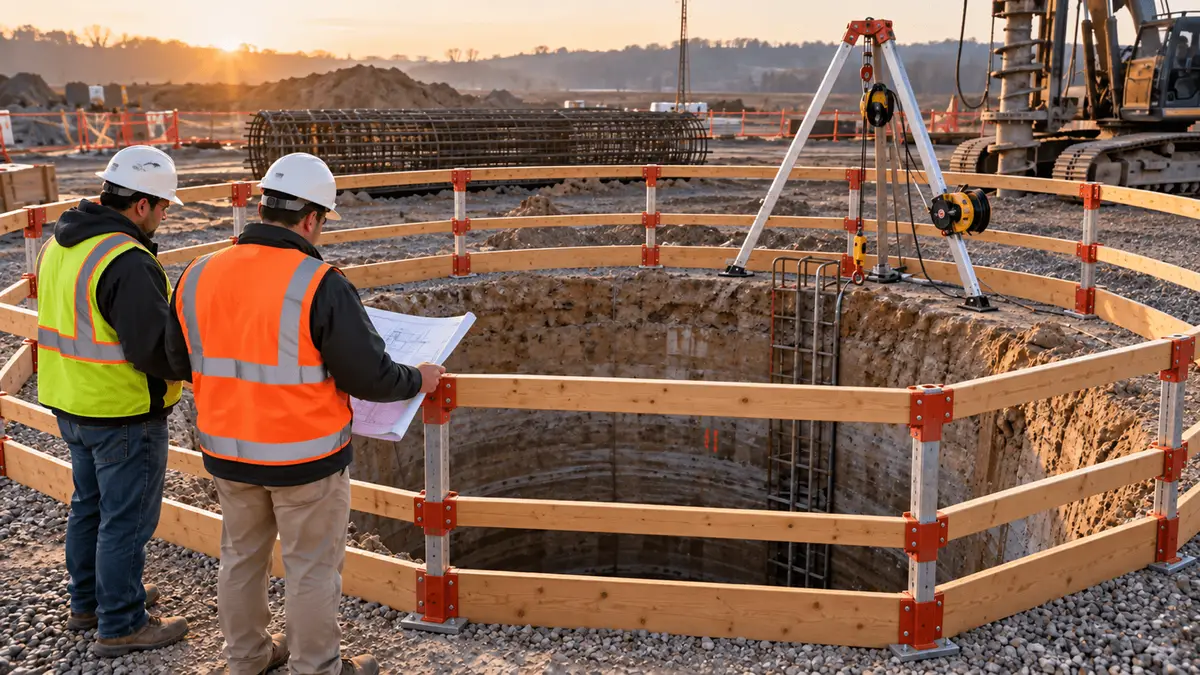
Deep, confined footing excavations also demand a deliberate retrieval arrangement. OSHA's excavation requirements address employees entering bell-bottom pier holes and similar deep, confined footing excavations by requiring a harness and lifeline, with an attendant while the employee is in the hole. The lifeline must be separate from any line used to handle materials. That separation matters because a material line may move, snag, or become unavailable at the moment a worker needs assistance.
Atmospheric conditions are another concern. A deep shaft can limit natural air movement, and some locations may reasonably be expected to develop hazardous atmospheres because of nearby utilities, contaminated soil, exhaust, decomposition, or the work process. Testing and ventilation decisions should reflect the specific site and task. A reading taken only at the opening does not necessarily describe conditions at depth, and a single reading does not show whether the atmosphere remains stable while work continues.
Surface activity must be included in the same plan. Spoil, reinforcing steel, concrete equipment, drilling components, and vehicles can create falling-object or surcharge hazards. The opening also needs effective protection so workers do not step or fall into it. Entry planning should define where people, equipment, spoil, and material lines can be located, rather than leaving those choices to the moment a delivery arrives.
What Employers and Supervisors Need to Know
Start with the work package. The employer and competent person should know the planned depth, shaft diameter, bell dimensions, soil information, groundwater expectations, adjacent structures, underground installations, and the tasks that require entry. If design assumptions, drilled conditions, or field observations conflict, the team needs an appropriate technical review before entry. A competent-person inspection does not replace engineering that is required for a protective-system design or unusual excavation configuration.
The competent person should inspect the excavation, adjacent area, and protective measures before work and as conditions require during the shift. Inspections are also required after rainstorms or other hazard-increasing events when employee exposure can reasonably be anticipated. For a drilled pier, relevant events can include additional drilling, casing movement, vibration from nearby equipment, unexpected water, sloughing soil, a delayed concrete placement, or changes in traffic and material staging.
The inspection should look for fissures, slumping, bulging, loose material, water accumulation, loss of soil, and changes at the opening or base. It should also confirm whether casing, shoring, or another protective approach matches the actual depth and loading. Protective systems must be able to resist loads that are intended or could reasonably be expected. Field changes should not be improvised beyond the manufacturer's data, tabulated data, or engineered design that governs the system.
Employers should define the entry route and keep it usable. The means of access must reach the work location without forcing a worker to climb on reinforcing steel, suspended equipment, or an improvised surface. The route should not conflict with the lifeline, ventilation duct, lighting cable, or material line. At the surface, the access point should stay controlled so equipment cannot swing, roll, or travel into the entry area.
The retrieval setup deserves a functional check before entry. Confirm the harness is appropriate, the lifeline connection is secure, the anchorage and retrieval equipment are positioned for the actual opening, and the attendant can maintain the required attention. A line that runs over a sharp edge, through an obstruction, or alongside material handling equipment may not work as intended. Crews should test the path without placing a worker in the hole.
The attendant's role should be clear. The attendant is not a spare laborer who can leave to guide a truck or retrieve tools. The worker in the excavation needs continuous attendance, reliable communication, and a known method to summon additional help. The plan should identify what conditions require immediate exit, who can order that exit, and what the attendant should do if communication fails.
Atmospheric controls should be based on hazard evaluation. Where testing is required, use suitable equipment, verify it is ready for use, and test at relevant depths because gases can stratify. Ventilation air must come from a clean source and should be directed so it reaches the worker's area without creating another hazard. Engine exhaust, welding fumes, curing chemicals, or nearby releases can change conditions after the initial test, so monitoring frequency should match the hazards and work.
Material handling must stay separate from worker protection. No employee should be under loads handled by lifting or digging equipment. A material line should never double as the lifeline. The lifting plan should address reinforcing steel, buckets, tools, and concrete placement so suspended loads do not pass over the entrant and lines do not entangle the access or retrieval system.
The team should also identify the stop-work boundary. Entry should not continue when the competent person finds evidence of a possible cave-in, protective-system failure, hazardous atmosphere, water accumulation that is not controlled, loose material, or another dangerous condition. Workers exposed to the hazard must be removed until precautions are taken. The authority to make that call should be real, visible, and supported by the project schedule.
Documentation can make these controls easier to coordinate. A short entry record can capture the pier identifier, date and shift, depth and geometry, observed soil and water conditions, protective system, atmospheric results if applicable, retrieval setup, attendant, communication method, and inspection findings. The record should reflect actual decisions, not replace the competent person's judgment or employer's site procedures.
How Training Supports Safer Decisions
Training should help workers distinguish a bell-bottom pier entry from routine work around an excavation. General crew members need to understand opening controls, falling-load restrictions, line separation, communication signals, and the instruction not to enter without authorization. An entrant needs task-specific instruction on access, harness and lifeline use, atmospheric precautions, exit triggers, and how to avoid interfering with the protective or retrieval system.
Attendants need practice maintaining communication, recognizing distress or changing conditions, keeping the entry area controlled, and initiating the site's response plan. Supervisors need to coordinate drilling, inspection, reinforcement, concrete, traffic, and emergency arrangements so one activity does not defeat another. The competent person needs knowledge and authority suited to the excavation hazards and the protective systems being used.
Scenario-based training is useful because many failures begin as coordination problems. A crew can walk through what happens if water appears at the base, the gas monitor alarms, the entrant stops responding, a concrete truck arrives early, or soil begins raveling near the opening. The discussion should identify who stops work, who communicates with the entrant, who controls equipment, and how rescue services are contacted without sending an unplanned rescuer into the hole.
Hands-on practice should use the actual or equivalent harness, lifeline, retrieval device, monitor, ventilation equipment, and communication system. Online coursework can support hazard recognition and regulatory knowledge, but it cannot confirm that a worker can fit the equipment, operate the device, interpret readings, or carry out the site's procedure. Employers should document the site-specific and practical elements separately.
Training also supports consistent inspections. A competent person who knows the warning signs can connect fissures, sloughing, water, vibration, and changing geometry to a decision about entry. Supervisors who understand those signals are less likely to pressure the competent person to treat a pause as a paperwork delay. Crews who know the stop-work triggers can report changes early instead of waiting for the next scheduled inspection.
Retraining or additional instruction may be appropriate when the method changes, a new type of pier or protective system is introduced, observations show that procedures are not being followed, or an incident or near miss exposes a gap. Training records should state the subject, date, participants, and practical evaluation completed. A certificate alone does not assign competent-person authority or demonstrate site-specific ability.
Key Takeaway
Bell-bottom pier entry should be treated as a coordinated excavation operation, not a quick trip into a drilled hole. Before entry, the employer and competent person should connect actual ground conditions, protective-system information, access, atmospheric evaluation, surface controls, retrieval equipment, attendance, communication, and stop-work authority.
The most useful pre-entry question is simple: if conditions change while the worker is at the bottom, can the team recognize the change, communicate it, stop conflicting work, and bring the worker out without improvising? If the answer is uncertain, the plan is not ready.
Training supports that readiness by giving each person a clear role and shared language for hazards, inspections, and exit decisions. The employer must still provide the equipment, procedures, supervision, and field verification required for the actual excavation. Careful planning cannot remove every hazard, but it can prevent a specialized excavation from being managed as though its risks were routine.
Sources
OSHA, 29 CFR 1926.650 Scope, Application, and Definitions - https://www.osha.gov/laws-regs/regulations/standardnumber/1926/1926.650
OSHA, 29 CFR 1926.651 Specific Excavation Requirements - https://www.osha.gov/laws-regs/regulations/standardnumber/1926/1926.651
OSHA, 29 CFR 1926.652 Requirements for Protective Systems - https://www.osha.gov/laws-regs/regulations/standardnumber/1926/1926.652
OSHA, Compliance Directive for the Excavation Standard - https://www.osha.gov/enforcement/directives/cpl-02-00-165