
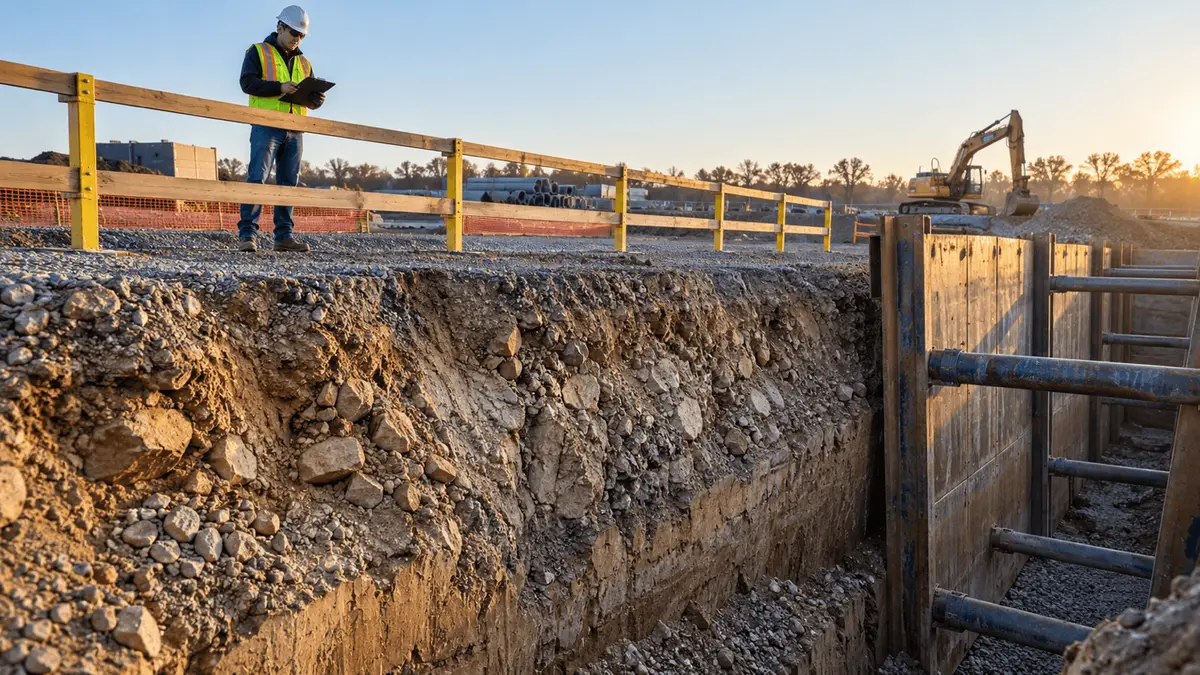
Loose rock and soil above an excavation can fall without warning, so competent-person inspections must look beyond cave-in protection before entry. A trench box, shoring system, or properly sloped wall addresses major ground movement, but it does not automatically stop a fist-sized rock, clod, tool, or piece of broken pavement from striking a worker below. That separate exposure deserves a deliberate check before employees enter and whenever digging, weather, vibration, or material handling changes the face.
The practical question is not whether a wall looks generally stable from a distance. It is whether loose material can fall or roll from the excavation face, whether spoil or equipment can reach the opening, and whether people will work in the path. A competent person needs authority to pause entry, examine the conditions, select or confirm protective measures, and order corrections before work resumes.
Why Loose Material at an Excavation Face Matters
Loose material can develop at many points in an excavation cycle. An excavator bucket may leave fractured ledges or undercut clods. Utility crossings can interrupt an otherwise uniform face. Broken pavement and base material can remain near the top edge. Drying, rain, freeze-thaw movement, vehicle vibration, surcharge loads, and repeated bucket contact can loosen material that appeared secure earlier. Even a small change can create a falling-object exposure for a worker installing pipe, checking grade, setting bedding, or connecting a service.
OSHA's excavation requirements distinguish protection from cave-ins from protection against loose rock or soil. The rules call for adequate protection when material could fall or roll from an excavation face. Examples include scaling to remove loose material, protective barricades placed as necessary on the face, or another method that provides equivalent protection. The same standard also addresses excavated material, equipment, and other objects that could fall or roll into an excavation from the surface.
That distinction matters during planning. A protective system may be correctly selected for the soil and depth while a separate falling-material hazard remains. The top of a trench shield may also sit below the top of the cut under certain permitted configurations, which makes the condition of the exposed face above the shield especially important. Crews should never assume that being inside a shield resolves every hazard above them.
The likely path of material is as important as its size. A chunk that drops onto a bench may stop, break apart, or continue toward the work area. Loose gravel can collect on a sloped surface and release when equipment moves nearby. Material at the lip can be knocked in by a boot, tire, hose, or suspended load. The inspection should consider where material could travel, not just where it currently rests.
Workers on sloped or benched faces can also create exposure for people below. Work sequencing should avoid placing employees at lower levels where tools, soil, or material from an upper level can reach them unless adequate protection is provided. This is a coordination issue as much as a soil issue, especially when grading, pipe work, surveying, and inspection occur at the same time.
What Employers and Supervisors Need to Know
The employer remains responsible for providing a workplace free of recognized excavation hazards and for meeting applicable Subpart P requirements. Assigning a competent person does not transfer that responsibility. The employer should select someone who can identify existing and predictable hazards and who has authorization to take prompt corrective measures. That authority must work in practice, including when stopping entry affects production.
Supervisors should know the planned excavation geometry, protective system, access route, work sequence, nearby loads, and equipment movements. They should also know who will remove or secure loose material and how that task will be performed without placing another employee in danger. A plan that merely says to inspect the wall is incomplete if nobody knows what happens after a hazard is found.
Before the shift, the competent person should examine the excavation, adjacent areas, and protective systems. The review should include the face above and beside the work zone, the top edge, benches, ramps, crossings, utilities, pavement, spoil placement, stored materials, and any equipment positioned where it could introduce loads or falling objects. A view from more than one safe location may be necessary because a shield, pipe, or equipment can hide portions of the face.
Conditions that deserve closer attention include cracks behind the edge, fractured or raveling material, fresh sloughing, undercut sections, loose stones, unsupported pavement, material caught on a bench, soil dropping between a shield and the wall, water erosion, and evidence that vibration is disturbing the face. The absence of a large cave-in indicator does not make these smaller falling hazards acceptable.
The competent person should connect each finding to worker exposure. Ask who will enter, where they will stand, how long the task will last, whether workers must look down or use both hands, and whether a safe retreat path remains available. A material condition may require a different response when employees work directly beneath it than when the area is isolated and no exposure exists.
Corrective options depend on the site. Scaling may remove loose material, but it should be performed with a method that does not put a worker beneath the material being released. Barricades or retaining measures may stop material on the face. The excavation profile may need correction. Loose pavement may need removal or support. Spoil and equipment may need to be moved farther from the edge or controlled with retaining devices. A registered professional engineer may need to address a condition outside the competent person's knowledge or the selected protective-system data.
Supervisors should also control the two-foot setback for excavated or other materials and equipment unless a sufficient retaining device or a combination of measures protects employees. The distance is not a housekeeping suggestion. It addresses material that can fall or roll into the excavation. Site constraints may require stronger planning rather than accepting a narrower margin without protection.
When the Inspection Must Be Repeated
An excavation inspection is not a one-time release for the day. OSHA requires competent-person inspections before work starts, as needed during the shift, and after a rainstorm or another hazard-increasing occurrence when employee exposure can reasonably be anticipated. Loose-material conditions can change faster than the overall excavation geometry, so supervisors need clear triggers for another look.
Useful triggers include a new digging pass, trimming the face, moving a trench shield, removing shoring, exposing a utility, changing the slope or bench, placing a load near the edge, beginning compaction, allowing traffic closer to the cut, or switching from excavation to pipe installation. Weather triggers include rain, rapid drying, freezing and thawing, runoff over the edge, and wind that moves unsecured surface material.
Crews should also report small observations. A few pebbles falling, dust releasing from one seam, a new clod in the shield, or material collecting on a bench can show that the face is changing. These signs should prompt the competent person to reassess the source and exposure rather than simply remove the debris from the work area.
After a correction, verification matters. The record should identify the location, observed condition, action taken, person responsible, and time entry was allowed to resume. A photograph can help when company policy permits, but it should support rather than replace the competent person's judgment. The field record should be specific enough for the next supervisor or shift to understand what changed.
How Training Supports Better Decisions
Training should help competent persons distinguish cave-in protection, loose-face hazards, surface materials, and falling-load exposures. These issues interact, but they do not have identical controls. Scenario-based instruction can show how a trench box may protect against a cave-in while employees remain exposed to loose material above the box or at an unprotected end.
Supervisors benefit from training on inspection triggers, work sequencing, documentation, and stop-work authority. Equipment operators need to understand how bucket contact, swing paths, spoil placement, and travel near the edge can create new hazards. Pipe crews and laborers need a simple reporting process and should know that they may not remove loose material from below or enter while the condition remains unresolved.
Effective field practice can use a short walkaround before entry. The competent person points out the protected work zone, identifies any loose-material concerns, confirms spoil and equipment controls, reviews the access route, and states what changes require everyone to exit. The crew then repeats the critical triggers in its own words. This approach tests understanding better than collecting signatures after a generic briefing.
Excavation and trenching safety training can support the knowledge needed for these conversations, but training alone does not select a protective system or approve a changing excavation. Employers must pair instruction with site-specific procedures, competent-person inspections, manufacturer or tabulated data where applicable, and engineering support when required.
A Practical Face and Edge Review
Begin at a safe location where the full excavation can be observed. Compare actual depth, width, slope, benches, support, and shield position with the work plan and protective-system information. Look at the ground surface for tension cracks, displaced material, runoff paths, traffic effects, and objects that could reach the opening.
Next, trace the exposed face from top to bottom. Identify fractured rock, raveling soil, hanging clods, loose pavement, utility disturbances, erosion channels, and material resting on benches or support components. Consider whether vibration, digging, or the next task could release it. Do not enter to obtain a closer look unless the entry conditions are already safe.
Then trace the likely travel path. Determine whether falling material could enter the shield, strike the access route, reach a worker at a pipe joint, or bounce from a bench. Check both ends of the work zone and any gap between a protective system and the face. Confirm that surface spoil, tools, materials, and equipment are set back or retained.
Finally, document the decision and communicate it. If entry is not allowed, establish a clear boundary and state what must be corrected. If entry is allowed, identify the limits of the inspected area and the events that cancel the decision. An inspection cannot reasonably cover a future condition that has not yet been created.
Key Takeaway
Loose rock and soil deserve their own line of inquiry during every excavation inspection. A competent person should examine the face, edge, benches, protective-system relationship, and worker positions before entry and after any condition-changing event. Employers and supervisors should provide practical removal, retention, isolation, and stop-work procedures rather than relying on appearance or the presence of a trench box.
The best result is a crew that understands one simple rule: protection must address what can cave in and what can fall or roll in. When the face changes, material moves, or the work zone shifts, employees should leave the exposure area until the competent person has inspected the new condition and authorized work to continue.
Sources
Occupational Safety and Health Administration, 29 CFR 1926.651 Specific Excavation Requirements, https://www.osha.gov/laws-regs/regulations/standardnumber/1926/1926.651
Occupational Safety and Health Administration, 29 CFR 1926 Subpart P Excavations, https://www.osha.gov/laws-regs/regulations/standardnumber/1926/1926SubpartP
Occupational Safety and Health Administration, Trenching and Excavation Safety, https://www.osha.gov/sites/default/files/publications/osha2226.pdf